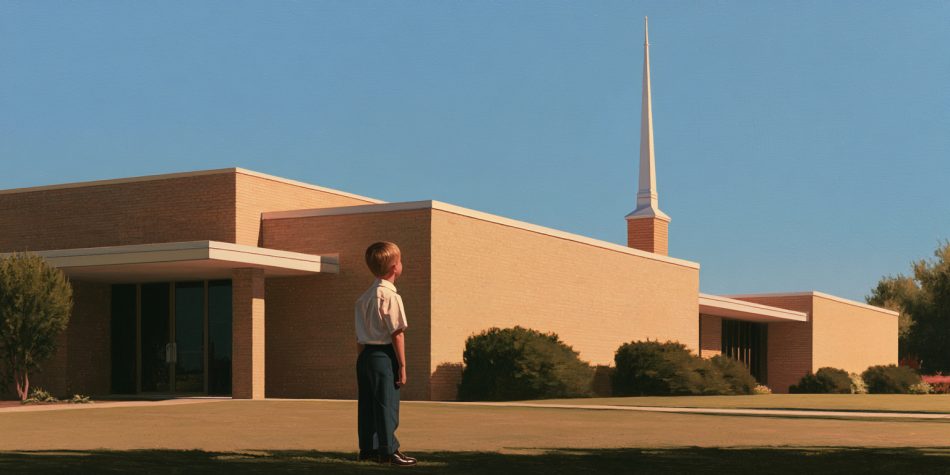

One of my earliest memories at a chapel of The Church of Jesus Christ of Latter-day Saints is of walking around its exterior. The building had a detached steeple. I stood at its brick base, looking up to the tip of its spire. The sun was high, and I squinted at how bright it was.
Growing up, my closest temple was in Los Angeles. My sister once got down on the grass to take a picture. The bottom of the picture was dark and shadowed. Toward the top of the photo, near the peak of the steeple, it brightened. She turned it into a painting I keep in my house to this day.
No one ever told me the steeple was important. It wasn’t addressed in lessons. No one asked about it in temple recommend interviews, but since those earliest days, I have associated it with lifting my eyes, light, and the Church.
I saw a steeple, I looked up, and I saw light.
And I didn’t just associate the steeple with my own faith’s houses of worship. I came to instinctively feel a sense of peace and hope whenever I saw a steeple, as it represented people in my community seeking their God.
Where Do Steeples Come From?
My experience with steeples is not revolutionary. In fact, for hundreds of years, religious architects have understood the steeple’s symbolism and used it to create experiences like mine.
As a result, Christians have learned to read the vertical line of a church as an invitation to look beyond.
The steeple developed from several distinct elements of medieval architecture. The first was the bell tower. Bell towers were built tall so their bells could be heard across the town. Over time, those bell towers were incorporated into the church building, and many eventually received roofs topped by increasingly slender spires. As that silhouette became associated with worship spaces, it was integrated even in the absence of a bell tower.
In 12th-century France, Abbot Suger oversaw the rebuilding of the church at Saint-Denis. The project included what he called “high and noble towers” and helped establish what became known as Gothic architecture.
On one of the church doors, Suger inscribed a poem:
Marvel not at the gold and the expense,
but at the craftsmanship of the work.Bright is the noble work;
but, being nobly bright, the work
Should brighten the minds,
so that they may travel through the true lights
To the True Light where Christ is the true door.
In what manner it be inherent in this world
the golden door defines:
The dull mind rises to truth through that which is material.
Suger understood his work to be explicitly symbolic. He saw the material forms he used as a means of directing congregants’ minds to the truth.
It was a century later that the bishop of Mende, William Durandus, wrote an extensive treatise on church architecture and its connection to Christian worship. He wrote of the steeple, “The pinnacles of the towers signify the life or the mind of a prelate which aspireth heavenwards.” Durandus saw the vertical architecture as a symbol of spiritual ascent.
The symbol became ingrained through repetition. No declaration was needed: for generations, the appearance of the steeple was the first visible marker of what the building was.
St. Paul’s Church in Harlow, Essex, England, was built in the 1950s. It included a low, detached bell tower, but the main building also bore a spire that the architects described as a “symbol for the church.”
The tower’s practical and symbolic functions had become fully separate.
Latter-day Saint Architecture
The steeple was an early feature of Latter-day Saint architecture.
Despite the Church and many of the early Saints experiencing poverty, the Kirtland Temple, the first temple built by Latter-day Saints, featured a white tower spire and weather vane. Similarly, the Nauvoo Temple’s steeple was finished in the midst of the exodus. The decorative element was finished just five days before the early Saints left the city.
The steeple encapsulates a temple’s teaching and purpose.
President George A. Smith, who served in the First Presidency, said of the Salt Lake Temple’s spires, “Every one points to a moral lesson, and all point to the celestial world.”
Folk stories have also developed around the importance of steeples. As the St. George Utah Temple neared completion, Brigham Young Jr. wrote that his father was unhappy with the tower because he believed it was too short. Soon after Young Sr.’s death, lightning struck the steeple. And when the workers rebuilt it, they made it taller. The folk interpretation has long been that Young Sr. directed the lightning after his death.
Every temple completed by The Church of Jesus Christ in the first 89 years of its history included a steeple. Then, between 1919 and 1927, three temples were built without steeples.
Every temple once again included a steeple for 90 years until the 156th temple was dedicated in Paris, France, in 2017. Today, 97% of temples include a steeple.
The exceptions are also illustrative. The three temples in the early 20th century were each built to suggest Solomon’s temple in ancient Jerusalem. Hyrum Pope, one of the architects of the Cardston Alberta Temple, explained that the architects wanted to evoke a sense that the design was “ancient as well as modern.”
At the time, a new movement in sacred architecture was emerging, typified by Frank Lloyd Wright’s Unity Temple.
Pope drew on this language to communicate the power of God. But the symbolism of ascent remained within the structure. Each ordinance room was placed half a story higher than the previous one. The temple was also precisely aligned with the four cardinal directions, symbolizing spiritual orientation. The other early 20th-century temples without spires followed similar designs, communicating religious symbolism in a language appreciated by the people worshipping there.
While Wright’s design style for churches eventually faded, the longer tradition of the steeple has remained. And according to some estimates, about 80% of Christian churches in the United States have steeples.
Steeples and Worship
As a small child, I had the kind of experience that generations of architects sought to create. I saw a steeple, I looked up, and I saw light.
A church has pews so we can sit, and it has a steeple so we will look up.
But it is more than just decoration.
Worship has never been limited to the minimum physical actions required to make an ordinance valid. Worship forms our attention, memories, and imaginations.
The steeple encapsulates a temple’s teaching and purpose. It transforms the temple’s work of bringing us closer to the divine into a material form, a visible movement.
There is a reason why steeples appear in drawings, wedding announcements, flyers in the foyers, family photographs, and in the memories of millions of Latter-day Saints. They are a part of how we imagine our interaction with God.
We don’t talk about them because we don’t have to. A church has pews so we can sit, and it has a steeple so we will look up.
Today, there are occasional conflicts about the steeples on our temples. And we should work to make sure our temples fit into their communities. But steeples are worth defending. And we should be grateful for the legal protections that enable us to build them.