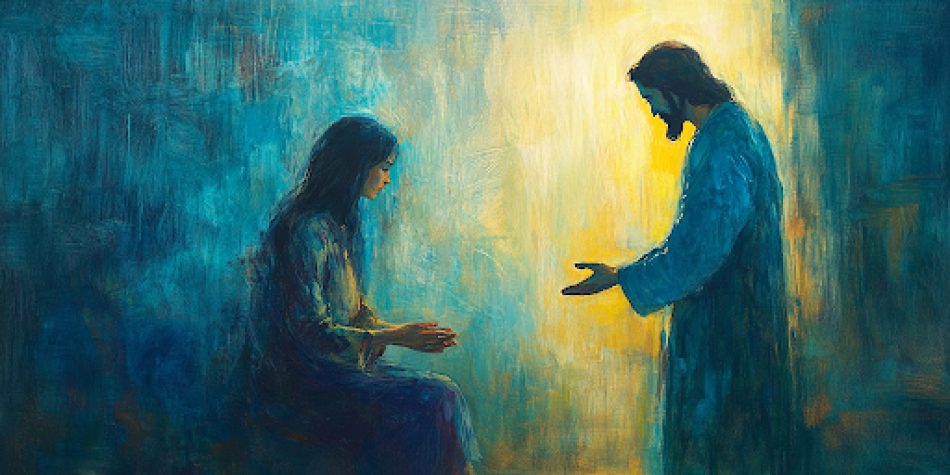
A woman prays as Christ's hand reaches toward her, symbolizing divine comfort and Jesus Christ as the way, the truth, and the life.

December Book Club: Who Is Truth?

Truth as a Person, Jesus Christ, reshapes how we approach revelation, moving us beyond contemporary ideological frameworks.

Through the years, my co-author Edwin Gantt and I have witnessed many friends experience doubt about the Church and its teachings. In some cases, there were signs they were living their lives in ways that alienated them from the Spirit of God. But in many cases, the seeds of their doubt were intellectual in nature—specifically, they had adopted ideological frameworks or “-isms” through which they evaluated all prophetic counsel and divine truth. Across the spectrum, they asked, “How can prophets speak for God if they teach things that contradict what I know to be true?”

This pattern revealed something profound: Many of us have unconsciously elevated abstract systems of belief—whether political, philosophical, or theological—to the level of absolute truth. When we do this, we begin measuring prophetic teachings against these ideological frameworks rather than measuring our ideological frameworks against the words of God’s servants. We call this “ideolatry,” which happens when we prioritize abstract ideas over ongoing revelation from God—a worship of ideology.

Our modern conception of truth has been heavily influenced by Greek philosophical traditions.

This observation led us to write “Who Is Truth?” The book explores a simple but profound possibility: What if truth isn’t primarily a set of abstract ideas or principles at all? What if truth is, as Christ himself declared, a Person? What if this isn’t just a poetic metaphor—what happens when we take Christ’s declaration literally? Drawing on the distinction between ancient Greek and Hebrew ways of thinking, we show how our modern conception of truth has been heavily influenced by Greek philosophical traditions that emphasize the abstract, universal, and unchangeable. In contrast, Hebrew thought understood truth in more personal, concrete, and relational terms. Our modern conception of truth has been heavily influenced by Greek philosophical traditions.

When we see truth as a set of abstract ideas, we expect religious teachings to remain static and unchanging. We measure new revelations against our mental models of how things “must” be. But if truth is a Person—specifically, Jesus Christ—then we can understand why God might give different instructions to different people in different contexts while remaining perfectly reliable and trustworthy. We remain open to surprise, just as we do with people. Of course, the idea that “truth is a person rather than an idea” is itself a mental model that we should keep provisional and find useful only so long as it points us towards and keeps us connected with the Truth made Flesh.

This message feels particularly urgent in our current moment. We live in increasingly polarized times, where ideological divisions are hardening into what feels like unbridgeable chasms. Social media and partisan news sources make it easy to surround ourselves with voices that reinforce our existing views while dismissing or demonizing those who see things differently. These ideological echo chambers don’t just separate us from each other—they can separate us from God by making us increasingly resistant to any divine guidance that doesn’t align with our chosen framework.

We see this happening across the political and ideological spectrum. Progressives might dismiss prophetic counsel about gender, sexuality, or family as outdated cultural artifacts. Conservatives might resist Church teachings about refugees, immigration, or vaccine policies as compromises with worldly thinking. In each case, we risk letting abstract ideological commitments—our “-isms”—harden our hearts not just against our fellow Saints but against the voice of the Lord speaking through His servants. When this happens, we become less able to hear God’s voice, less willing to consider perspectives different from our own, and less capable of building Zion with those who see things differently than we do.

The book isn’t primarily about answering specific doctrinal questions. Rather, it’s an invitation to fundamentally reconsider how we think about truth itself. Instead of measuring prophetic counsel against our preferred ideological frameworks—whether conservative, progressive, libertarian, or otherwise—we invite readers to aside these “-isms” and place God at the center of their affections.

It’s an invitation to fundamentally reconsider how we think about truth itself.

This shift in perspective—from truth as abstract ideas to truth as the living Christ—has the power to transform how we approach both our faith and our relationships with others. When we truly embrace truth as a Person, we approach prophetic counsel differently, we listen to others differently, and we hold our own views more humbly. Rather than starting with our ideological framework and asking, “How can I reconcile prophetic counsel with what I know to be true?” we can start with our relationship with God and ask, “How can I draw nearer to Him, align my heart with His will, and enjoy His presence in my life?”

In short, the solution to our ideological divisions isn’t finding the right framework of ideas (although developing unity surrounding essential doctrines may be part of the project of building Zion)—it’s drawing closer to the Person who is Truth. 

What binds us together is not a shared system of abstract beliefs (an “ism”) but shared covenants with the divine person of God. Those covenants set forth a shared identity and a shared set of commitments and values that bind us to our Father in Heaven and make us Christ’s people. Ultimately, what will save us at the great and last day is not the ideas we claim to know but whether we know and are known by the good shepherd Himself—a fundamentally different sort of knowledge.


About the authors

Jeffrey Thayne

Jeffrey Thayne blogs at ldsphilosopher.com, and is the coauthor of “Who is Truth?” He has a Ph.D. from Utah State University in Learning Sciences

Edwin E. Gantt

Edwin E. Gantt is a Professor of Psychology at Brigham Young University. He is the author of numerous scholarly articles and books, including Taking Sides: Clashing Views on Psychological Issues and Who is Truth? Reframing Our Questions for a Richer Faith (co-authored with Dr. Jeffrey L. Thayne). He has a Ph.D. from Duquesne University.
On Key

You Might Also Like

How Could Avoiding ‘Sexual Soloing’ Be a Good Thing?

“Sexual soloing” is a normal developmental challenge for many people. Yet contrary to popular declarations, there are a great many empirical reasons to question its widespread embrace as “healthy,” especially in the context of pornographic arousal.

When Did We Stop Trusting the Media? A Review of “September 5”

When did we begin to lose trust in the news media? There are plenty of theories. Some suggest March 6, 1981, Walter Cronkite’s last broadcast. Others suggest it was the coverage of President Bill Clinton’s perjury and impeachment. Others suggest it was the advent of 24-hour news stations. The newest film from Paramount Pictures suggests another option in its title, “September 5.” September 5, 1972, is the day that the Black Sabbath militant group kidnapped Israeli Olympic athletes. In total, eleven Israelis were killed. But according to the journalists at the center of the movie, none of that was nearly as important as making sure the “ABC” logo was on the TV screen while the coverage went on. A brief epilogue about how the incident turned out ends with these eerie words, “900 million people watched.”  “September 5” is interesting because, in a movie presumably about the attacks, we see none of it ourselves except through camera lenses and TV screens. It’s not a movie about the attacks at all; it’s a movie about watching the attacks. The film opens as Geoff takes over the control room for ABC Sports. He’s running the night shift, when word comes in about the attacks.  The ABC studios are yards from where the attacks are happening. So they rush Peter Jennings into the Olympic village, and put their own studio camera on top of the building so they can keep a camera on the room where the hostages are being held at all times. Geoff wakes up his bosses, Marvin and Roone, who often debate the relative merits of their decisions, such as whether to turn the story over to ABC News rather than the sports division or whether or not to call the attackers “terrorists.” These compelling arguments make for thoughtful viewing. Ben Chaplin, who plays Roone, an American Jew, does particularly good acting work as he tries to find a nugget of morality in what they are doing.  But every argument ends with the decision being made that will best help ratings and ABC. No matter how many times they argue about good practices, such as waiting for a second confirmation that the hostages were all safe before reporting, the better angels of our trio of decision-makers always lose.  By the way, the hostages weren’t safe, ABC did get the story wrong because they were relying on German state news, and Germany was trying to look safe and less militaristic in their first major international attention since the end of WWII. But for a moment, when the station thought the hostages were safe, their only concern was getting them in the studio for interviews.  Marvin Bader tries to use the language of “the story” as though his audience deserved to have “the story” in real-time. And no matter what decision they made it was in pursuit of capturing the story. But this justification rang shallow as the movie moved on. When the German police burst in to get them to stop telecasting their rescue attempts live because the militants were watching, they stopped to get them to put their guns down, but turned the feed back on nearly as soon as they had left. All of this makes this an engaging movie that is worth watching. When journalists are the main characters, we expect them to be the good guys. “All the President’s Men,” “Spotlight,” “The Post.” Even the film “Shattered Glass” about a dishonest journalist, spends more time highlighting the good journalists who caught him. “September 5” doesn’t offer the media such a convenient way out. By making its characters clear-headed and conflicted, they are more than simple villains. They are exactly what the pressure of studio news would naturally produce. There are real powerful forces driving the decisions of the news industry that are at odds with what is right or good, and all too often, there’s nothing we can do about it. If we are curious about how the spiral of trust began, this film serves as a worthwhile primer while being entertaining as all get out. The film is rated R. It is thematically tough, dealing with questions like whether to broadcast an execution live, but none of the violence of the incident is actually seen the movie. In terms of a ratings feel, I might compare it to the film “Gravity” while using the word “f***” three more times than is allowed in a PG-13 film. I wouldn’t recommend this for young children or young teens, but the themes about how media manipulates us would be important for older teens, and I might consider watching this film with my kids once they turn 15 or so.  If I did, I’d ask them questions about the nature of journalism. Is getting the story more important than the lives of the kidnapped Olympic team? Do we need to know about what’s happening in real-time on the other side of the world? How has constant news coverage made the world a better or worse place? What motivates those who choose what to show on the news, and how they tell those stories? Four out of Five Stars. September 5 has already had a limited release, and it is rolling out in individual markets across the country through January. 

Louis Moeller 'Different Opinions' | How CRT & Classical Liberalism Collide | Public Square Magazine | Critique of Liberalism Critical Race Theory | Who is the Father of Classical Liberalism

How CRT and Classical Liberalism Collide

Most people seem not to appreciate how deeply some of the popular ideas advanced by advocates of Critical Race Theory conflict with the foundations of liberal democracy. More, not less, attention needs to be given to this disconnect.

Subscribe To Our Weekly Newsletter

Stay up to date on the intersection of faith in the public square.

You have Successfully Subscribed!

Pin It on Pinterest

Share This