The late Christian apologist Ravi Zacharias once lamented our nation’s penchant to talk so much about left and right but so little about what is actually right. Or, as he put it another time, our obsession with left and right makes us forget there is still an up and a down—a right and a wrong.
Here we are in the heat of another U.S. presidential election. The politically obsessed myopia endures. Many see through the two-team prism—you are either for the Democrats or the Republicans. Whichever side you choose, so the thinking goes, you accept all of it. After all, the nation’s soul is at stake! Your side is wholly right, the other side is entirely wrong. Your side is light, the other side is darkness.
It is a devilish dualism.
As we sit amid the madness, a Book of Mormon teaching on unity begs our attention.
Some 2,000 years ago, a society in the Western Hemisphere was, in important ways, a lot like modern America. About 33 years after the birth of Jesus, we see a people called the Nephites who once enjoyed prosperity and peace but are now too well acquainted with vice. Goodwill and faith in God have, for the majority of them, given way to vain ambition. They pursue power, authority, and wealth at all costs. This leads to class distinctions and the fracture of their religious landscape.
A small group of believers remains among them, led by a holy man named Nephi. He does the miracles so familiar to readers of today’s New Testament. He casts out devils. He raises the dead. He heals sickness. He preaches repentance. He baptizes in the name of Jesus.
Then an epic and deadly concoction of storms, fires, and earthquakes shakes their entire world into near oblivion. Some cities are submerged in water. Others burn to ash. Roads are broken up. Many people perish. Their surviving kindred can do nothing but mourn, howl, and weep while enduring three days of a vaporous darkness so thick that no light can mitigate it.
Into this paralyzing darkness comes the piercing, yet gentle, ministerial voice of Jesus. It is a most miraculous occurrence. He explains the what and the why of all they have just experienced. The rampant death and destruction are requisite, He says, with the justice of God for their most egregious violators of societal harmony. He pleads with the survivors to let the gift of extended life spur them on to change their ways. Though they sit in the dark, utterly unable to create their own light, hope remains. How so? As Jesus tells them, “I am the light and the life of the world” (3 Nephi 9:18, emphasis added).
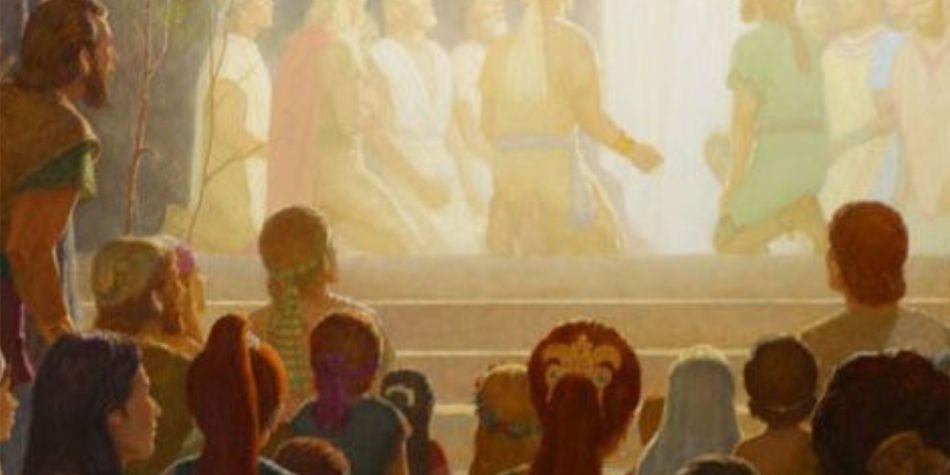
The light returns to the land the following morning. And so, too, does Jesus. The miraculous is turned up another notch. The resurrected Lord of the earth appears in person to a whiplashed, humbled people. He invites them to know for themselves that He is more than a ghost. They approach Him. They touch and feel the evidence of crucifixion in His hands, side, and feet. They are overcome to be in the presence of the King of Kings. They fall at His feet in worship. They shout His praises.
Jesus then delivers one of the finest lessons on unity and oneness the world has ever known. Though a small band of believers and a church were established prior to the great destruction, Jesus pushes the reset button. Notice the how and why of what He does.
With the eyes of all the people upon Him, he invests Nephi and a few others with the authority to baptize. He then shows them and the people how to properly perform this rite. Why do this if, as the Book of Mormon record shows, they already had authority and were already baptizing correctly prior to His coming? Because in addition to their other shortcomings as a society, they could not agree on the basics. They were known for their “great doubtings and disputations” (3 Nephi 8:4).
Who is wrong or right is not nearly as important as what is wrong or right.
Jesus repeats three times a simple declaration: “There shall be no disputations among you as there have hitherto been” (3 Nephi 11:28). Who was wrong and who was right in those debates? He does not say. It does not matter. Who is wrong or right is not nearly as important as what is wrong or right. When it comes to arguing and being disagreeable, Jesus declares that “the spirit of contention is not of me, but is of the devil” (3 Nephi 11:29). Hearts boiling over with anger have no place in His loving kingdom. Only the soft, simple hearts of children will do.
Because our elections generate more heat than light, we need frequent reminders that there are no purely evil or wholly good people—no matter their voting preferences. Gulag survivor Alexandr Solzhenitsyn learned this through eight years of deep reflection enabled by the terrors of the Soviet prison system. He was once himself a decorated captain in the Soviet Army. But he was, in his mind, “a murderer, and an oppressor” who in his “most evil moments … was convinced that [he] was doing good.” Only the crushing tutelage of the prison camp enabled his soul to give birth to this remarkable sentence: “The line separating good and evil passes not through states, nor between classes, nor between political parties either—but right through every human heart—and through all human hearts.”
Elections certainly matter. But few certainties are found in electoral politics. Ours is an age where, in the words of Rabbi Jonathan Sacks, “veracity is taking second place to the mass manipulation of emotion.” Indeed, what Augustine St. Clare says in Uncle Tom’s Cabin, printed in 1852, could be said by many Americans to describe 2020: “Such pious politicians as we have just before elections—such pious goings on in all departments of church and state, that a fellow does not know who’ll cheat him next.”
Can we both hold a strong opinion and confess the limits of what we know? Can we acknowledge that those with different views are probably, like us, genuinely interested in the common good? Do we really want to allow the acids of animus toward our neighbor to destroy both our relationships and our souls? I don’t think we do. Not when we count the cost. Not when we taste the bitter fruit of soured friendships.
Of course, relationship building is expensive (it requires a major investment of time and humility) and we are all too often drawn to cheap things. But a key message of the resurrected Jesus in the Book of Mormon is that even a country as divided as ours can rise to the challenge.
What happened to that Book of Mormon people of “great doubtings and disputations” when Jesus left them? For two centuries afterward, “there was no contention in the land, because of the love of God which did dwell in the hearts of the people.” Indeed, “there were no robbers, nor murderers, neither were there Lamanites, nor any manner of -ites; but they were in one, the children of Christ, and heirs to the kingdom of God.”
Achieving this utopian-like peace was not an effortless enterprise. Those people reconsidered their ways, abandoned deceitful patterns of thinking, and made better choices. They saw the divine in every face.
A country founded not on left and right but on the simple yet too-often-misunderstood ideal that all men and women are created equal surely can still do the same.