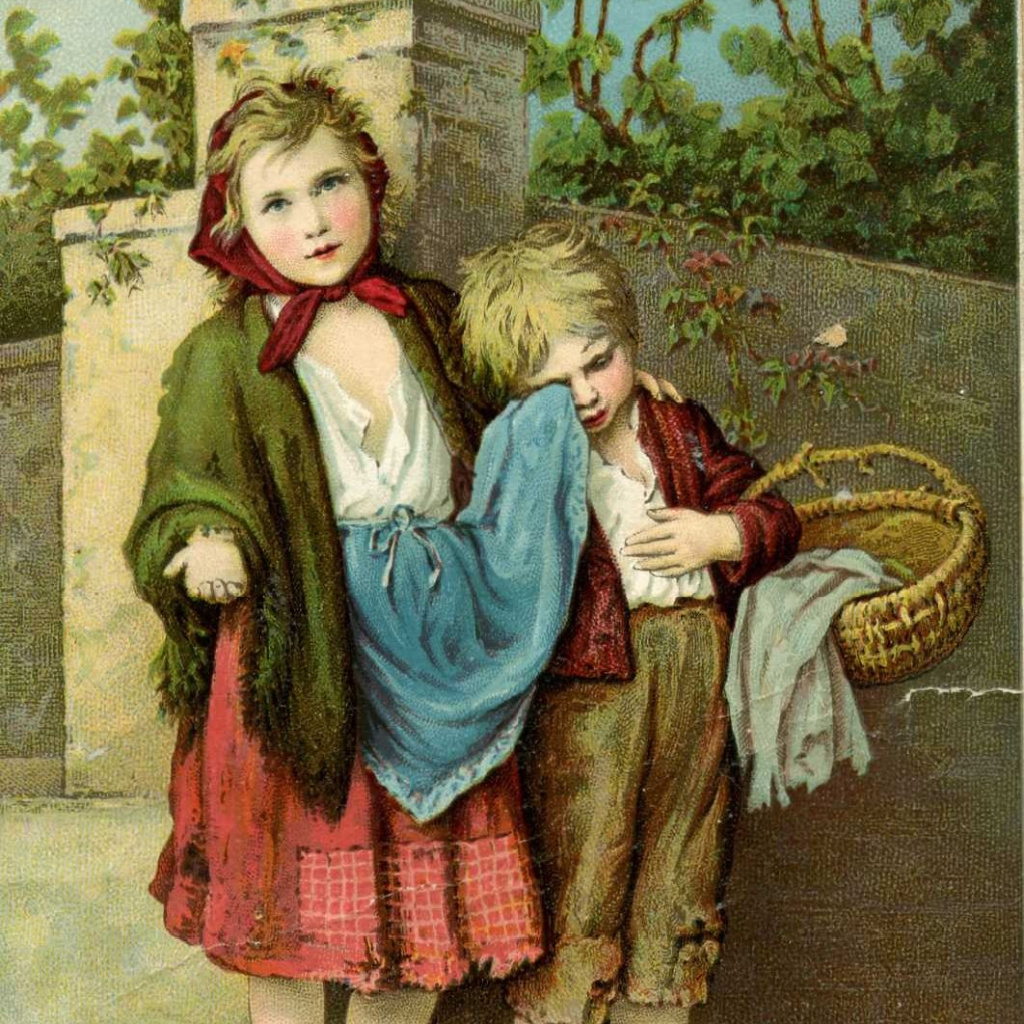
Many years ago, there lived a woman named Sally. She was a widow with three children. Life had been hard and she would have welcomed a change for the better if it came. She thought she saw it come when a man, who was a widower from her past, returned with a proposal of marriage, in his nice suit of clothes, with talk of a prosperous farm. The thoughts of a better life were inviting and she heard him mention servants and that he was a man of substance. She accepted and crossed the river with him to view her new possessions: a farm, overgrown with wild blackberry vines and sumac, and a floorless, windowless hut. The only servants were two thinly clad barefoot children. Their father had borrowed the suit and the boots to go a-courting in. Her first thought was the obvious one: go back home! But she looked at the motherless children, especially the younger, a boy whose melancholy gaze met hers. For a moment she paused, then, rolling up her sleeves, she quietly spoke these words: “I’ll stay for the sake of this boy.” Oh, Sally Bush, what a treasure stood before your eyes that day. She didn’t know when she looked at that melancholy face of ten years, that her stepson would save this nation, and become the immortal Abraham Lincoln. He was speaking of her, when he later said, “All that I am, and all that I ever hope to be, I owe to my angel mother.”
Every Mother’s Day my father would read this story. For me, it has come to symbolize the Heroic Mother and the influence she can have on the world.
In our modern age, motherhood is often seen as demeaning and unrewarding work. Common expressions include, “Why do women have to be the ones to stay home with babies?” “I can be much more than just a mom.” These sentiments don’t offend me, they sadden me. The meaning and power of motherhood are increasingly lost on younger generations. Mothers shape culture. The love and nurture children receive from their mothers can echo down the generations and throughout the world. Yes, women can do many important things outside motherhood, but mothering a child in love and truth shapes eternity. Mothers shape culture.
No one answers the divine call of self-denial like mothers. Our lives are broken and rebuilt with each new child. In our denial for the sake of another, Christ promises we lose less than we gain. He tells us, “Whosoever will lose his life for my sake shall find it” (Matthew 16:25).
These words are not just a slogan—they are a promise made to us by the Creator of the universe. A Mother who is also a disciple of Christ can take refuge in these words—a refuge we often need amid the stresses and difficulties of raising children. If we believe Christ—that losing ourselves is for our benefit—we start to view the self-loss that inevitably accompanies motherhood as a blessing rather than a burden.
It is difficult to accept this paradox of ‘lose your life to find it’ in the gospel of Jesus Christ. The belief that we should focus on ourselves first and foremost to find happiness is pervasive, despite being wholly untrue. In fact, modern psychological studies agree with Jesus—focusing on ourselves makes us miserable. The miserable fruit of our self-obsessed culture is becoming increasingly obvious as mental health deteriorates.
Author GK Chesterton beautifully explains how Christ’s promise is kept—how our life enlarges through self-loss. He writes, “How much larger your life would be if your self could become smaller in it; if you could really look at other men with common curiosity and pleasure… You would begin to be interested in them. … You would break out of this tiny and tawdry theatre in which your own little plot is always being played, and you would find yourself under a freer sky, and in a street full of splendid strangers.”
I, for one, would not naturally acquiesce to demands that I “become smaller.” I am no shrinking violet—few modern women are. My natural inclination is to be strong-willed, opinionated, and often distrustful of authority. My siblings could tell unflattering stories, as could several of my former teachers.
But what if our loving Heavenly Father is the one asking us to quiet down—to put our opinions to the side—to let go of our grand designs? What if He says, now, as a mother, is the time for us to take a new role—to take the role of a servant, of a nurturer? For Christ our King, who led by example and was born a helpless baby, who washed the dirty feet of men, who would deny him and betray him, for Him—I will gladly obey. When Sally Bush allowed her desires to shrink, when she stayed for the sake of that child, she gave God room to work a grand miracle through her.
Corrie Ten Boom, a Christian woman who survived a German concentration camp, summarized well our optimal mindset, “Hold everything in your hands lightly, otherwise it hurts when God pries your fingers open.”
What loving God would pry my hands open when I am holding something I love and desire? What loving mother would not pry the marble out of their 9-month-old’s hands for fear he might swallow it? But once his hand opens, we can fill it with something better. While we are greatly loved by our Heavenly Father, we are immature children— we must be schooled by our wise and compassionate Creator.
As George MacDonald put it, “I would rather be what God chose to make me than the most glorious creature that I could think of; for to have been thought about, born in God’s thought, and then made by God, is the dearest, grandest and most precious thing in all thinking.” How can we know what new life God wants for us?
How can we know what new life God wants for us—what is His will? We start with our simple duty. These requirements may seem small and insignificant to us compared to our grand plans—but we know they should be done. My opinionated and capable self may say, “Feeding this baby takes far too much of my precious time.” And yet I know I must and my baby is unlikely to let me forget it. I can grow in resentment for wasted time, or I can let go of the old life pulling me away and cuddle my sweet infant. Duty is a gift to us in these first days of our new and simpler life. It guides our steps.
It is a happy thing for us that this is really all we have to concern ourselves about—what to do next. No man or woman can do the second thing. He can do the first. ~George MacDonald
Our baby must be fed. The diaper must be changed. The toddler has to be potty-trained. These duties are not easily neglected. And so we do them, and in the doing, we forget ourselves. We focus entirely on our very own “splendid strangers.” As our will becomes smaller, the world and our place in it expands. We begin to fulfill the measure of our creation—we look on in awe and remembrance as the wonderous world is opened to our marvelous child.
With time and perspective, the very shape of duty can change. We are no longer cooking lunch, we are sharing God’s bounty with our eternal friend.
The doing of things from duty is but a stage on the road to the kingdom of truth and love. ~George MacDonald
Friends come and go, coworkers leave at 5 pm, and even the bond between spouses may sadly break, but we will always be our child’s mother. We will always have at least one relationship that has benefited, from the very first moments, from the shrinking of our Self. We have the chance to start from scratch with our child—to act out our role with selflessness and intention. This is a grand opportunity. And because of this, we encounter the most pure and divine form of love available to mankind—a mother’s love. We have given much, so we receive much.
No love in mortality comes closer to approximating the pure love of Jesus Christ than the selfless love a devoted mother has for her child. ~Elder Jeffrey R Holland
Sally Bush, though poor and uneducated, was a strong and capable woman. Lincoln credited her for nurturing in him a love of learning. He truly meant it when he said he owed all his accomplishments to her. Their bond remained strong until his death. As a mother, I am always called back to a simple life of service.
My own life as the mother of five children is vastly different than the one I dreamed of as an ambitious young woman. I never got a postgraduate degree. I have gathered few accolades. Fifteen years in, I have long since stopped caring; in fact, I wonder at what I once desired. I am surrounded by five precious spirits, who I would gladly die for, but more importantly, who I live for and who have taught me how to love. While I remain flawed and often selfish, I am grateful that, as a mother, I am always called back to a simple life of service.