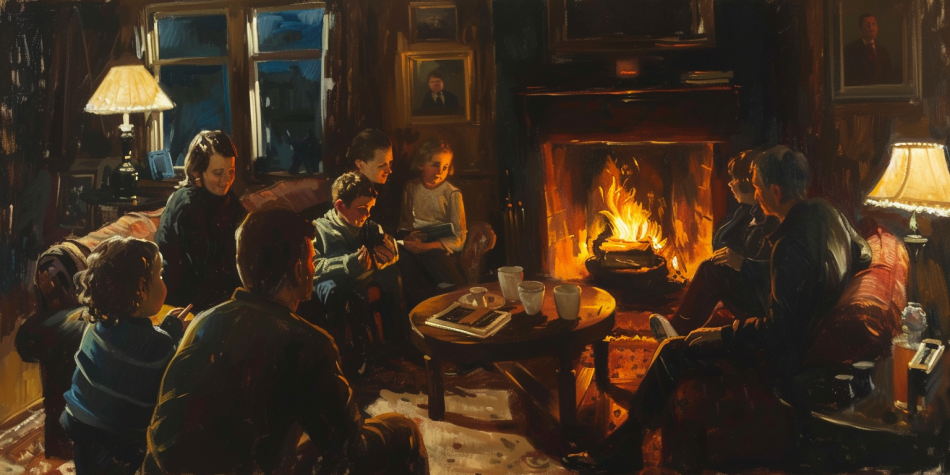
A family shares a warm, intimate moment at home, epitomizing the essence of the International Year of the Family.

Redefining Wealth for the 21st-Century Family

What really defines the wealth of nations? Is it GDP or the strength and stability of its family units?

As the world grapples with pressing issues of economic and social development, the United Nations convened a council dedicated to these very challenges. Recently, delegates gathered to deliberate on policies aimed at elevating social development globally. Amidst the discussions, Sha Zukang, the under-secretary for economic and social affairs, said, “The real wealth of nations occurs when each and every individual has access to a decent job and educational opportunity, quality and affordable healthcare, adequate and nutritious food, secure shelter, and social protection.” His words resonate deeply, highlighting the fundamental importance of addressing basic human needs for the betterment of society. 

However, the basics of human flourishing and development go beyond supplying the necessities of life. Indeed, we would posit that the lack of these essentials reflects a deeper problem within our contemporary times. If we want to treat social development at its core, we must go beyond treating the symptom-like manifestations of a deeper problem. This idea is reflected in what Elder D. Todd Christofferson said in a recent conference address, “The concept of sustainable development is an interesting and important one. Even more urgent, however, is the broader question of sustainable societies.” The Family: A Proclamation to the World gives further insight into sustainable societies through the promotion of the family. It reads:

 We warn that the disintegration of the family will bring upon individuals, communities, and nations the calamities foretold by ancient and modern prophets. …We call upon responsible citizens and officers of government everywhere to promote those measures designed to maintain and strengthen the family as the fundamental unit of society. 

The Doha International Family Institute, DIFI, supports these statements in its own declaration, “the family is the natural and fundamental group unit of society.” From prophetic revelation, in addition to the pro-family stances of various other organizations, it is possible to trace some of the degradation and poverty in society to the disintegration of the basic and fundamental unit of society—the family.

The lack of these essentials reflects a deeper problem within our contemporary times.

In discussing sustainability more in-depth, Elder Christofferson shares, “Sustainability is not guaranteed, and a thriving society can fail in time if it abandons the cardinal virtues that uphold its peace and prosperity.” Here, he is, of course, referring to the virtues that come through gospel truth, including the truth found in the doctrine of the family. Based on his assertions, while it is important to create a society that promotes the general welfare and equal opportunity, it may not have the lasting effects that we want it to if we do not uphold the basic foundational strength and security that comes from families. Patrick Fagan, former William H.G. Fitzgerald fellow in family and cultural issues at The Heritage Foundation, notes, “Studies show that income disparity in America is affected most by the stability of a child’s home environment—primarily, whether that child has married parents or is part of a broken family.”

With this general understanding in mind on a worldwide scale, The United Nations established “The International Year of the Family” in 1989 to help in creating sustainable societies, with their first conference in 1994. The UN designated May 15th as the annual day to celebrate the family, and every 10 years on this date a larger memoration takes place, usually in the form of a conference. As part of the purpose of this celebration, they note, “The family constitutes the basic unit of society and therefore warrants special attention. The Doha International Family Institute, DIFI, hosted the global conference in 2014 and is again hosting in 2024. In DIFI’s declaration they affirm their mission by stating: “Strengthening the family presents a unique opportunity to address societal problems in a holistic manner.” Here at Public Square Magazine, we want to join in the celebration of the International Year of the Family by creating a series completely dedicated to the family.

A thriving society can fail in time if it abandons the cardinal virtues.

Over the course of the next several months, we will be releasing an article once a month which explores different aspects and issues within family life, including the nature of marriage, discussions of gender, the eternal nature of families, the law of chastity, the sanctity of life, and other topics. After publishing this series, we will also compile these writings into an accessible PDF formatted book available for your personal download. With the creation of this family series, we aim to enrich dialogue and highlight the family as a cornerstone of social development.

About the author

Public Square Staff

Our core team, including our Editor, Managing Editor, Communications and Media Directors, Visual Display Director and Copy Editor.
On Key

You Might Also Like

Mother Figurine Holding a Baby | Public Square Magazine | Meaning of the Lyrics Peace on Earth, Goodwill to Men

Now is the Time for Peace on Earth, Goodwill to Men

You’ve heard it before: “Peace on earth, goodwill to men.” Whether viewed as prophecy for a hopeful future, as rebuke to a fallen world, or as the deep aspiration of many human hearts, these words invoke wonder still today, especially at a time like 2020. I believe these words point towards legitimate reasons for great hope in humanity’s future, even in the midst of our current distress. A closer look at their meaning provides a glimpse into bright possibilities. The modern-day enshrinement of these words was penned by the hand of Henry Wadsworth Longfellow during a time of deep personal sadness and grief in his 1863 poem “Christmas Bells.” Subsequently, these words have been sung by millions as the hymn “I Heard The Bells On Christmas Day.” Sadly, few choirs will sing this popular carol during the Christmas season this year as many of our most cherished traditions are disrupted by the continuing, unprecedented epidemic.  Notwithstanding the familiarity of these words in the modern context, their first recorded rendering came anciently in a most unusual setting. It was one of the few instances in all of secular or religious writings where an entire host of heavenly beings—angels—came to deliver a message to a few lucky ones on earth. Their entire message as recorded in Luke 2:14 of the New Testament was “Glory to God in the highest, and on earth peace, good will toward men.” If there was more to the message or not, we don’t know. But this was the message that was recorded and handed down over thousands of years since that momentous event.  It was this short heavenly song of praise that Longfellow was referring to when he lamented that “hate is strong and mocks the song of peace on earth goodwill to men.” Then as now, we join Longfellow in observing a world stricken with contention, tragic death, and human suffering with no clear end in sight. As a bold counterpoint, however, his poem and the hymn conclude with a resounding proclamation of hope that indeed there will be yet “peace on earth and goodwill to men.” Is it possible to find for ourselves this same hope of which Longfellow wrote so long ago?    Some might assume that the author had somehow arrived at more pleasant circumstances and material conditions. Yet in describing his world that Christmas morning in 1863, Longfellow was feeling the weight of personal tragedy in the death of his wife and the strife of a hot civil war spreading devastating carnage across the land. In such a heavy time, he couldn’t help but underscore how much the surrounding hate he saw in the world seemed to mock the idea of peace and goodwill – a word that suggests to “tease or laugh at in a scornful or contemptuous manner.” The hate he was referring to, and which has the power to infect us in our own day, was between groups of people and between individuals who looked at each other with scorn and contempt. In an environment that fosters hate, any suggestion that feelings of scorn and contempt might be replaced with feelings of peace and goodwill can seem to be almost laughable (another reason it’s powerful to have a heavenly host delivering this message to the world).   We sometimes think of peace and goodwill as synonyms. They are not. In fact, they represent very different human conditions – either one by itself being incomplete. But together they weave a social fabric of heavenly dimensions. There are many examples of one without the other, but relatively few of both existing and being sustained for any great length of time.  In its simplest form, peace could be defined as the absence of conflict. When this kind of peace is voluntary, due to an underlying feeling of goodwill toward all, it is a wonderfully satisfying human condition.  However, a “peaceful” absence of conflict can also be achieved through coercion, even in the notable absence of goodwill. In that case, it comes at the obvious, and dear price of freedom and liberty and represents a most cruel form of the human condition. Coerced peace is usually a political construct as it requires overwhelming use of force to constrain human behaviors. There have been modern examples of peace without goodwill in the recent past. One can reflect on Yugoslavia, Libya, Iraq, and other nations. For example, Yugoslavia was created after World War II as a federation of six different ethnic regions. A strong central governing party ensured that conflicts were resolved emphatically and quickly. There was “peace,” but without the underlying goodwill among the different ethnic groups. Under Josip Broz Tito the country experienced an extended period of prosperity characterized by enforced peaceful interaction among the various ethnic groups. In many ways, it was considered a model of economic success.  But after Tito died in 1980, the ability to continue the peaceful climate through coercive means declined, and the unresolved conflicts among the different ethnic groups emerged with frightening consequences in human suffering for the whole country and region. In a relatively few years, the region completely lost both its peace and prosperity.  Similar events have unfolded in other countries where peace was enforced despite the absence of “goodwill toward men.” As the power to enforce coercive peace diminishes, people are subsequently often subjected to tragic suffering that can take decades and even generations to overcome to a point of regaining a semblance of stability. In short, peace without goodwill has a terrible historical record for producing great human suffering in the end.  Unlike “peaceful” conflict suppression, goodwill to men cannot be coerced. It is almost by definition an innate feeling of each individual human heart. It can be contagious, and it often seems to be either in large supply or in short supply in a particular family, community, or nation. It would seem that goodwill to other human beings is something that would be a universal good. However, once again we find that

A resilient but barren olive tree stands as a symbol amidst the human side of the Middle East crisis, offering hope for peace to bloom

The Human Voices from Israel and Palestine

Amidst the Israeli-Palestinian conflict’s turmoil, what resounds in the hearts of those directly affected? Personal narratives from Gaza to Jerusalem unveil a tapestry of despair, hope, and unwavering resilience in the face of adversity.

Subscribe To Our Weekly Newsletter

Stay up to date on the intersection of faith in the public square.

You have Successfully Subscribed!

Pin It on Pinterest

Share This