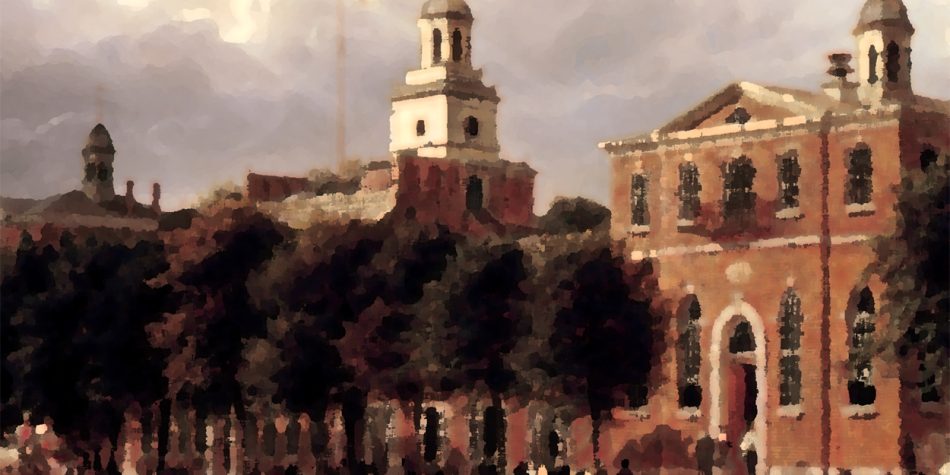
We believe in the public square. And we believe it’s worth preserving.
That’s not to say, of course, our faith is untested. After all, the public square these days is sometimes inhospitable territory for those who hold romantic ideas about right and wrong, the pursuit of the good, the polis as a place to cultivate virtue, and the church as a seat of salvation. But rather than sit back aghast as the storm clouds of cultural hostility collide, we feel an urgency to build more robust civic shelters.
One of the central, most under-recognized messages of the Book of Mormon is the fragility of a society overcome by unbridled animosities. So it’s perhaps fitting for a band of members of The Church of Jesus Christ of Latter-day Saints to try in some small way to counter the accelerating vitriol and caustic rhetoric.
Today, we announce Public Square Magazine as an effort to amplify thoughtful voices of faith and to lift the contemporary discourse; to cultivate trust amidst disagreement; to extend a call to people of goodwill and sound conscience: bring what you can and bring what’s missing.
From the Greek Agora to the New England-style commons and “town greens” of colonial times, the public square has functioned as the seat of indispensable, ongoing communication—the core of any community. While some of these exchanges reinforce common commitments and principles, the public square is also a space for navigating disagreements in a productive, civil manner.

That clearly hasn’t always been the case. Nor does our public discourse always instill great confidence today. More and more, those inclined to speak—religious or not—confront the prospect of capricious kinds of public backlash. We can understand why so many across the political spectrum feel exhausted, checked out, and dejected. Indeed, well-respected Christians have wondered aloud whether now is simply a season for sanctuary or a time for retreat.
If, in fact, America’s intellectual landscape has grown less friendly to some of its religious sojourners, we say that’s all the more reason to speak with greater cogency in every byway, hill, valley, town hall and, yes, swamp.
It was theologian Stanley Hauerwas who once suggested that Christians lost the 1970’s debate around abortion because they didn’t participate sufficiently in the larger public conversation about sex and related topics, and thus, “by ceding the terms of the debate, the debate got framed in ways that made the failure of conservative Christianity a foregone conclusion.”
Into that kind of a vacuum, it’s been far too easy for terms of public conversation to be established in a manner that occasionally paints faith as incomprehensible, or even threatening, rather than as an essential aspect of life for most of humanity, deserving of studied consideration.
As Antonio Gramsci once observed, “when one way of thinking becomes dominant enough, it renders other options unthinkable.” After underscoring the need to magnify more positive voices, Elder Quentin L. Cook, a member of The Quorum of the Twelve Apostles of The Church of Jesus Christ of Latter-day Saints, described how adding a new perspective to the conversation “creates a pause in the discourse and allows people to evaluate where they stand on a particular matter.” By contrast, “Silence allows the rhythm of negativity to continue uninterrupted and unchallenged.”

On a visit to see her missionary son in England near the end of the nineteenth century, Latter-day Saint Elizabeth McCune was alarmed to learn that anti-Mormon agitators were skewing conversation with deceptive injections of fear. Especially effective was critics’ insistence that if people learned the truth about the Saints living in Utah, they’d understand how oppressed women were within the faith community.
Elizabeth, however, spoke up and provided her own lived experience as a woman in Utah and a member of The Church of Jesus Christ of Latter-day Saints. Her voice opened more productive exchanges and multiplied opportunities to share, helping begin formal sister missionary work in the Church.
You can never have enough tolerant and reasoned voices sharing what they believe to be true and beautiful.
We hope this publication will add many thoughtful, considered voices to the public square. We aim to curate the best thinking of people ready to speak, while simultaneously helping awaken future Elizabeth McCunes. We will publish a wide variety of commentaries, essays, and features, from many different stylistic approaches and perspectives. We will cultivate a stable of Latter-day Saint writers and thinkers alongside thoughtful voices of other religious persuasions.
Despite evidence of the social benefits of religion to society, it’s not entirely uncommon to hear assertions that faith communities are little more than modern barriers to progress or that religion is already too prevalent an influence in society.
We reply that you can never have enough tolerant and reasoned voices sharing what they believe to be true and beautiful. You can never have enough souls striving toward the divine.
Typically, not far from the American courthouse, town hall, or city square, a house of worship still stands as a reflection of the central value of faith as a community asset. In this new effort, we hope to remind a troubled nation of the continued relevance of faith in addressing so much of what ails us.
The body of believers must now more than ever put pen to paper; click conviction into every keystroke; stand athwart history and belt “come, come, ye saints” until, in fact, all is well.
Restoring faith in the public square requires nothing less.