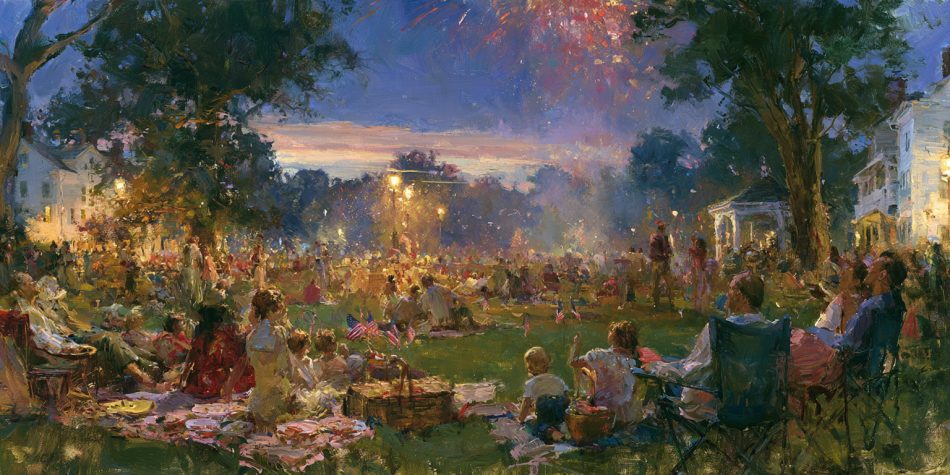
As the scent of burgers mingles with the sound of laughter and the booming of fireworks on July 4, our nation’s 250th anniversary demands more than celebration alone.
Latter-day Saints should look beyond the festivities and reflect upon the deeper meaning of the freedoms we enjoy. From the blessings promised to this land to the founding of America and the Restoration of the Gospel, Heavenly Father’s guiding hand has quietly moved through the centuries, preparing the way for the founding of a land of liberty where He could restore His gospel. Though the history of the United States has, at times, been filled with injustices and failures to live up to its own principles of liberty and justice for all, its founding principles created an inspired framework through which liberty, religious freedom, and human dignity could be expanded.
As we revel in parades and picnics, our nation is threatened by a growing disregard for God and the blessings of freedom He has bestowed. To honor this anniversary properly, we should recall America’s inspired founding and draw from that remembrance the strength to defend the divinely inspired Constitution in a polarized age where God‑given liberties are increasingly misunderstood or ignored.
A Land of Prophecy
Book of Mormon prophecy reveals God as guiding when and how nations would come to the American continent. The prophet Lehi taught that “there shall none come into this land save they shall be brought by the hand of the Lord.” The prophet Moroni taught that “this is a choice land, and whatsoever nation shall possess it shall be free from bondage, and from captivity, and from all other nations under heaven, if they will but serve the God of the land, who is Jesus Christ.”
The American continent has long been home to many peoples with diverse languages, governments, economies, and religions, including those described in the Book of Mormon as being led to the Americas. The Book of Mormon describes how the people of the American continent were, for a time, kept “from the knowledge of other nations,” including the nations across the Atlantic whose later arrival would drastically reshape history.
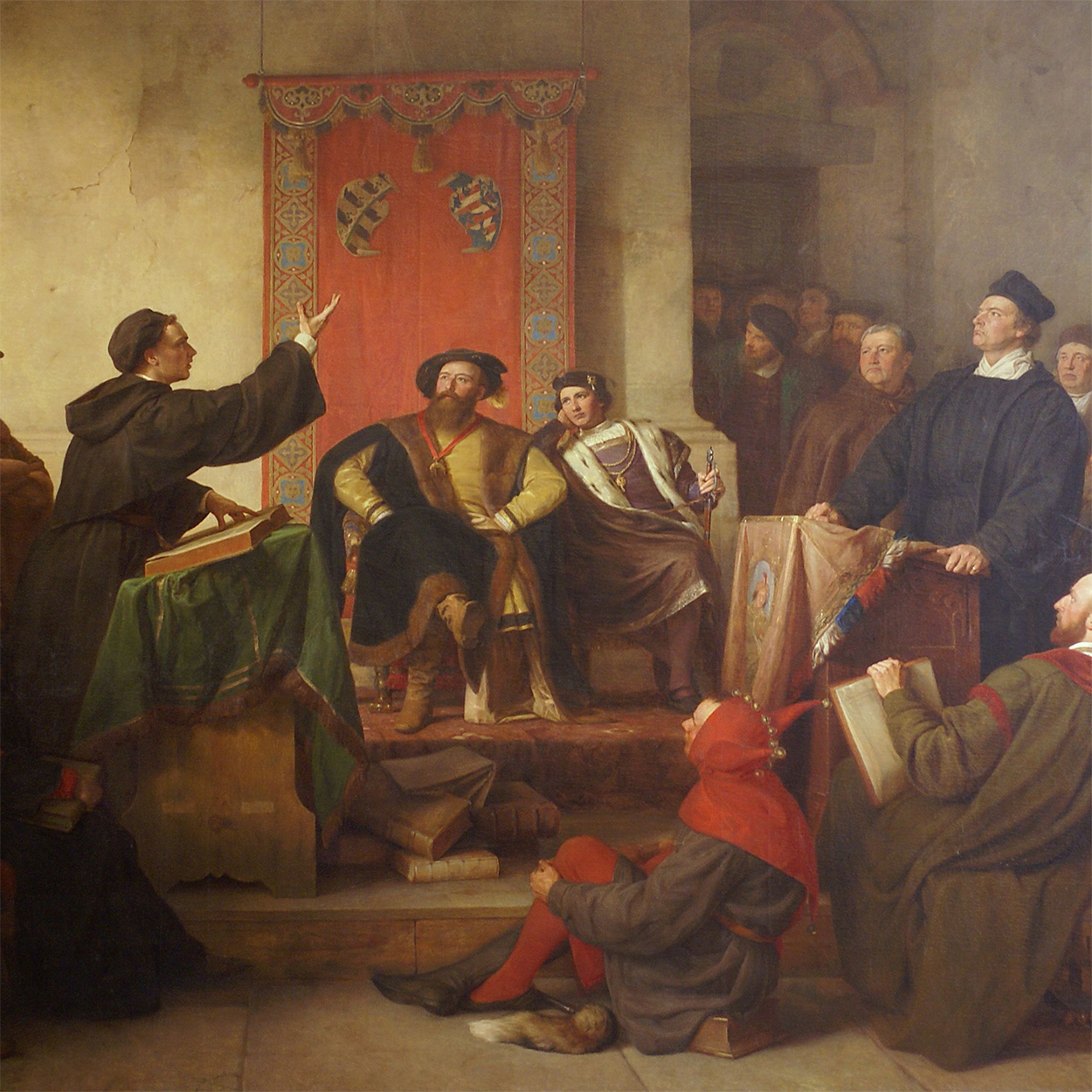
Europeans did not arrive in the American continent until after the nations of feudal Europe experienced the Renaissance and Reformation and established themselves as independent kingdoms. The Book of Mormon prophet Nephi described the Europeans’ first encounter with America, starting with Christopher Columbus, as inspired:
And I looked and beheld a man among the Gentiles, who was separated from the seed of my brethren by the many waters; and I beheld the Spirit of God, that it came down and wrought upon the man; and he went forth upon the many waters, even unto the seed of my brethren, who were in the promised land.
Given the devastation European conquest brought to many Indigenous peoples, it can be difficult to see how inspiration was at play. While Columbus is a morally complex figure with a challenging history, we also learn from his journals and letters that he was particularly interested in the biblical passages that referred to the gathering of Israel, he employed persecuted Jews and conversos in Spain, and felt guided by the Holy Ghost in his revolutionary voyage to the New World.
Nephi also saw that, after Europeans learned of the New World, many would seek to escape the persecution and tyranny of the Old World and flee to America to obtain religious freedom (1 Nephi 13:13-16). Building upon the Renaissance and Reformation, the Pilgrims and their Mayflower Compact established early settlements “for the Glory of God, and Advancement of the Christian Faith,” a covenant land with a biblical foundation. The concept of practicing religion according to the dictates of one’s own conscience, revolutionary before the founding of America—and often taken for granted today—became one of the quintessentially American ideals that has spread through much of the world.
A Providential Revolution
In that same vision, 2,300 years before the American Revolution, Nephi saw that American colonists would prevail in their war for independence with God’s help (1 Nephi 13:16-19).
President Ezra Taft Benson taught, “Our Father in Heaven planned the coming forth of the Founding Fathers and their form of government as the necessary great prologue leading to the Restoration of the Gospel.”
Latter-day Saints should look beyond the festivities and reflect upon the deeper meaning of the freedoms we enjoy.
God inspired the Founding Fathers to craft the Declaration of Independence, and in it they affirmed their faith in God. The declaration begins: “We hold these Truths to be self-evident, that all Men are created equal, that they are endowed by their Creator with certain inalienable Rights, that among these are Life, Liberty, and the Pursuit of Happiness.” With faith in God for their success, the Founders concluded the Declaration with these words: “And for the support of this Declaration, with a firm Reliance on the Protection of divine Providence, we mutually pledge to each other our Lives, our Fortunes, and our sacred Honor.”
And many paid the price they pledged. Roughly a dozen signers of the Declaration suffered serious losses to homes, estates, or property—through looting, occupation, destruction, or burning—often at the hands of British or Loyalist forces. Five others were taken as prisoners of war—and in the particularly horrible case of Richard Stockton, starved and kept in freezing, brutal prison conditions for months. One signer lost his son in the Revolutionary War, and another had two sons who were captured. Nine died from a variety of causes during the war and did not see the Constitution established.
Many of the founders have since had proxy temple work performed on their behalf. In August 1877, Elder Wilford Woodruff, then a member of the Quorum of the Twelve Apostles and president of the St. George Temple, received a visitation by the spirits of the signers of the Declaration of Independence. They asked Elder Woodruff why the saving priesthood ordinances of the temple had not been performed for them.
Elder Woodruff recorded this visitation in his journal. “Before I left St. George, the spirits of the dead gathered around me, wanting to know why we did not redeem them. Said they, ‘You have had the use of the Endowment House for a number of years, and yet nothing has ever been done for us. We laid the foundation of the government you now enjoy, and we never apostatized from it, but we remained true to it and were faithful to God.’”
After the temple work was completed for the Founding Fathers, Elder Woodruff wrote in his journal, “I felt thankful that we had the privilege and the power to administer for the worthy dead, especially for the signers of the Declaration of Independence, that inasmuch as they had laid the foundation of our Government, that we could do as much for them as they had done for us.”
As president of the Church, President Woodruff later declared in the April 1898 general conference that “those men who laid the foundation of this American government were the best spirits the God of heaven could find on the face of the earth. They were choice spirits … [and] were inspired of the Lord.” Indeed, the Founders were exceptional in their faith, education, wisdom, vision, and leadership ability.
An Inspired System of Government
The founders helped to lay an inspired system of government. In 2 Nephi 10:10-14, the Book of Mormon prophet Jacob foretold that in the latter days the Gentiles would colonize America and would establish it as a land of liberty where no kings would rule. Through Jacob, the Lord declared that He would protect the inhabitants of the land and that anyone who tried to establish a kingdom would perish.
God inspired the Founding Fathers to craft the Declaration of Independence.
As the commanding general of the Revolutionary War, George Washington was so popular after the conflict that many wanted to crown him king. Washington, who had spent his life reluctantly wielding power only to voluntarily lay it down, adamantly refused in divine fulfillment of Jacob’s prophecy. Washington was a humble man who recognized the hand of God in the victory of the Continental Army. He had not shaken off one tyrannical monarchy in order to preside over another.
In rejecting even the suggestion of kingly power, George Washington showed the kind of humility and restraint that many scriptural civilizations lacked, recognizing that monarchy always carries the risk of tyranny and pride.
Instead of creating a kingdom, the liberated colonists chose a radical exception to the global status quo by establishing a constitutional republic, something Abraham Lincoln would later summarize as “of the people, by the people, and for the people.” Thus, Washington’s humility and desire to serve as president rather than rule as an autocrat is one shining example of what has come to be known has “American exceptionalism.”
A Divinely Guided Constitution
Having designated America a land of liberty, God raised up a group of inspired and intelligent leaders who could draft a constitution and establish the first truly free society in modern times. The Lord revealed to the Prophet Joseph Smith that He inspired the Constitution for the specific purpose of eliminating slavery and protecting the God-given rights belonging to all people. He declared:
According to the laws and constitution of the people, which I have suffered to be established, and should be maintained for the rights and protection of all flesh, according to just and holy principles;
That every man may act in doctrine and principle pertaining to futurity, according to the moral agency which I have given unto him, that every man may be accountable for his own sins in the day of judgment.
Therefore, it is not right that any man should be in bondage one to another.
And for this purpose have I established the Constitution of this land, by the hands of wise men whom I raised up unto this very purpose” (D&C 101:77-80, emphasis added).
Thus, the Lord inspired the Constitution as a means to eventually abolish slavery and protect the sacred agency that Heavenly Father had given us as a critical part of our eternal progression.
Of course, it took significant work and nearly a century to end the despicable practice of slavery in the United States.
Although the abolition of slavery was not immediately achieved at the founding of our republic in 1776, some states immediately began to strip away at slavery’s foundation. For example, during the Revolutionary War, Vermont used its state constitution to abolish slavery in 1777, becoming the first state in the Western Hemisphere to do so. New Hampshire followed in 1779.
Pennsylvania began gradual emancipation in 1780. Massachusetts came next with a state supreme court decision in 1783, and Rhode Island began gradual emancipation in 1784, shortly after the war. Later that year, Connecticut initiated a gradual plan to emancipate its slaves.
Thus, within eight years of our founding in 1776, six of the original Thirteen Colonies had abolished slavery or begun gradual emancipation. Many in the founding generation drew on the principles of the Revolution to challenge slavery and to establish a constitutional framework that, while imperfectly applied, contained principles capable of more fully securing life, liberty, and the pursuit of happiness for all.
So why did many of the Founders, who denounced slavery, nevertheless own slaves themselves? The answer is complex, as they operated within the socioeconomic system inherited from British colonial rule. Both Washington and Jefferson helped articulate the age’s ideals of liberty while remaining entangled in slavery. Washington came to oppose the institution privately and freed the people he personally owned in his will, while Jefferson opposed slavery in principle but freed very few of the hundreds he enslaved. He vociferously condemned slavery as a “cruel war against human nature” in his original draft Declaration, but Virginia passed various pro-slavery laws during his lifetime that made manumission difficult. In spite of their complex history with slavery, the Founders’ lives demonstrate how God can work through imperfect people to accomplish His purposes and lay a foundation for later generations to fulfill.
Defending the Constitution
Heavenly Father has given a sacred responsibility to His covenant people to befriend and defend the Constitution. As recorded in Section 98, the Savior told Joseph Smith, “Therefore, I, the Lord, justify you, and your brethren of my church, in befriending that law which is the constitutional law of the land” (D&C 98:6). Because He created all mankind to be free, Jesus asks us to do our part to ensure that the rights and privileges of all mankind are protected.
He also warned against laws that encroach upon the God-given rights and privileges of personal liberty, and of our obligation to elect honest and wise leaders (D&C 101:77-80 and 98:5-10).
The Lord further revealed to the Prophet Joseph Smith that the Constitution and the United States would one day be imperiled. Several contemporaries of the Prophet Joseph Smith reported that he prophesied that the Constitution would seemingly hang by a thread, and Latter-day Saints would step forth to save it from threatened destruction.
Our modern prophet, President Dallin H. Oaks, has described an apostolic responsibility for studying the meaning of the divinely inspired United States Constitution in the work of the restored Church. For example, he has identified how the First Amendment’s antiestablishment and religious exercise guarantees were the fertilizer in the soil from which the Restoration took root.
We are free because of divine providence from our Father in Heaven.
Of the Constitution, President Oaks has stated, “I have always felt that the United States Constitution’s closest approach to scriptural stature is in the phrasing of our Bill of Rights.” On the occasion of our bicentennial 50 years ago, he declared, “Without a Bill of Rights, America could not have served as the host nation for the Restoration of the gospel.”
It is no wonder then that the Prophet Joseph Smith called the Constitution “a glorious standard… a heavenly banner.” The dedicatory prayer for the Kirtland Temple, as dictated by Jesus Christ to the Prophet Joseph Smith and found in Section 109, contains these words: “May those principles, which were so honorably and nobly defended, namely, the Constitution of our land, by our fathers, be established forever” (D&C 109:54).
A Sacred Responsibility
As we celebrate Independence Day on America’s 250th birthday, we must remember that we are free because of divine providence from our Father in Heaven. We are free to exercise our moral agency to choose good over evil. He asks us to love Him and each other, and to keep all His other commandments. May we use our agency to be peacemakers, especially in our politically divided society.
As American citizens and as members of The Church of Jesus Christ of Latter-day Saints, we are among the most blessed of all of Heavenly Father’s children. With those blessings, we have a sacred responsibility to be a light to the world. We are called not only to share the restored gospel as part of the gathering of Israel, but to be the “salt of the earth” (Matthew 5:13). In other words, “to be the seasoning, savoring, preserving influence in the world, the influence which would bring peace and blessings to all others.”
President Oaks declares that our belief in the divine inspiration behind America’s founding gives us a special responsibility to uphold constitutional principles, trust in the Lord, and remain optimistic about our nation’s future. We should pray for our nation and peacefully and lawfully engage in civic life. Upholding the Constitution, he counsels, also means learning its inspired principles, supporting wise leaders who defend them, and being informed citizens.
Heavenly Father inspired the founding of our republic as a land of liberty. This was an important step so that Jesus Christ could restore His gospel upon the earth. Therefore, when influences—whether political or cultural—seek to undermine our nation’s inspired founding principles, we should protect the heritage with which God has blessed us.
The significance of America’s 250th birthday invites us to do more than celebrate; it calls on us to remember, recommit, and reclaim the sacred purpose of our nation. Let us resolve today, as Old Glory flutters triumphantly in the background of our Independence Day celebrations, that we, as Latter-day Saints, will righteously honor our responsibility—as prophesied by the Prophet Joseph Smith—to rise up and defend our divinely inspired Constitution. Then, with God’s continued grace, the United States of America will have many more milestone birthdays to come—birthdays on which our children and grandchildren can rejoice in a nation still anchored to the principles with which He made us free.