Almost two years ago, I stood before a judge who administered an oath requiring me to “support, obey and defend the Constitution of the United States.”
As a newly admitted lawyer, this felt like a sacred honor. My burning interest in constitutional law drove me to law school. Now I had sworn to be one of its defenders. I now had a formal role to play in upholding its principles.
There’s something important about taking an oath. It establishes an obligation to a principle, even when honoring that obligation is hard. I take my constitutional oath very seriously.
But we have too often assumed that the duty to uphold and defend the Constitution rests only with public servants and attorneys. Friends who are not lawyers often ask me how they can protect the Constitution. Too often, they’ve been told there’s not much they can do unless they go to law school.
I profoundly disagree. Yesterday, President Dallin H. Oaks spoke at the National Cathedral in Washington, D.C., about the relationship between becoming a peacemaker and upholding the Constitution.
His address got me thinking: What might a citizens’ oath to uphold the Constitution look like?
Inspired by President Oaks’ address, I believe it would center on becoming a peacemaker: someone who listens to and loves our fellow citizens (especially those most different from us), is willing to compromise to achieve mutually beneficial policy objectives, and upholds the Constitution’s principles. This is an oath we can all take, and one that our Constitution desperately needs.
An Oath to “We the People”
When we think of the Constitution, what images come to mind? Parchment? Pocket pamphlets? Perhaps the U.S. Capitol, the White House, or the Supreme Court, or the people who work in them?
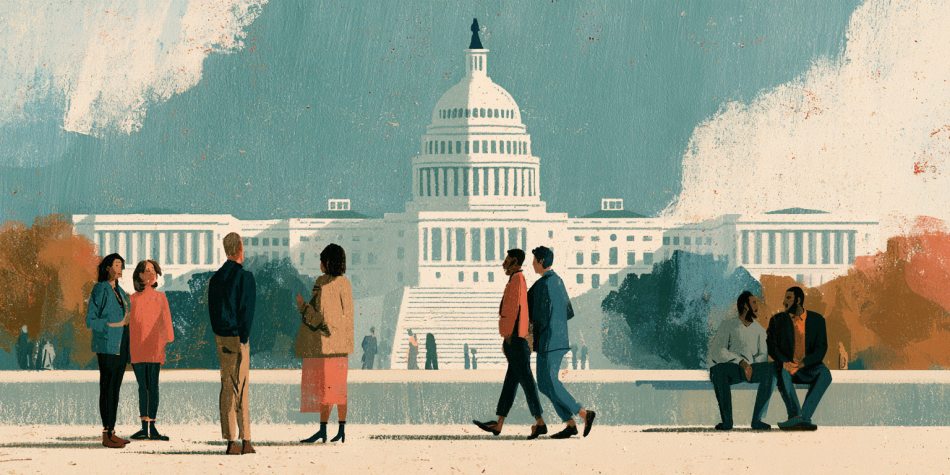
I urge us to think differently. Start with who you live with. Then think of your next-door neighbors. Then think of your broader community—the people among whom you work, shop, recreate, and worship.
Think of people because the Constitution belongs to “We the People.”
Instead of parchment, pamphlets, or policymakers, I want you to think of these people. The friends and enemies of your community. The people you love, the people you fear, the people you know nothing about.
Think of people because the Constitution belongs to “We the People,” the opening words of its preamble. It doesn’t just belong to the Supreme Court or the lawyers or the National Archives. Through its organizing principle of popular sovereignty, the Constitution belongs to all of us. We are the source of its power and legitimacy. But the “we” is collective. Not just you and your favorite political commentators or me and mine.
The principle of popular sovereignty strengthens as we learn to become peacemakers. If we see the Constitution as belonging to all of our fellow citizens, we will realize that our protection of it cannot be only self-serving. We cannot, as President Oaks taught, “seek total dominance for all of our own positions.” Instead, he taught, “We should make every effort to understand the experiences and concerns of others, especially when they differ from our own.”
If we are to have, as Lincoln said, “government of the people, by the people, for the people,” we have to believe this really means all of us.
An Oath To Love and Need Each Other
Knowing that we cannot neglect our fellow citizens’ interests in our civic engagement, we have to face an even more demanding truth. Not only do our fellow citizens share the source of the Constitution’s power with us, but we need them in our civic life, and we need to love them.
President Oaks taught yesterday that “All of us should accept the reality that we are fellow citizens who need each other.” He later noted that “the Lord has taught me that it is possible to obey and seek to improve our nation’s laws, and also to love our adversaries.”
Loving our adversaries is part of the hard peacemaking work our Constitution needs.
Of course, many are cynical about that kind of project in our politically polarized nation. Hostile social media arguments and political violence make the risks feel high.
But the reality is that we really do need each other. As Rev. Martin Luther King, Jr., wrote from Birmingham Jail, “We are caught in an inescapable network of mutuality, tied in a single garment of destiny. Whatever affects one directly affects all indirectly.” We cannot shun certain groups of our brothers and sisters and believe that we are serving our nation.
Forged in compromise, the Constitution also requires compromise for the creation of laws.
An Oath to Compromise
A peacemaking oath to support the Constitution isn’t limited to interpersonal peacemaking. It also includes—not uncontroversially—peacemaking in policy.
Forged in compromise, the Constitution also requires compromise for the creation of laws. Its early proponents anticipated, not unwisely, that all kinds of “factions” would animate our governance, as James Madison wrote in The Federalist Papers. “The latent causes of faction are thus sown in the nature of man,” he wrote in No. 10. The Constitution’s remedy was structuring government as a democratic republic, where representatives would have to persuade one another and moderate their positions to create law. Or, as President Oaks put it, the Constitution “compels a divided people to build coalitions that allow them to act together for the common good.”
This ought to give us hope for our polarized times. Divisive differences were anticipated from the start. We just have to be willing to work them out.
President Oaks has taught that “on contested issues, we should seek to moderate and unify.” These are words I couldn’t get out of my head as I interned in Washington, D.C., in the years after his talk. I encountered people on both the right and left who wished the Church would take a different path in its approach to religious liberty. Those on the left were frustrated that the Church’s reason for supporting compromise legislation was to protect religious liberty. Those on the right were frustrated that the Church would agree to compromises that seemed to go against its own teachings. One side wanted the Church to compromise its core commitment to protecting its doctrine; the other wanted the Church to remain unyielding in protecting it.
But what President Oaks teaches is “a better way forward—a way to resolve differences without compromising core values.” This approach is what he has called “fairness for all.” “When there is genuine conflict on the effect of constitutional rights,” he taught, “contesting positions need to be balanced legally and negotiated politically in a way that upholds all essential rights to the greatest extent possible.” In other words, you may get your rights, but you also have to respect theirs.
This approach undergirds the 2015 Utah Compromise, the 2022 Respect for Marriage Act (RFMA), and the unpassed federal Fairness for All bill. Each of these measures committed to legislation the core value of religious liberty, which allows the Church to carry on in accordance with its doctrines. Yet each one also provides other protections—LGBT nondiscrimination in the Utah Compromise, and same-sex marriage recognition in the RFMA. These measures represent efforts to accomplish peacemaking in the policy context.
For many members of the Church, the Church’s support for these measures may have initially felt surprising or even hard to reconcile. (More on that here.) Some may have felt the compromise was far more significant than the moment required. But I learned during my time in Washington that the Church really means it when it says “moderate and unify.” As President Oaks taught, this requires “all of us to obey some laws we dislike and to live peacefully with some persons whose values differ from our own.”
It may be that this call to be so willing to compromise is a prophetic call specific to our time. Perhaps it is. But it is a prophetic call nonetheless.
The peacemaking approach of “fairness for all” is sometimes unpopular, even among members of the Church. In seeking to follow this call, I have had to moderate some of my own positions, even when my original position felt more philosophically consistent or morally pure. But if politics is the art of the possible, then we will almost certainly need to moderate our expectations for what constitutional policymaking can achieve.
The thing nobody likes about peacemaking in a policy context is that the lines are hard to draw. How much of a principle can I forgo before I have compromised my own core beliefs? Are my beliefs compromised by allowing something I do not believe in? (The Church’s example has taught us: not necessarily.) What is truly essential to protect, and what is not?
These are challenging issues to resolve. If they’re causing us to think hard about them, discuss them with others, and question our own positions, this might be good evidence that we are doing the exact work we need to do.
An Oath to Principles
Finally, any oath to the Constitution must include an oath to the Constitution’s principles. This is, admittedly, where lawyers often come in. When constitutional principles are violated, we expect litigation, if not law review articles, to alert us to what’s wrong.
The thing nobody likes about peacemaking in a policy context is that the lines are hard to draw.
The late U.S. Supreme Court Justice Antonin Scalia was known for pulling out another nation’s constitution at his law lectures. He would read its extensive Bill of Rights, which guaranteed freedom of speech, freedom of press, freedom of protests, and many other rights, far exceeding those of the United States. He then asked his audiences which country the constitution was from.
He would shock them when he told them it was the 1977 Constitution of the Soviet Union—not exactly the poster country for constitutional liberty. He went on to say that “every tyrant” and “every banana republic” “in the world has a bill of rights.” “Unless the real constitution of a country prevents the centralization of power, all the rest is words on paper.”
Our Constitution’s structural division of power is a vital safeguard for our individual liberties. It is also a safeguard for the rule of law.
If there is anything peacemakers should be inflexible on, it is the rule of law. We must expect government actors to follow the law, especially the supreme law of the land, the Constitution.
Our branches of government should check each other. But even these checks and balances are not foolproof. Those in power must also sometimes exercise self-restraint, hence the Latter-day Saint admonition that “honest men and wise men should be sought for diligently, and good men and wise men ye should observe to uphold; otherwise whatsoever is less than these cometh of evil.”
An important way we can defend the division of power is by understanding what each branch is allowed to do, then voting with those limits in mind. We should carefully investigate candidates’ intended actions and whether they seek to undertake duties that are duly committed to another branch. Individuals who show a reckless disregard for rules or the law may carry those same tendencies into public office.
When we see violations—prospective or committed—we should contact our members of Congress, who were intended to have the greatest power in the government, not the least, and urge them to act. We can write op-eds to raise awareness for our fellow citizens. We can support state leaders who refuse to surrender states’ rights to the federal government. And most importantly, we can encourage good and honorable people to run for office, and then vote for them.
Will You Take the Oath?
So, on our Constitution’s birthday, will you take a citizens’ oath to defend it? You don’t have to memorize the preamble (though it’s inspiring) or own three copies of the Federalist Papers (though why not?) or read constitutional law cases (though I promise it’s super fun).
These are not the things that protect the Constitution. Instead, the Constitution is protected by sustained efforts to know, listen to, and love your neighbor. To focus on supporting legislation of compromises—fairness for all—that deters needless litigation and that actively promotes pluralism. To vote for candidates who do not merely articulate fondness for constitutional principles but who show that they are committed to them, even when those principles limit their own power or constrain their policy agenda.
These are the things anyone can do. And our nation needs you to do them.
On this Constitution Day, I hope you will join me in taking a citizens’ oath to defend the Constitution by being a civic peacemaker. It is what our Constitution needs.