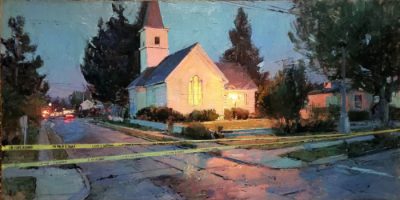

I live in a neighborhood in Provo, Utah, developed in the 1950s, referred to as “The Neighborhood of Tomorrow” on the community’s original plans. If you think that sounds like an enchanted corner of Disneyland, you’re not far off.
Our community features hidden private parks, a large church building and park where my neighbors gather to worship and socialize, and a neighbor-owned grocery store where you can procure pebble ice, maple bars, and Ben & Jerry’s—all of life’s necessities. A few blocks from our home, a 1950s drive-in offers burgers and the world’s best fresh-lime sodas, made with simple syrup and fresh-squeezed lime juice. It’s an idyllic community, mostly because our neighbors have enormous hearts.
A few years ago, a family on our block marked Pride Month by flying a trans pride flag outside their home in support of their child. Around the same time, other neighbors began displaying various political signs and flags outside their homes, including several “title of liberty” banners.
For those unfamiliar with the origins of the title of liberty: At a pivotal point in the Book of Mormon, Moroni was a chief commander of armies battling against forces that “sought to destroy the Church of God, and to destroy the foundation of liberty which God had granted” the land’s inhabitants. To rally his people, Moroni tore a piece of his coat and wrote on it “‘In memory of our God, our religion, and freedom, and our peace, our wives, and our children’—and he fastened it upon the end of a pole.” Moroni also “caused the title of liberty to be hoisted upon every tower which was in all the land.” In that wartime crisis, adversaries who refused to enter into a covenant to “support the cause of freedom” were put to death.
If it’s easy, we’re not doing it right.
I don’t know whether the titles of liberty in our neighborhood were prompted consciously or unconsciously by our neighbor’s pride flag or if they appeared coincidentally after it went up. I do believe they were displayed in an earnest effort to express community members’ faith. After all, in the Book of Mormon, Moroni’s actions to defend God, family, peace, and liberty are sanctioned by God, and the title of liberty is a proclamation of faith and a call to preserve religious liberty. Like all Americans, members of my community enjoy a First Amendment right to fly flags and display signs in their yards supporting religious, political, or other causes they believe in. But to me, during that particular summer and fall, our idyllic, peaceful neighborhood began looking and feeling something like a battleground.
I suggest that if Latter-day Saints listen intently, God is revealing a different approach to preserving life, liberty, and freedom today. Rather than being counseled to isolate ourselves into tribes, fashion banners, take up arms, and fight “the enemy” to the death, we are being counseled by the Lord’s prophets to exercise and promote religious freedom in perhaps what is a higher and holier way revealed to meet the exigencies of our day:
- “peacemakers needed”
- “we should not seek total dominance for our own position”
- “seek fairness for all”
- “seek to moderate and unify”
- “work for a better way—a way to resolve differences without compromising core values”
- “pour oil on troubled waters”
- “exercise our influence civilly and peacefully”
- “reconcil[e] existing conflicts and avoid[] new ones”
Such work is not for the fainthearted. It requires not planting flags in the ground but engaging in the hard work of planting and nourishing seeds, which if nourished will cultivate peaceful pluralism and religious freedom for all in our diverse society. This prophetic counsel is not an out-of-touch, namby-pamby, touchy-feely approach to today’s polarizing issues. It is much more difficult work, but those who believe in the law of the harvest as an eternal truth understand it is the only approach that will work.
So what seeds can we plant to exercise, promote, and protect our right to religious freedom? I propose here just a few of many possible varieties of fruit-bearing seeds.
Planting Seeds of Knowledge
In April 2021, President Dallin H. Oaks encouraged Latter-day Saints “to uphold and defend” inspired principles of constitutionalism, including five principles inherent in the U.S. Constitution:
- Popular sovereignty, meaning people are the source of government power, and they exercise that power through elected representatives;
- Federalism, or the division of power between a central “federal” government and state or regional governments;
- Separation of powers, meaning the establishment of independent executive, legislative, and judicial branches of government that exercise checks on one another, holding each other accountable to the Constitution;
- The Bill of Rights, which guarantees enumerated individual rights and “places specific limits on government authority”; and
- The rule of law, or the principle that we are “governed by law and not by individuals,” ensuring “our loyalty is to the Constitution and its principles and processes, not to any office holder.”
Learning about, internalizing, and being guided by these overarching principles is a seed-planting exercise in promoting and protecting religious freedom and other freedoms.
Instead of doing the harder work of studying and promoting these principles, we may be tempted to do the easier work of popping a pocket version of the Constitution in a backpack or purse. We may “like” social media posts purporting to espouse constitutional principles. Or we may vote for candidates who claim to know and stand for constitutional principles. But those acts alone are not a fulfillment of President Oaks’s charge.
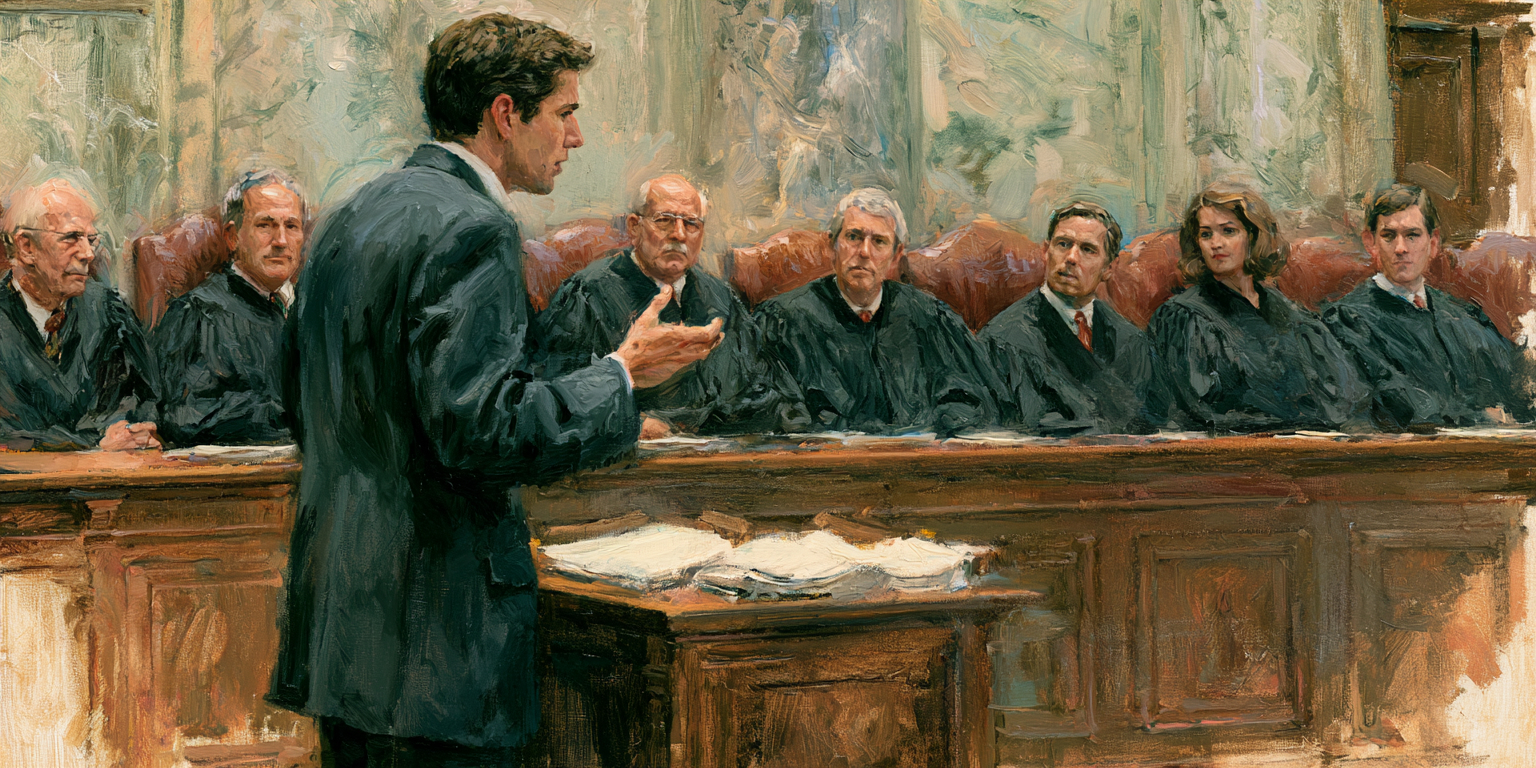
President Oaks emphasized the principle of the rule of law—that individuals are not a law unto themselves, meaning we aren’t free to create our own preferred Constitution or rely on the interpretations of friends, politicians, or talking heads. Key here is understanding the legal doctrine of judicial review, established by the U.S. Supreme Court’s 1803 Marbury v. Madison opinion. That doctrine means that courts with jurisdiction—not individuals—are responsible for interpreting the meaning of the Constitution and declaring unconstitutional the executive and legislative acts that don’t comport with its principles.
Of course, we as individuals can advocate to amend or repeal legislation that we believe to be contrary to constitutional principles, but those of us who aren’t judges have no authority to declare law unconstitutional, on online fora or elsewhere. So it behooves us all to be more informed about judicial decisions interpreting the Constitution, and the reasoning behind them, and to be more careful and considered in our language. At a minimum, learning and focusing on key constitutional principles, rather than digesting and regurgitating polemic and partisan positions, will help us plant seeds to promote and protect constitutional rights, including the right to religious freedom.
Planting Seeds of Moderation and Unity
Even if we plant flags and signs in our yards with the best of intentions, they can convey virtue signaling more than true virtue.
Judge Thomas B. Griffith, now retired from the U.S. Court of Appeals for the District of Columbia Circuit, has championed President Oaks’s counsel to moderate and unify. At BYU’s Religious Freedom Annual Review in 2021, Judge Griffith explained how efforts to moderate and unify led to the drafting and signing of the U.S. Constitution and are critical to upholding its principles today:
To me, the key insight as to what happened in the summer of 1787, what I would say is the miraculous element of that event is, . . . . when the Convention was on the verge of dissolution, eleven moderates got together and decided they were not going to let the Convention fail. And so they did something truly remarkable. They convinced their fellow delegates to enter into a compromise for the sake of unity before they knew the terms of the compromise.
I believe that is what President Oaks is talking about when he says that we should work to moderate and to unify. You want to support and defend the Constitution of the United States? Then get off your cable channels, stop repeating talking points that are prepared by partisans, and look to build the spirit of amity and mutual deference in your community; that’s how we support and defend the Constitution.
In the spirit of the Founders, moderating and unifying today requires that we moderate our expectations and not seek a monopoly on rights in a society where we must live alongside those not of our faith—mutually honoring and making space for freedom of religion or belief, or nonbelief, for all.
Planting Seeds in Support of Fairness for All
In his 2021 Joseph Smith Lecture at the University of Virginia, President Oaks discussed the benefits of collaborative legislation as a way to resolve differences without compromising core values—a message reiterated in his April 2026 general conference address.
President Oaks asserted that collaborative legislation is generally preferable to judicial decisions for resolving religious freedom conflicts. Litigation declares winners and losers, is limited in scope to the particular case, and is “ ill-suited to the overarching, complex, and comprehensive policy-making” required in sensitive conflicts, like those between nondiscrimination and religious liberty interests. He explained:
There are worthy constitutional and ethical arguments on both sides of such disputes, and, so far as possible, we should seek to accommodate them consistent with the most important interests of all sides. This is not easy when we differ so fundamentally on matters of such immense importance. But the effort is essential if we are to live together in peace in a pluralistic society.
Notably, the phrase “most important interests” indicates that not all interests or values are “core.”
President Oaks cited the Utah Compromise of 2015 as a promising model of accommodation legislation. That collaborative legislative effort has been held up by national thought leaders in New York Times op-eds and scholarly publications as a remarkable achievement in bringing together organizations and individuals from both the religious and LGBTQIA+ communities in Utah (which aren’t necessarily mutually exclusive, though we often speak of them as if they are) to draft and pass two bills in the Utah Legislature that protect fundamental rights in employment and housing for both groups. In fact, representatives from both “sides” in that process agree that the bills’ popular name—the Utah Compromise—is a misnomer; while the two sides collaborated on a legislative solution, neither believes they compromised core values.
Planting Seeds Through Informed Voting
To protect religious freedom and other constitutional rights, we can and should prepare to vote by studying candidates’ proposed policies and considering their methods for getting things done. If we want to follow President Oaks’s counsel to support collaborative legislation, it follows that we must support political candidates who will collaborate. President Oaks has also urged church members to “seek out and support wise and good persons who will support [inspired constitutional] principles in their public actions.” This may entail looking beyond messaging or party to examine how candidates’ policies potentially promote or restrict religious freedom.
In an interview with BYU Law School’s International Center for Law and Religion Studies, religious freedom expert Knox Thames discussed how “the promotion of religious freedom has been a consistent topic across all U.S. administrations, Republican or Democratic.” He explained this is so “partly because it’s mandated in law but also because it’s an American value and . . . part of our diplomatic engagement.”
Thames’s subsequent analysis of U.S. policies demonstrates that, when researching candidates, we must scratch beneath the surface of messaging and decide which principles and policies most resonate with our personal priorities relative to religious freedom, among other issues. In selecting candidates, we can make pro and con columns and examine policies that affect both majority and minority religions. This process can help us conduct our own personal calculus to decide which candidates align most closely with our values and desired strategies and outcomes. As President Oaks explains:
No party, platform or individual candidate can satisfy all personal preferences. Each citizen must therefore decide which issues are most important to him or her at any particular time. Then members should seek inspiration on how to exercise their influence according to their individual priorities.
He followed with the kicker: “This process will not be easy.”
The implication being, if it’s easy, we’re not doing it right.
Planting Seeds Outside Your Faith Community
Our latter-day prophets are asking us to show true, Christlike love as the fullest expression and exercise of our religious freedom.
As President Oaks stated, appreciation and support for free exercise of religion “depends on the value the public attaches to the positive effects of the practices and teachings in churches, synagogues, mosques, and other places of worship.” In short, if we don’t contribute to society through the freedoms we are given, those freedoms won’t be valued or supported by others.
Community service is a significant way for religious individuals and organizations to exercise religious freedom for the benefit of others. Those in a season of life when serving outside their immediate sphere is difficult, or impossible, may consider donating to faith-based service entities like the Church’s Humanitarian Aid Fund or other religious organizations that offer aid to those of all faiths who are in need or vulnerable.
Planting and Nurturing Seeds with Patience and Love
There are many other ways and places to plant seeds of religious freedom I have not discussed here. We plant them through teaching and serving at home and at church. We plant seeds whenever we offer connection and friendship, demonstrate curiosity about the beliefs of others, or share the gospel. And in all our planting, we should seek to cultivate the fruits of the Spirit: love, joy, peace, longsuffering, gentleness, goodness, faith, meekness, and temperance.
Obviously, we can’t do all of this seed planting at once. Planting requires prioritizing, working, nurturing, and practicing patience. One of my neighbors is fond of invoking Alma chapter 32, saying, “The adversary always offers fruit. God offers seeds, which will eventually produce fruit if we nurture them.” Unfortunately, as 21st-century humans, we’re programmed to want fruit and want it now.
One fairly easy way to feel like we’re exercising and promoting our rights is by flying a banner. I certainly don’t begrudge my neighbors the right to fly flags and banners. Our family flies the Stars and Stripes on our porch from Memorial Day to Labor Day. And just prior to an election, we post campaign signs in our yard supporting candidates or issues we feel strongly about.
But I worry that, even if we plant flags and signs in our yards with the best of intentions, they can convey virtue signaling more than true virtue. Scott Miller, former dean of BYU’s College of Humanities, cautioned against the potentially reductive nature of some symbols, stating:
We should constantly consider the import of symbols and phrases we use to describe others, as well as those we associate ourselves with. In one way or another, as we seek to be identified primarily by the name of Christ, we must face this enigma: How can we be open and loving in a world where people cannot imagine the complexity and divinity of those with whom they disagree? While symbols have their place, we should be wary of the “lazy” communication that symbols can offer.
Miller advocates for “a more productive kind of communication that involves greater imagination for human possibility, mutual understanding, and grace.”
Indeed, I fear adopting symbols in the form of flags, bumper stickers, or pocket constitutions in an effort to promote religious freedom may be the latter-day equivalent of broadening the phylacteries on our foreheads. The more productive but much harder work involves planting and nurturing principles of faith and constitutional principles in our hearts.
I would also suggest that some symbols used historically may not be called for today. The title of liberty, for example, was used in a very specific context—during a short period in Book of Mormon history when religious dissenters were put to death. I in no way discount the faithfulness of Moroni and his people, nor would I armchair-quarterback their choices in their unique, historical context.
I do suggest that leaders of The Church of Jesus Christ and of other faiths today are asking us to do work that may be even more challenging than dividing ourselves into all “manner of -ites.”
That hard work involves engaging and nurturing relationships with those who dissent, those who have disaffiliated themselves from our Church, and those who believe differently from us, or who have no religious belief.
Our church leaders, by word and by deed, are asking us to bridge the vast concrete driveways that divide us from our neighbors, to plant seeds of friendship, fellowship, and love, no matter our differences—to collaborate with those who believe very differently than we do to help secure the blessings of freedom of religion or belief, or nonbelief, for all.
Our nation and others won’t understand the value of protecting religious freedom if we fail to live the values we espouse. For members of The Church of Jesus Christ, that means following the example of Jesus Christ and exemplifying His teachings in all we do, rather than simply adopting outward signs or symbols of religious belief. Our latter-day prophets are asking us to show true, Christlike love as the fullest expression and exercise of our religious freedom.
In his 2021 Joseph Smith Lecture, President Oaks quoted Elder Lance B. Wickman, former general counsel for the Church, who so beautifully stated:
When we exercise our religious freedom to serve and lift to strengthen community ties and to pour oil on troubled waters, and to make America better—when we use our religious freedom to bring people together in unity and love—we are defending and preserving religious liberty and the Constitution in a most profound way.
I believe that is the work we are called to today. Planting and nurturing seeds of religious freedom in a spirit of love and unity will bear fruit for generations to come.