unnamed (31) (1)

Joy As Though He Had Already Come

Does Christ have to be in our very midst for us to feel the joy of His presence?

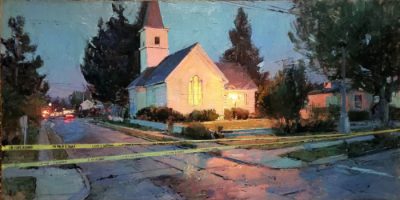
Not long ago I had a dream. I was in a crowded mid-sized town with a soul full of worry and care. It was 2021 after all, plus I had my own personal demons as well, as we all do. The entire town was about the same as I regarding their emotional statenot so completely burdened by concern that we could not function (though a few of us could not, as is always the case). But we were, as a town, tilting towards darkness. The darkness of too much worry about the future, of things getting worse, not better, of the sun setting not rising, of climate catastrophes, of divisions, of personal failures, of broken lives, shattered families, of ruined dreams and institutions, all these things growing not shrinking. And, to top it all off, we all knew (or could know), the intimate details of catastrophes anywhere and everywhere in the wide world, because of the technology we nervously and constantly hold in our hands.

So here we wereliving generally well, yes, mostly not hungry or cold, trying-to-be-happy but still too burdened. We were, yes, so very sad.

It became evident to me that I was very joyful and much enlivened and lightened this particular day of my dreamthe darkness lifting, a peace encircling me as it had not since I was at a family reunion when 10 years old. And it was clearly understood why: simplythe news was that Jesus was in town.

I knew when I saw Him I would fall, collapse really, at His feet and He would know me and throw everything off my weary shoulders. With Him there as the singular object of my adoration and concentration, I would be saved from myself, my worry, my failures, my darkness, my guilt, my pride, my enmity.

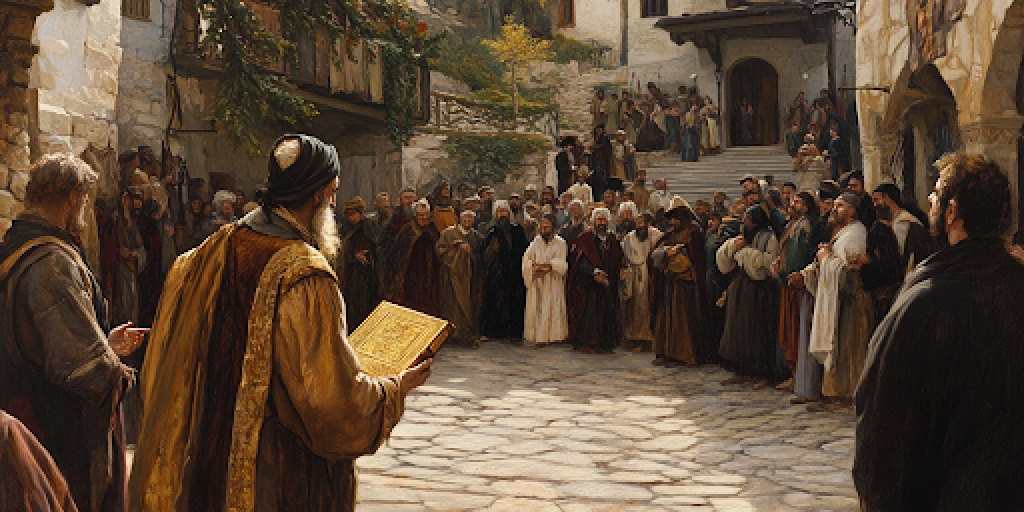
And so I began to hurry through the streets and alleys of the town, excitedly sharing the news so that others wouldn’t have to be sad but could be happyproblems not gone but the soul strong enough to endure them. I would talk to my friends, acquaintances, and strangersin the street, in restaurants where I would sit down with them to eat, at the library, schoolyards, stores, barbershops, but mostly in the streets because I noted that I was in an awful hurry. Just as it had been so obvious to me that anticipating visiting soon with Jesus brought me a lightness and joy now, so it was becoming obvious to everyone with whom I spoke. No arguing, no doubting, no wondering, just elation and joy, for one and all. There was a clarity and ease and believability in the words I spoke, and which were now being spoken by others who had heard. That was new, and it was nice.

I really wanted to tell everyone in the town, and I also wanted to get to Him, to get to the part of town where people were already with Him. I had heard He was on the far side of the town, and I took note. Far away, but not too far.

I also noticed that there were no barriers and no hindrances to talking about Jesus being on the other side of town and encouraging everyone to go see Him. It seemed natural to me and to everyone else. No racial, educational, socio-economic, ethnicity, class, or religious differences inhibited me, or anyone else, as they often do, despite my best efforts, to talk about Jesus. It was, for lack of a better phrase, a free-for-all of happy anticipation most of us felt about going to see Jesus who would somehow release joy to overtake us and our lives.

Towards the end of the day, there came some astonishing news through the grapevine: Jesus was actually not in our town. In fact, He had never been there. This contradicted all that I, and now most of the town’s inhabitants, had been so looking forward to. And yet, strangely enough, it was not heartbreaking. 

This lesson was pressed upon my mind: the dream was about covenants Christ offer us. He does not have to be here; they are enough. 

Part of the message from the angel sent to ancient King Benjamin was this:  “And the Lord God hath sent his holy prophets among all the children of men, to declare these things to every kindred, nation, and tongue, that thereby whosoever should believe that Christ should come, the same might receive remission of their sins, and rejoice with exceedingly great joy, even as though he had already come among them.” (emphasis my own).

As this messenger explained to the good-hearted king, he had been sent to declare this unto him, “that thou mayest rejoice; and that thou mayest declare unto thy people, that they may also be filled with joy.”

And so, what profound gift does Christ offer in 2022 to a weary, hyper-connected, distracted, divided, hungry, homeless, abused, pained, unbelieving, frenetic, addicted, militarized, doubting, sophisticated, materialistic, secular, proud, lonely, traumatized, angry, refugee-engulfed, world? Covenants. His Covenants. His Covenants that He made and that He enlivened and upon which He has laid His hands and that He has connected to the earth and God’s children by angels’ hands. Through these He asks us to do and be holy things, and we promise to so do and to so be, and in the cyclical trying and failing and promising again of it all, peace in Christ can engulf us – the places and people of our broken world. For Christmas 2022 may the attempt at unwrapping and holding close one of these Covenants in Christ be a favorite gift, that you and I both give to others and receive for ourselves.


About the author

Chris Stevenson

Chris Stevenson is the President and Co-Founder of the National Museum of American Religion. He co-founded the Community Levee Association, which champions virtue to the American experiment. He wrote "Letters from an American Husband and Father."
On Key

You Might Also Like

The Supreme Court’s Textualist Temptation

The Supreme Court’s much-anticipated decision in Bostock v Clayton County may in fact tell us more about how courts decide what law is than what law says. It may also serve as an unexpected opportunity for judicial conservatives to move away from textualism and reclaim a more inclusive jurisprudential methodology. For over four decades the legal community has been arguing about first principles for interpreting our laws. In Bostock v Clayton County, a case about LGBTQ rights that the United States Supreme Court will decide this term, the central question involves an interpretation of the federal Civil Rights Act of 1964, which famously bans discrimination based on race, religion, sex, or national origin. The case is important because it will determine whether discrimination based upon “sexual orientation” is covered by the original prohibition in the statute against discrimination on the basis of “sex.” But the case may actually be more important for the ideas used by the court in how we interpret our laws. The case presents what may well become a textbook example of the application of textualism, and its related concept, originalism, to the interpretation of a landmark statute. Thus from the standpoint of how laws are interpreted, the case is fraught with meaning and symbolism.  That argument will take center stage in a highly ironic way. Judicial liberals will be arguing for textualism (typically the conservative position) and conservatives will be arguing for a much more broadly based contextual understanding (usually the liberal position). From my perspective as a judicial conservative, this is an opportunity to restore textualism to its traditional place in jurisprudence, which could also have the added benefit of reducing the tension between textualism and originalism, something that has received too little attention from conservatives. To understand the debate, some brief history is necessary.  Textualism, Orginalism, and the Rise of Judicial Activism For many decades the main complaint of conservatives focused on “judicial activism”—the idea that courts are reading into the language of our laws certain policies that the framers or the legislators did not address. This is typically done by using arguments based upon fairness, equality, and broad readings of the purpose of the language in question. Doing so, conservatives, argued, was to subvert democratic decision-making and turn republican government into rule by the judiciary. This further tends to foreclose the discussion, debate, give and take, and compromise that will address all the related implications of the decision. To deal with their concerns, many judicial conservatives argued for increased reliance on two particular methods of interpretation: originalism and textualism. Textualism focuses on the literal words being interpreted, their grammatical meaning and their dictionary definition, and largely, although not entirely, ignores other considerations if the meaning of the words is thought to be clear. Originalism focuses on the meaning of the words as they were understood at the time, usually in the sense of how they would have been understood by the public. Neither method was new, but various champions of these concepts who emphasized their application (particularly when it came to constitutional questions), rose to prominence. Several of them are now on the United States Supreme Court. The late Justice Antonin Scalia was especially associated with textualism, and current Justice Gorsuch has publicly associated himself with this same approach Scalia favored. Justice Thomas is a devoted originalist; and Justice Alito is sympathetic to both originalism and textualism. On the other hand, the so-called “liberals” on the court are much more in tune with what former Justice William Brennan called “living constitutionalism.” That approach takes the position that many of the provisions of constitutions are intended to have broad and evolving meanings. They are generally in favor of giving preference to judicially developed ideas of fairness, equality, and policy considerations that they believe are appropriate for the current times and circumstances. While not rejecting the ideas of originalism or textualism out of hand, they view the usual application of those concepts as too narrow —insisting that other approaches should be given equal or more weight, depending on the circumstances. In this way, what others might argue is plain, they often find ambiguous. It’s also the case that many of the tools that they would apply are broadly accepted by judicial conservatives and liberals alike, such as looking at the structure and purpose of the law, and related statutes, as well as somewhat more controversial but commonly used methods such as legislative history, or even weighing the consequences of a decision. By contrast, originalism emphasizes the long understood idea that a written constitution by definition was constructed by its framers to have fixed meaning. Constitutions provide for a means of amendment, and that process implicitly confirms that what was not amended should be understood as unchanged. The bedrock idea is that a constitution represents the will of the people, freely adopted by both representation and ratification, and not imposed by any other means. Although statutes can be freely changed by the legislature, originalists insist they should have the meaning that they had when enacted. This straightforward concept is eroded, however, by two hundred years of change, some obvious and some, as the great historian Gibbon would have said “insensible”—happening so gradually and imperceptibly that most hardly even noticed it. Major events like the Civil War and the amendments to the Constitution that it generated, introduced broadened concepts of due process and equal protection to the constitutional text and our way of thinking about laws more generally. The massive economic growth of the country also generated different ways of thinking about commerce, and how the state regulates behavior through a huge administrative process.  Together with these developments, a growing body of legal academics began to emphasize various sophisticated issues, such as the potential elasticity of some of the language of law, arguing that standards such as “cruel and unusual punishment” were intended to have an evolving meaning, not one fixed for all time unless amended. Finally, as judges and scholars have noted for over 150

Subscribe To Our Weekly Newsletter

Stay up to date on the intersection of faith in the public square.

You have Successfully Subscribed!

Pin It on Pinterest

Share This