Painful and terrible things happen every day in our communities and nation. And when we check out the news, we’ve all become accustomed to exploring their circumstances in often lurid detail.
Compared to the appropriate sorrow we might feel when another instance of abuse or violence happens, however, the extent of exquisite detail can draw us into the story—not simply to “mourn with those who mourn”—but to do something very different. There’s no question that when crime is committed, journalists have a responsibility to document the wrongdoing and to provide a public notice. But, often stories about crime are written to fascinate and engrosse us in the details. We are shocked, and, sadly, maybe even entertained?
On August 19, 2019, news broke that Steven Murdock was accused of filming a woman getting changed in a dressing room. He was arrested and arraigned, and last week Murdock pled guilty to the charges.
The filming took place in a suburban, Nashville mall. Because the incident involved such a violation of law and human decency, it’s not just understandable that it made the local news, but that’s precisely the role of journalism to shine a negative light on any such reprehensible behavior.
But one detail, it seems, contributed to this story becoming a national phenomenon, carried by some of the largest news outlets in the country and beyond. Steven Murdock was also a local high councilor for The Church of Jesus Christ of Latter-day Saints.
To get a better sense of how and why this detail drew such attention, looking at four of the articles detailing the story:
- “Mormon local leader charged in dressing room camera incident” from the Associated Press
- “A Mormon leader secretly filmed woman getting changed in an H&M fitting room, police say” from Business Insider
- “Police: Man who filmed woman at dressing room identified as high member of LDS church” the highest search engine ranked local news story.
- “Mormon High Priest Put Creepy Cam Over H&M Changing Room Door: Cops” The highest search engine ranked national story from The Daily Beast.
Murdock’s history of faith undoubtedly makes this story especially sad―here’s a person who should have known better, who publicly espoused high moral standards, but was surreptitiously sought to engage in voyeurism.
This is a problem that needs to be faced seriously. Between 2006 and 2016, there was a 7-fold increase in voyeurism convictions in the UK―one of the countries with the most reliable statistics regarding this issue. When nearly identical stories of voyeurism have been reported on in the U.S. in the last two years, very few ever received national attention. And whether locally or nationally covered over the past eighteen months, none appear to include a single mention of the perpetrator’s religious faith.
In each of the four aforementioned stories, by contrast, Murdock’s membership in the Church is not only mentioned, but mentioned in the headline, the first line of each of the articles, and developed as a significant theme of the story. Titles variously identified the man as a “Mormon leader,” a “Mormon High Priest” or a “high member of LDS church”—with one noting he was a “local Mormon leader.”
It’s understandable that journalists would struggle to grasp the context of the label “high councilor.” The title, afterall, feels lofty, and in an ecclesistical setting does help convey the importance placed on those who serve and shepherd even at the local level. But, in more secular parlance, a member of the high council is perhaps akin to serving on the advisory board of a local non-profit, with no direct ecclesiastical authority. Indeed, there are more than 40,000 high councilors in the Church. And it would be rare for a Church member to know all the high councilors in their own geographic area, let alone in the next city over.
Without that context, it’s easy enough to overemphasize the significance of the man’s religious faith—the first local news piece, for instance, describes Murdock as “a prominent leader” with the Church.
By contrast, Travis Loller’s AP story explains in the first paragraph that Murdock serves as “a local leader.”
It’s worth asking whether putting someone’s religious tradition in the headline is appropriate when they hold a volunteer position of little prominence. Along the same lines, of the 49 total paragraphs in the four articles mentioned above, remarkably 34.6% of them discuss the Church. And while most outlets used an image of Murdock or the location where the incident happened, the Daily Beast curiously chose to feature the Church’s Conference Center in Salt Lake City, Utah—more than 1600 miles away from the incident, as if the Church was somehow involved in the story.
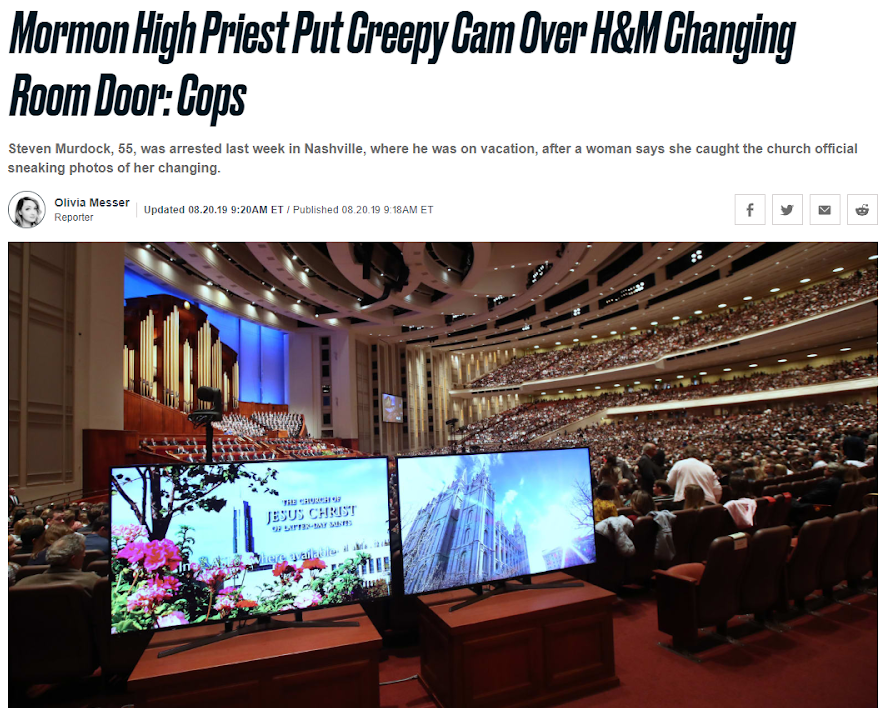
Illustrations of religious hypocrisy surely make for better copy. It’s hard to not recognize that the Daily Beast’s reporting—which was perhaps the most sensational— was rewarded with the most web traffic.
It was Elder Neal A. Maxwell who observed in the mid-1970s (reflecting on his early years working in Washington, D.C.) “I see so much of modern journalism searching for sensation—a search which can be addictive to journalists as well as to audiences.” It seems a better path would be to follow The Society of Professional Journalists code of ethics: “Provide context. Take special care not to misrepresent or oversimplify in promoting, previewing or summarizing a story.”
Religion media watchdogs such as Get Religion’s Terry Mattingly and Religion News Services’ Aysha Khan both called out the attempts at sensationalistic coverage in this story and suggested reframing it as the local news it is.
A more egregious example of this quest to insert a Latter-day Saint angle into any story possible was recently on display from the Associated Press. It read, “The Church of Jesus Christ of Latter-day Saints is forced to confront its history of polygamy after nine women and children from a Mormon offshoot where some practice plural marriage died in a cartel ambush.”
Senator Mike Lee (R-UT) asked about the coverage:
What if the victims had been from a woke, hip neighborhood in Manhattan? Would the AP have described the victims by saying that they lived in a place “where some people don’t believe in God”? That would of course be both weird and wildly inappropriate. And it would never happen.
This kind of focus affects people who belong to the groups reported on in this way. The comments and soclial media reactions to this story read like a greatest hits for jokes about Latter-day Saint polygamy and garments. But the most prominent theme across social media comments about the story is that religious people/leaders in general are hypocrites:
- “The most terrible people disguise themselves with religion so they won’t be questioned.”
- “A religious leader being a hypocrite and a charlatan… well, I never!!”
Still, a vocal minority pushed back, as one woman who said, “This makes me sick that anyone would do this. But I also think it doesn’t matter what religion he is, it’s the act that is so awful. I don’t believe the LDS church, Baptist church, Methodist church or any other church would condone this behavior.”
The sensationalist approach may “win,” but it’s our discourse and understanding that may ultimately suffer.
Of course, it wouldn’t—and doesn’t. Nor do we condone voyeurism. Any such act is rightly met with criminal charges.
The apostle Paul once encouraged the Saints to not “rejoice in iniquity” (1 Cor. 13:6). Rather than gawk at the details, imagine a public conversation centered on compassion for the victim. Instead of reinforcing deep suspicion about people of faith, this could be a conversation that invites reflection and improvement, while absolutely holding perpetrators publicly accountable both in the press and in the legal system.
But, rather than invoking any of this, our cultural tendencies can too often make “peeping Toms” of all of us—reveling in another person’s sin, crimes, escapades or misery. We can and must do better, and it starts with protecting victims, holding perpetrators accountable, and making the pursuit of solutions the most engrossing aspect of the journalistic enterprise.