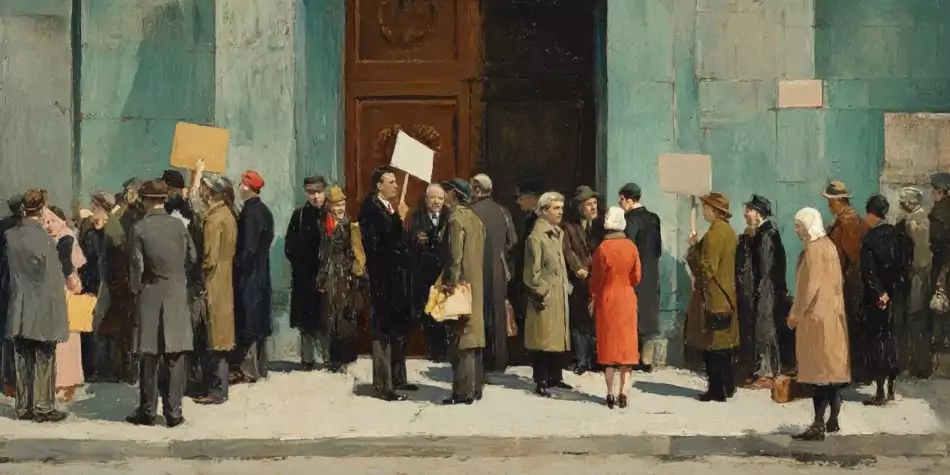
Demonstrators remain outside as worshippers enter, contrasting peaceful dissent with protests in church.

Protest Outside, Worship Inside: A Truce Worth Keeping

Political anger is pushing protests into worship spaces. What happens when the inside-outside line collapses?

Download Print-Friendly Version

On Sunday morning, January 18, 2026, roughly three dozen anti–immigration-enforcement protesters walked into a worship service at Cities Church in St. Paul, Minnesota. Some moved all the way up toward the pulpit while others chanted “ICE out” and “Renée Good,” invoking the woman fatally shot by an ICE officer in Minneapolis.

The protesters’ stated reason for choosing that congregation was personal: multiple outlets reported that one of Cities Church’s pastors, David Easterwood, leads the local ICE field office.

Whatever one thinks about ICE, about the pastor’s role, or about the protesters’ cause, the method matters. There is a moral difference between showing up outside a building to make a public argument and walking into a sanctuary to stop people from worshipping.

Protecting this boundary is more than theater.

Latter-day Saints have a long history with protesters. From religiously motivated protesters outside General Conference and temple dedications, to demonstrations outside temples because of the Church’s position on LGBT+ issues, to the Westboro Baptist Church protesting the funeral of Gordon B. Hinckley, seeing protesters before you worship is something that many Latter-day Saints have learned to experience.

But even those groups whose protests we find offensive have always maintained the line: protest outside, worship inside. 

The inside–outside line is more than mere preference. It’s a recognition that religious spaces matter, and a social agreement that keeps people safe and allows worship to be possible.

This is a bright line that Latter-day Saints understand intuitively and should be willing to stand up for. 

Protecting this boundary is more than theater. Worship spaces have been under attack—including others in Minnesota. Just last summer in Minneapolis, neighboring St. Paul, worshippers were attacked in a mass shooting at the Annunciation Catholic Church during an all-school Mass. And Latter-day Saints, too, have recently experienced violence at places of worship.

When outsiders burst into a place of worship without the intention to worship, the outcome can turn violent. Protesting in places of worship poses all kinds of risks to congregants, who want to protect themselves and their families. Such trespass is simply not safe for any involved, no matter how peacefully the interruption is managed.

Sanctuaries have never been perfectly safe.

“Sanctuary” is a norm we can lose—and once lost, it’s hard to rebuild. Even those who deserve public protest should be allowed to worship in peace, because worship is good for the soul. And if those who most need worship are afraid to go because those places of worship are open to the public and therefore vulnerable, they are less likely to position themselves to receive the moral education that is useful to them. 

To be clear, sanctuaries have never been perfectly safe. Scripture and history are full of sacred spaces violated by violence or contempt.

But the point of a sanctuary is not that nothing bad can happen there. It’s that we collectively agree it shouldn’t—and that agreement restrains the worst impulses in all of us.

Interrupting a worship service is a bad idea regardless of the intent. It inflicts collateral damage on the wrong people. It swaps moral clarity for spectacle. It invites escalation and copycat behavior. It risks legal consequences while muddying constitutional principles. 

It may be tempting for Latter-day Saints to not concern themselves with this violation. After all, the Church has long supported the immigrant community, and its support for constitutional principles likely means it will not be the focus of ire for these protesters. And more largely, Latter-day Saints are not the most natural target for the kind of inside-the-service disruption we saw at Cities Church. Our congregations are politically diverse, our official posture is not partisan, and our public messaging on immigration is neither “open borders” nor “enforcement-only.”

But here’s the sober second thought: we should not assume we’re safe from becoming a target anyway.

We should defend the norm of sanctuary for everyone.

Why? Our compassion is public, our chapels are accessible and welcoming, and counter-protest dynamics are real. If one side decides places of worship are legitimate “pressure points,” the other side will learn that lesson too. And counter-protesters looking for “religions that support immigrants” won’t always make fine distinctions between policy nuance and caricature. This could also invite the same kinds of protests that have traditionally taken place outside or places of worship to consider moving inside.

The U.S. Department of Justice has said it opened an investigation, with officials publicly referencing potential violations of the federal FACE Act, a 1994 law that (among other things) prohibits using force, threat of force, or physical obstruction to injure, intimidate, or interfere with someone “exercising or seeking to exercise” religious freedom at a place of worship—while also clarifying it does not prohibit First Amendment–protected peaceful picketing and demonstration. We believe this is a wise and justifiable instance for utilizing this law, and we encourage law enforcement to take a stand in reinforcing the norms of places of worship as sanctuaries. 

Regardless of where Latter-day Saints as individuals or as a group reside on the political spectrum, weakening norms around chapels as sanctuaries should concern each of us. We should defend the norm of sanctuary for everyone—because once it’s gone, it will be our youth, our converts, and our visitors who suffer alongside those of our neighbors. 
About the author

Public Square Staff

Our core team, including our Editor, Managing Editor, Communications and Media Directors, Visual Display Director and Copy Editor.
On Key

You Might Also Like

How the Loss of Organized Religion is Harming our Youth

Kevin Singer recently wrote an article for Religion Unplugged where he discusses whether spirituality could have anything to do with the mental well-being of our Gen Z population. He shares new research showing a strong connection between religiosity and emotional and mental health well-being. While the percentage of those questioned who consider themselves religious or spiritual is quite high, the number of those who belong to any kind of religion is low.  Could the loss of meaning and community associated with organized religion be partially responsible for our present mental health crisis? Could organized religion be a key component to our well being? And how can church leaders, help the young recognize the mental health benefits of ongoing faithfulness?

What Sex Really Is + Today’s Digest

Our daily rundown of the articles from around the web that we feel our readers would enjoy and appreciate. We hope to highlight the best of what’s around. Public Square Bulletin recommends: What Sex Really Is Aubrey Pollnow—First Things The latest from First Things is remarkable for two reasons. First, it explores implicature and the lengths Amia Srinivasan goes to in her most recent book to avoid being seen talking to the wrong people. Second, it provides a pithy but complete defense of a traditional sexual ethic. Tibet: No Religion Allowed in Social Media Short Videos and Webcasts Lopsang Gurung—Bitter Winter China has set new regulations for social media use in Tibet. Videos shared there cannot mention religion. The rules around this regulation are ambiguous, and enforcement remains to be seen, but this should spark major concerns for any religious freedom advocates. Is “Be True to Yourself” Good Advice? Brian S. Rosner—Crossway Rosner answers the title’s question by basically saying it depends on how you define “yourself.” And then spends the bulk of the article look at the new and sometimes problematic approaches to defining the self that have become socially dominant. The recent prophetic focus on identity from Russell M. Nelson suggests this kind of analysis may be helpful. What is the Church? Chad Nielsen—Times & Seasons An exploration of the remarks most meaningful to the author from general conference, Chad Nielsen examines Reyna Aburto’s talk, tying it into the larger picture of her ministry and earlier remarks. Pro-Abortion Rights Protesters Hit Catholic Churches: Why You Didn’t Read About It Clemente Lisi—Get Religion In the wake of a leaked Supreme Court ruling implication abortion, many have chosen to channel their frustration with hateful and bigoted acts targeted at Catholic churches, including in some cases vandalism and theft. But this story was largely missing from the popular press. The essential religion in media critics at Get Religion have an insightful answer.