
About a year ago, I wrote an article titled “Like Eve and Mary: The Story of Motherhood.” It explored the archetypal relationship between mothers and God. The response was generous and encouraging—but one question kept returning: What is the story of fatherhood?
I was determined to discover the answer. Yet it did not come to me as clearly as the Story of Motherhood had. Oddly, I found it difficult to locate direct communication between God and men in the Bible. Much of what we learn is conveyed through narrative rather than dialogue. Even in places where one might expect patriarchal communication—such as the prophetic era of Isaac—scriptures focus more on Rebekah. The Story of Fatherhood did not seem to announce itself as naturally or visibly as the Story of Motherhood.
Then it became obvious to me.
At least for me, one profound way of reading scripture had come into view: The Bible from beginning to end tells the story of fatherhood.
Our calling is not to withhold ourselves from our children, but to remain present, while accepting the real cost of loving them.
It is the literal account of a Heavenly Father’s dealings with His children. There are too many instances to reduce to a single thesis or dialogue. Christ is our Exemplar—the perfect Child of God. We strive to become like Him so that we may one day become like the Father. It follows, then, that the Story of Fatherhood can be told best through Christ’s relationship with the Father; archetypically symbolic of our longed-for relationship with God, and archetypically instructive for every man striving to live his own story of fatherhood.
Strikingly, the defining moments of that relationship are not spoken. They are not marked by what the Father says, but rather by what He does not say.
In fact, the Story of Fatherhood is told, in some of its most piercing moments, through the Father’s silence.
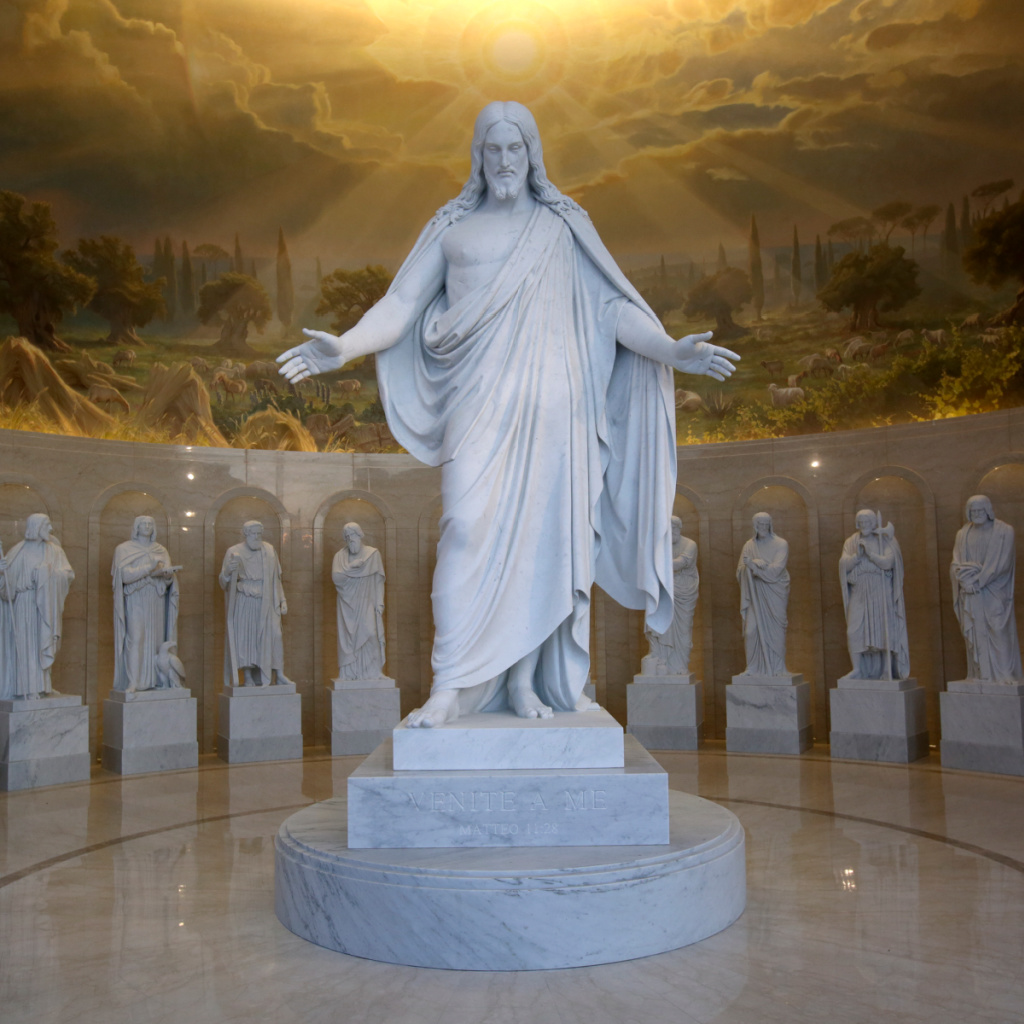
The first such moment unfolds in the Garden of Gethsemane, on the night before the crucifixion. Christ, crushed beneath the weight of the world’s suffering, cries out: “Abba, Father, all things are possible unto thee; take away this cup from me…” The second is similar. While on the cross, He gives voice to another agonizing plea: “My God, my God, why hast thou forsaken me?”
In both moments, Heaven is silent.
That silence—that salvific silence—is not abandonment. Our calling is not to withhold ourselves from our children, but to remain present, while accepting the real cost of loving them well. Silence, in these moments, does not equate to absence. It is restraint. It is submission. It is love that refuses the immediate in pursuit of the eternal.
As Christians, we rightly speak often of the sacrifice of the Son. Far less do we dwell on the sacrifice of the Father. What must it have been like for Him to hear the cries of His perfect Son and do nothing? This silence is not evidence of cruelty, distance, or apathy. It is evidence of love: a love so grand and pure, one willing to forgo the rescue of one in order to secure the redemption of many.
The Father certainly desired to let that cup pass—or so I can only imagine—but He chose not to. Why? Because the salvation of His children hung in the balance. Few have captured the cost of that choice more vividly and more strikingly than Elder Melvin J. Ballard, a mid-century apostle of The Church of Jesus Christ of Latter-day Saints:
In that hour I think I can see our dear Father behind the veil looking upon these dying struggles until even He could not endure it any longer; and, like the mother who bids farewell to her dying child, has to be taken out of the room so as not to look upon the last struggles, so He bowed His head and hid in some part of His universe, His great heart almost breaking for the love that He had for His Son. Oh, in that moment when He might have saved His Son, I thank Him and praise Him that He did not fail us, for He had not only the love of His Son in mind, but He also had love for us. I rejoice that He did not interfere, and that His love for us made it possible for Him to endure to look upon the sufferings of His Son and give Him finally to us, our Savior and our Redeemer. Without Him, without His sacrifice, we would have remained, and we would never have come glorified into His presence. And so this is what it cost, in part, for our Father in Heaven to give the gift of His Son unto men.
“For God so loved the world that He gave His Only Begotten Son.” We read those words often, yet too rarely with any appreciation for the gravity of what was given—or what it cost the Father to give it.
While this vastly oversimplifies, if the Story of Motherhood is one of celestial submission, then the Story of Fatherhood is one of celestial sacrifice.
What, then, are fathers asked to sacrifice?
The word sacrifice comes from the Latin sacer (sacred) and facere (to make): to make sacred. In its holiest form, sacrifice is the laying down of one’s life for another, as Christ did for us. Few of us will ever be asked to do that. Many of us, I would think, would be willing if we were.
I am a father. I would die for my children and for my wife.
But is that what is being asked of me?
There is a song by The Hunts titled “Please Let It Go,” in which one line confesses, “I was willing to die but I wouldn’t kneel.” Those lyrics haunt me, cut me to my core, each time I hear them. They are painfully true. I am willing to die—but am I willing to surrender my temper when it wounds the ones who matter the absolute most to me? I am willing to die—but am I willing to give up my vices for the sake of my marriage? I am willing to make the ultimate sacrifice, pay the ultimate price, as some would put it. But does that mean anything when I hesitate to make the necessary one today?
I have spent my entire professional career working with men who have been incarcerated. There is one central theme I see repeatedly: father wounds. Again and again, I meet men who grew up without the steady sacrifice children need from their fathers. Luckily, I did not grow up that way.
I had a father who was willing to sacrifice.
I saw it most clearly the day my father was going through his deepest, darkest moment. In the midst of awaiting news that would change his life forever, I saw him writing. He was writing letters—to me and my siblings. In the moment his future hung in the balance, he was thinking only of ours. In the letter to me, he wrote:
Son, please don’t let all this mess drag you down… We have the gospel, priesthood, and Spirit in our home. In the big picture of things, we both know this stuff just doesn’t matter. What does matter? Your relationship with your Father in Heaven. Your relationship with Jesus Christ. Your relationship with your family. Does anything else really matter?
I am a father now. I have two wonderful children. I am writing my own Story of Fatherhood, and I can only hope I am doing it well.
About a year ago, my wife, my children, and I were at the lake with some friends. Lost in conversation, my wife and I unfortunately failed to watch our children as closely as we should have. I noticed my six-year-old son drifting farther from shore. He could swim—but not well enough for where he was headed.
Not wanting to overreact, I watched.
Too long.
Then he began to struggle. He went under. When his head broke the surface again, a single word rang across the water—one I will never forget.
“DADA!”
Nothing would have kept me from reaching my son that day.
He disappeared beneath the water again.
I was far away, but already running. I hit the sand, dove into the murky water, and searched blindly, prayer pounding in my chest. I reached where I had last seen him.
Nothing.
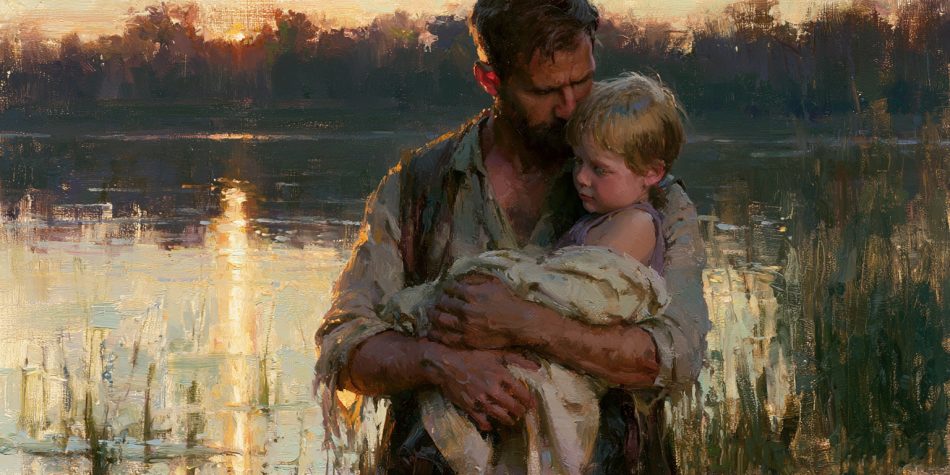
Then I saw small hands grabbing at a nearby paddleboard. I grabbed the hands and pulled with everything I had left. My son was in my arms—but my work was not yet finished. I kicked to shore, lifted him over my arm, and smacked his back until he coughed and was breathing again.
I looked at my son, and he met my gaze with tear-filled eyes. He whispered, “Dada, why did you leave me?”
I could not answer. I just held him.
“I never left,” I finally said through tears. “I was watching the whole time. I am so sorry I could not get there sooner.”
I am not a perfect father. But there is one thing I do know: there is nothing—no, nothing—that would have kept me from reaching my son that day.
And that knowledge always leaves me wondering.
How did the Father—perfect in all His being—show such restraint when His own Son, suffering, cried out, “Abba,” “Papa,” or even, “Dada?”