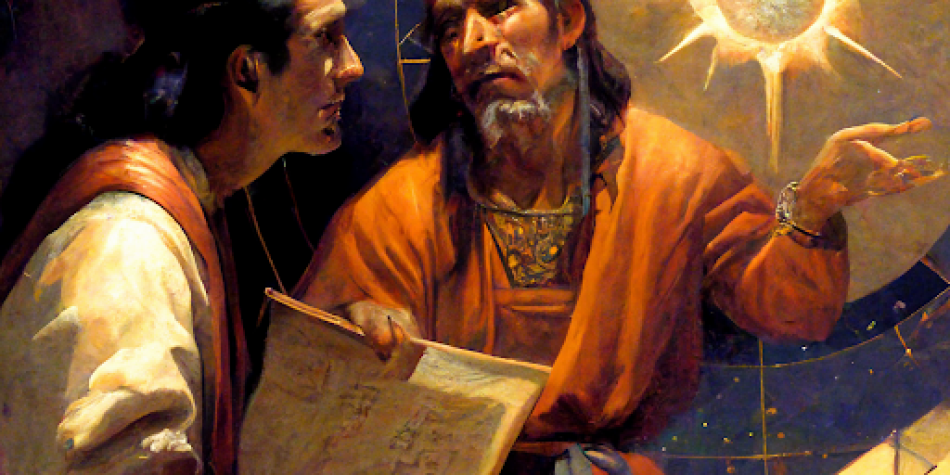
Alma 32, a chapter in the Book of Mormon, offers a profound exploration of faith, knowledge, and their relationship. However, the message of this chapter is often oversimplified, as readers isolate it from the historical context. Alma delivers his discourse on faith and knowledge in the aftermath of a heated debate with Korihor, an anti-Christ who questioned the existence of God and dismissed the idea of faith. Through the encounter with Korihor, Alma grapples with the question of what it means to know and how faith plays a crucial role in our quest for knowledge.
As we delve into the teachings of Alma 32, we discover a fascinating interplay between sensory experience, human reasoning, and trust-based understanding of faith. This chapter is not only a treasure of religious philosophy but also a valuable source of insights for anyone who seeks to deepen their understanding of faith and knowledge. Trust is required to know anything.
All things denote there is a God; yea, even the earth, and all things that are upon the face of it, yea, and its motion, yea, and also all the planets which move in their regular form do witness that there is a Supreme Creator.
Alma looked around and saw God everywhere; Korihor looked around and saw God nowhere.
Different ways of knowing. I would not be surprised if his exchange with Korihor weighed heavily on Alma when he was teaching what now shows up in chapter 32.
Take, for example:
Yea, there are many (like Korihor) who do say: If thou wilt show unto us a sign from heaven, then we shall know of a surety; then we shall believe. Now I ask, is this faith? Behold, I say unto you, Nay; for if a man knoweth a thing he hath no cause to believe, for he knoweth it.
Faith is not the opposite of knowledge. Instead, Alma distinguishes between two forms of knowledge: one based solely on sensory experience and reason and the other based on a combination of these with a trust-based understanding of faith. The latter leads to perfect knowledge. All knowledge-seeking methods require faith. But this is not always obvious.
The trust required to know anything. We have a strong enlightenment tradition of relying on senses and reason, so it doesn’t occur to us that we are employing faith when we assume our senses provide us accurate information and our reasoning is sound. While colloquially, faith means belief in something we can’t know, those with religious faith define it more closely as a form of trust.
Let’s return to the example of the thirsty man in the desert from the first essay in this series. He sees a pool of water, yet he also rationally knows that it could be a mirage. He must decide which form of knowledge to trust. In other words, he must put his faith in either his senses or his reason. His senses cannot prove that what he sees is real, just as his reason cannot prove that it isn’t reality. He simply has to choose to have faith in one or the other.
When Alma discusses knowledge, then, it’s not defined merely by reason or senses but as both combined with the faith that enables them. And when he says, “faith is not to have a perfect knowledge,” he uses the New Testament sense of perfect meaning complete. So he does not mean that faith is not to have knowledge free from error, but rather he means that faith is not complete knowledge, recognizing the way it acts with senses and reason that he expounds in his chapter thirty-two discourse.
Faithful action, faithful growing. Alma expounds on the idea that faith is an essential ingredient in knowledge because it enables our use of senses and reason. Starting in verse 28, Alma uses the analogy of a seed growing into a tree to explain how faith starts as mere belief but grows through nurturing and faithful action. Although the seed initially enlarges our soul and enlightens our understanding, it is not until we continue to care for it and act upon our beliefs that our faith can grow into perfect knowledge.
According to David A. Bednar, “faith grows out of and builds upon belief, producing action … [and] evidenced in deeds.” By acting and nurturing the seed planted in our hearts, we can experience the growth of our faith from mere belief into perfect knowledge. This creates the sensory experience that then, combined with our rationality and our faith, work together to provide whole, complete, perfect knowledge.
Alma points out that our knowledge is only perfect “in that thing,” meaning that it is both complete and not complete at the same time. It is complete in the sense of being sure and reliable, but it is not complete in the sense of coming to an end. There is always more to know. The seed still needs to grow into a tree from which we can enjoy the fruit.
Even after we have plucked and feasted upon this fruit, our knowledge and faith are still not at an end. A fully grown, fruit-producing tree still continues to grow and produce fruit year after year. And what other kind of knowledge could it be, considering our divine natures? As Dr. Richard Williams puts it:
As children of the eternal God, with a destiny described as “eternal progression,” what might we expect but a perfect knowledge that continues, a knowing that is a way of life—we might say eternal life—the rewards of which are fruit “most precious, … sweet above all that is sweet.”
Trusting in truth embodied. All of this only works, however, if we put our faith and trust in the right thing. And what is that? Following Alma’s message, Amulek explains the answer to this question to the Zoramites, saying:
The great question which is in your minds is whether the word be in the Son of God, or whether there shall be no Christ. (emphasis added)
Amulek explains that faith, in order for it to work, is always and must be centered on Christ. Faith gives us knowledge of the thing, or rather, the person, that our faith is in: Jesus Christ. Faith enables our use of senses and reason.”
In my experience, as we strive to follow our Savior, our knowledge of Him will continue to grow even as what we now possess will become more certain in our minds and in our hearts. We can all “taste the light” again and again and again.
As we conclude our exploration of the relationship between knowledge and faith, we recognize that they are not opposing forces but rather complementary aspects of our quest for truth. Alma teaches us that faith is not the absence of knowledge but rather a trust-based understanding of reality that enables us to grow in knowledge and understanding. By having faith lead out supported by sensory experience and human reasoning, we can attain complete and reliable knowledge that is constantly evolving and deepening. Alma’s teachings challenge us to examine our preconceived notions of knowledge and to acknowledge the importance of faith in shaping our understanding of the world around us. The lessons of Alma 32 have implications not only for religious philosophy but also for our everyday lives as we navigate a world that often challenges our perceptions and tests our faith.