visitation-1 (1)

Why Jesus As An Unborn Baby Matters

We don’t often speak of the short period when Jesus was an unborn baby Himself. Maybe we should?
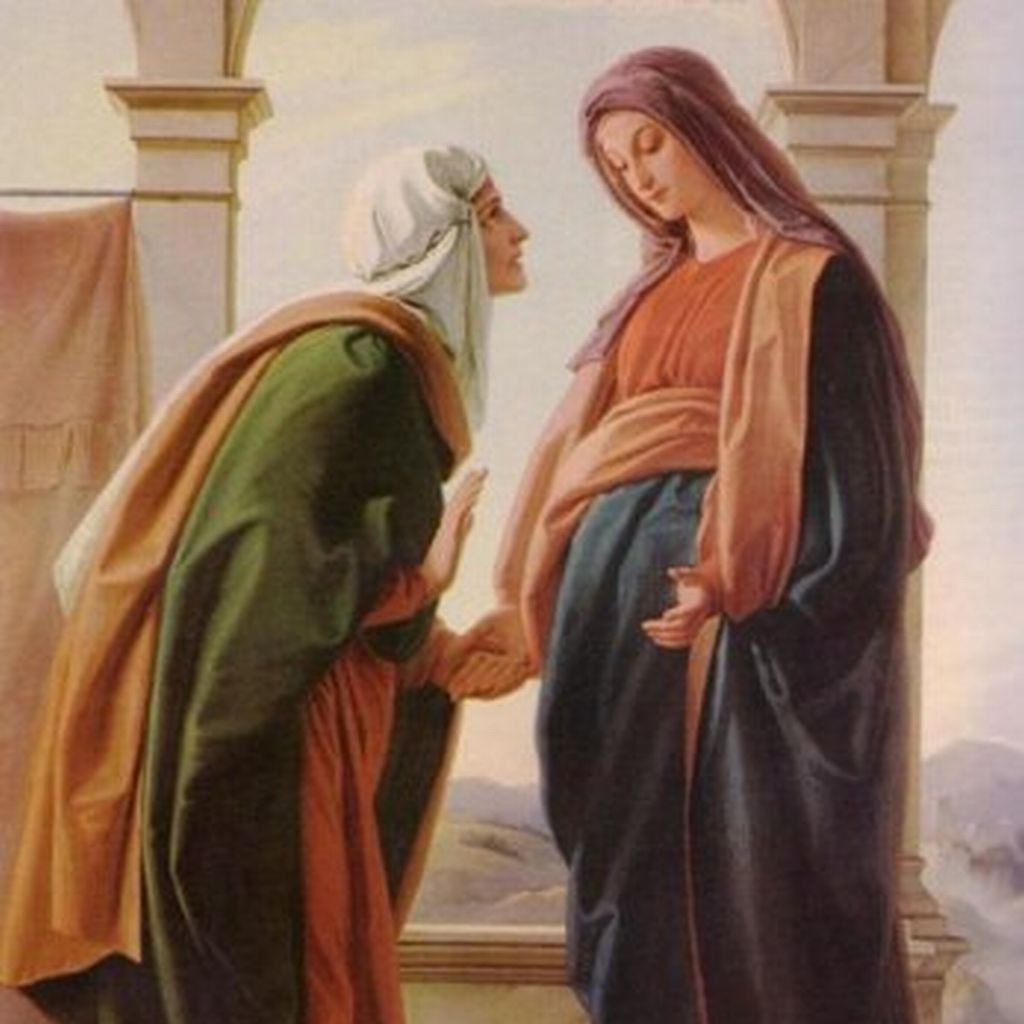
Mary visits Elizabeth (Artist Unknown)


Originally published Dec 22, 2020, at TheFamilyProclamation.org as “Why Seeing Christ as an Unborn Baby Will Change Your Christmas Forever”

Before the manger. Before the star. Before the shepherds. There was a mother and her unborn baby.

On a day that would not only change her life but the lives of countless others throughout eternity, Mary learns that she is chosen by God to be mother to the Savior of the world. After faithfully accepting the most important call in human history, she conceives through the power of the Holy Ghost (Luke 1:35).

The angel also tells her that her cousin Elisabeth is miraculously expecting a baby and is “in her sixth month” of pregnancy (Luke 1:36). And in haste, Mary prepares for a trip to the hill country of Judea to visit this older cousin Elisabeth—the one person in the world who would understand and the one person who God had prepared to help her. The Greek translation of the word “haste” or “speed” is spoudē, which also means “diligence,” “eagerness,” and “earnestness.”

This tiny, unborn baby knew he was in the presence of the Messiah.

Biblical scholars estimate that Mary was in her first trimester at this point, while Elisabeth was nearing the end of her second trimester. It is no wonder, then, that young Mary’s heart is filled with diligence, her mind with eagerness, and her eyes with earnestness toward the future as she travels the 100 miles to Ein Karem on the outskirts of Jerusalem.

An unborn baby leaping for joy. At the end of this faith-filled journey, Mary goes to the door of Elisabeth’s home and calls out to her. What happens next is remarkable:

And it came to pass, that, when Elisabeth heard the salutation of Mary, the babe leaped in her womb; and Elisabeth was filled with the Holy Ghost: And she spake out with a loud voice, and said, Blessed art thou among women, and blessed is the fruit of thy womb. And whence is this to me, that the mother of my Lord should come to me? For, lo, as soon as the voice of thy salutation sounded in mine ears, the babe leaped in my womb for joy (Luke 1:41-44).

We often speak of this element of the story in passing.  But, think of the significance: the baby in Elizabeth’s womb leapt for joy when he heard the voice of the mother carrying the Christ-child. This tiny, unborn baby knew he was in the presence of the Messiah.

Throughout this chapter, these remarkable women testify about the divinity and mission of the babies they were carrying, as they embarked on a journey with a story unlike any other. 

‘Before I formed thee … I knew thee.’ Dr. Betsy Barber, associate professor of psychology at Biola University, shares the following insight about this joyful response:

Jesus and his cousin, John, … are yet both clearly present as themselves. Baby John the Baptist is leaping for joy in his mother’s womb at the presence of the Lord, whom he will follow and die for. Here we see the apostle already established as a person by God and recognized by his parents, acting with intention: “leaping for joy” inside of his mother. And Jesus the Messiah is established as himself, too, with Elizabeth calling Mary “the mother of my Lord.” 

“Established as a person”…”leaping for joy.” The implications of these passages in Luke for important issues we are grappling with in society today are powerful. But there are many more that teach us this same truth:

  • “Before I formed thee in the belly I knew thee; and before thou camest forth out of the womb I sanctified thee” (Jer. 1:5).
  • “For I know the plans I have for you,” declares the Lord, “plans to prosper you and not to harm you, plans to give you hope and a future” (Jer. 29:11).
  • “The Lord … made thee, and formed thee from the womb, which will help thee. … He that formed thee from the womb, I am the Lord that maketh all things” (Isa. 44:2, 24).
  • “For you were created in my inmost being; You knit me together in my mother’s womb. I praise you because I am fearfully and wonderfully made; Your works are wonderful, I know that full well. My frame was not hidden from you when I was made in the secret place, when I was woven together in the depths of the earth. Your eyes saw my unformed body, all the days ordained for me were written in your book before one of them came to be” (Psalm 139:13-16).
  • “Did not he that made me in the womb make him? And did not one fashion us in the womb?” (Job 31:15).
  • “John [was] filled with the Holy Ghost from his mother’s womb” (D&C 84:27).

Seeing the Savior like never before this Christmas. These scriptures can teach us so much. Mary knew she was carrying her Savior even before He was born. The tiny baby in Elisabeth’s womb (John) knew His Savior even before He was born. And how about us? 

If these ancient icons had this awareness before they even knew the Lord in the flesh, can we as well? When was the last time you felt His presence? Would we know Him if He were close by?

Every Christmas, believers all over the world lovingly worship Christ as a baby born in Bethlehem. Yet, perhaps there’s even more to discover. Maybe it’s time to see the story of the unborn Christ-child as an extended part of the Christmas story.

After a period of years that has been tumultuous like no other, may we relish now this season of joy and see Him differently. If even an unborn baby felt joy when he was in the presence of his Messiah, maybe we too can feel joy any time we bring ourselves into the presence of the Savior.

As we sit down with our families this Christmas Eve, consider making this a new tradition: adding Mary and Elisabeth’s remarkable experiences in Luke Chapter 1 to our reading of the Christmas story in Luke Chapter 2. In different ways, perhaps imagining our Savior as an unborn baby can change the way we view Him as a newborn baby this Christmas.


About the author

Angela Fallentine

Angela Fallentine is a policy advisor and research analyst on the family at the United Nations. She previously received a master’s degree from Harvard University, where her public policy research focused on strengthening families in humanitarian settings in the Middle East.
On Key

You Might Also Like

Is it Time for Latter-day Saints to Support Same-Sex Marriage?

I wanted to thank Blair Hodges for calling attention to an article we ran earlier this year by Professor Robert P. George.  Blair has been a frequent critic of the magazine, and we appreciate his engagement and efforts in drawing attention to the work we’re doing. As one of the pre-eminent political philosophers working today, Professor George’s decision to publish with us was a major sign of legitimacy.  Hodge’s article was, in many ways, perceptive. He noticed that Professor George, and by extension, many of our editors here, is concerned that many people, especially religious people, struggle to justify their beliefs about family, marriage, and sexuality through anything other than appeals to religious authority. (We kindly disagree that these positions are anti-LGBT+ as Blair describes them.) And he’s right about that motivation. Church leaders have been very clear about the doctrine of the family for more than a generation, as we highlighted earlier this year. But where the cultural messaging on sexuality is so dominant, it’s easy for Latter-day Saints to feel overwhelmed and struggle to explain to others why they accept what prophet leaders of the Church of Jesus Christ teach what they do.   And Hodges is right that we hope to make a difference in this regard with our work. But otherwise, his article falls into the same traps of many before him that George and others have largely dealt with. Conflating “Hyper-Individualism” with “Expressive-Individualism” Hodges attempts to address George’s concern with individualism. But he makes a category error. Individualism, as Hodges uses it, seems to be a synonym for selfish. Individualism, as George uses it, means how we define the individual. These are two substantially different concepts. On this basis, Hodges raises concerns about hyper-individualism (hyper-selfish)—pointing out this issue is no more relevant to LGBT+ issues than to anyone else. That’s a fine argument to make, but it really has nothing to do with the point George makes. His point being, how we define the individual is of crucial importance to issues of sexuality. Because today the predominant cultural approach to defining the self is expressive individualism. Expressive individualism is a philosophy that holds that who we are is defined by what we feel we are at our psychological core. And that the greatest good is expressing that psychological core to the world, including through our behavior.  As described by Carl Trueman in his recent book The Rise and Triumph of the Modern Self, this idea has its roots in the work of Romantic philosophers like Jean-Jaques Rousseau and like-minded poets, literary figures, and artists of the 18th and 19th centuries, but largely took off in the 1960s at the beginning of the sexual revolution. Expressive individualism has substantially become our culture’s default approach to defining identity. But many Christians push back on this idea as we choose to make our central identities based on a different foundation.  As articulated by President Nelson in a recent devotional for young adults, he explained that the three identities we should prioritize (and not allow to be obscured) are 1) Child of God 2) Child of the Covenant 3) Disciple of Christ As Latter-day Saints, then, we choose to make those our central identities and base our choices on that foundation.  Hodges also suspects that “queerness would be less ‘central’ to a person’s identity the less social pressure and regulation they’d face about it.”  But what does Hodges mean by less central? If identity powerfully influences the choices we make, then the less central an identity, the less influence it has over our choices. These choices include why, how, when, and with whom someone has sexual relations. Prioritizing disciple of Christ and child of the covenant as identities, as Russell M. Nelson suggests, would lead to different choices about sex than prioritizing sexuality as identity. Love and Disagreement One of Hodges’ main requests is that George “spent more time saying how a person can be loving towards someone while also condemning an important part of their identity.” In our view, this is a tired argument in an already wearisome conversation. Sexuality is not an inevitably central part of identity.  Our editorial team falls across the political spectrum. In each of our lives, we have people who love us despite having serious concerns with that political part of our identity.  Our editorial team are all Latter-day Saints. In each of our lives, we have people who love us despite harboring serious questions about the important religious part of our identity. We’ve also felt loved by people who thought it was a dangerous and outdated idea not to have sex until marriage, constituting an important part of all our sexual identities. But Hodges’ argument suggests it’s somehow impossible to love someone while having honest concerns about how they prioritize the sexual part of their identity.  But of course, it’s not. Not only is it possible, but Christian believers are under clear command to love those we disagree with.  It’s those who demand “you can’t love me unless you agree with my paradigm for identity” that are preaching an extreme and radically alternative  approach to tolerance in a pluralistic society, not those who say, “I love you, but I disagree.” That has been the durable default of pluralistic tolerance that has helped make our diverse nation possible. Race and Sexuality Blair also goes to the old tired well of comparing race and sexuality. This is a comparison that many civil rights activists have rejected.  Dr. Alveda King, Martin Luther King Jr.’s niece, and William Avon Keen, president of the Southern Christian Leadership Conference of Virginia, the organization Martin Luther King Jr. started, have rejected the connection between sexuality and race in civil rights.  In fact, George takes on Blair’s point at length in his article in Harvard’s Journal of Law and Public Policy: Revisionists today miss this central question—what is marriage? when they equate traditional marriage laws with laws banning interracial marriage. … But the analogy fails: antimiscegenation was about whom to