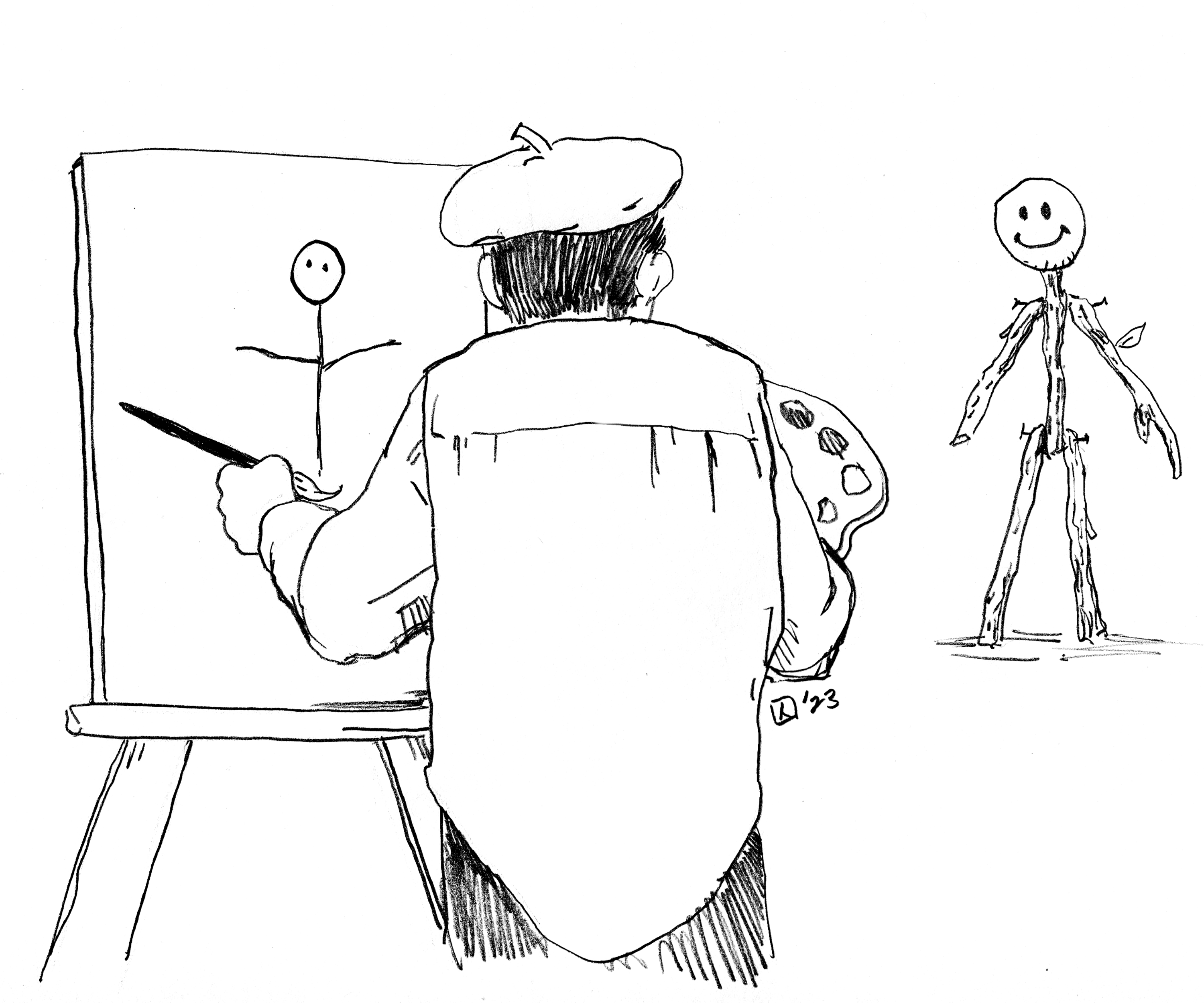
A teacher offers marigolds while hiding a Bible, symbolizing niceness vs kindness in gospel instruction.

An Inconvenient Truth and The Rise of Latter-day Niceness

When does discipleship lose conviction, courage, and clarity? When "niceness" is modeled for comfort and approval.

Download Print-Friendly Version

In the early years of gospel formation, Latter-day Saint parents and Primary leaders tend not to talk about the Wrath of God and instead focus on the positive and loving attributes of Christ described in the New Testament.  The ultimate goal is to become like Jesus. We often hear the phrase ‘Be Christlike’ and sing songs like “I’m trying to be like Jesus” and “I know Heavenly Father Loves Me.”   Children are taught to be kind, loving, gentle, meek, nice, charitable, and peacemakers. All of these attributes are essential, but incomplete.

The God of the Old Testament is Jesus Christ. In those scriptures, we see a God who follows through on consequences and values justice: the flood destroyed many, Sodom and Gomorrah were demolished, and the Israelites took 40 years to reach the promised land. In each of these stories, the consequences were a direct result of sinful choices. The God of Abraham is a God of covenants, who required His children to keep His commandments. I have heard many people state that they don’t like the God of the Old Testament because He seems too mean. It’s ironic when He’s described as not being “Christlike.”

Kindness is not the absence of conflict—it is the presence of integrity.

A deeper study of the New Testament highlights the importance of keeping commandments, but no one seems to quote those scriptures. I once saw a popular Latter-day Saint influencer send out a newsletter and declare that throughout her faith journey to learn about Christ, she would only read the four Gospels. Nothing before His birth, nothing after His death. Not even the Christ Paul testified of—a Christ who delivers justice; many don’t like to see that part of our Savior. I could see her intent to stay close to Christ, but my heart ached for narrowing down the King of Kings to just a “teddy bear Jesus” like the kind described in Elder Holland’s 2014 talk, “comfortable, smooth gods … who pat us on the head, make us giggle, then tell us to run along and pick marigolds.”

In contemporary culture—and even within Latter-day Saint communities—there is growing pressure to be “nice” at all costs.  Unfortunately, this is happening in our wards too. I heard from one follower: 

One of the trends I’ve noticed is that our ward is increasingly becoming more divided due to new move-ins in the past couple of years who have brought an uneasy spirit into the ward. The underlying issue? No one wants to discuss hard topics for fear of possibly ‘offending’ others. Sigh. We are definitely living in the last days!

Perhaps we avoid difficult conversations, downplay doctrine, and hesitate to stand for truth because it might create discomfort. But is that Christlike? Or have we confused true kindness with mere politeness?

Perhaps we have also avoided teaching lessons about God’s justice: the moments when Christ rebuked hypocrisy or the times He boldly stood for truth despite opposition. While these stories might seem to contradict the loving Jesus we eagerly teach our children, could leaving them out unintentionally create an incomplete picture of discipleship—one that equates being Christlike with never making anyone uncomfortable?

Christ Was Kind, Not Merely Nice

If Jesus had only been “nice,” meaning primarily concerned about not causing discomfort to others, the Pharisees probably would have loved Him.  Perhaps they would not have sought His crucifixion. But His kindness—which calls people to repentance—made people uncomfortable.  Here are a few examples from Christ in the New Testament demonstrating this balance:

  • Niceness would have ignored the woman at the well to avoid religious conflict. Kindness engaged her in truth, helping her recognize her spiritual need (John 4:7-26).
  • Niceness would have let the rich young ruler walk away happy. Kindness told him the truth—that he lacked something, even if it was hard to hear (Mark 10:17-22).
  • Niceness would have kept quiet before Pilate. Kindness bore testimony, even when it led to His crucifixion (John 18:37).

Clearly, kindness is not the absence of conflict—it is the presence of integrity.

Why Niceness is a Counterfeit Virtue

Many church members today may feel an increasing pressure to be nice rather than truthful. This shift reflects cultural trends, not gospel principles. Psychologist Jordan Peterson points out that “niceness” is often a socially enforced behavior, not a moral virtue. In contrast, kindness requires moral courage—the ability to do what is right even when it is hard socially. Psychologist Dr. Harriet Lerner describes this in her book The Dance of Connection:

Niceness is concerned with not upsetting others, even at the cost of honesty. True kindness is the ability to speak with clarity and care, even when the truth is hard to hear.

This distinction is critical in discipleship. The Savior was not simply “nice”—He was good. The difference? Goodness is rooted in truth. 

If we prioritize niceness over kindness, three common dangers arise:

1. Niceness Encourages Silence, Not Strength

Many hesitate to share their testimony of eternal truths—especially about family, gender, and discipleship—because they don’t want to offend. Elder Dallin H. Oaks, quoting Hugh Nibley, clarified, “You have to be willing to offend here, you have to be willing to take the risk. That’s where the faith comes in … Our commitment is supposed to be a test, it’s supposed to be hard, it’s supposed to be impractical in the terms of this world.” Truth spoken with love may still offend, but it is redemptive.

One sister shared with me,

I once hesitated to correct a Relief Society discussion that veered into personal opinions rather than doctrine. I worried that addressing it might seem unkind. But as I gently guided the conversation back to scripture and prophetic teachings, the Spirit in the room shifted. One sister later thanked me, saying she had been confused about the topic and appreciated the clarity. That experience taught me that truth delivered with love blesses rather than wounds.

Similarly, we’ve all been in situations where the desire for niceness overshadows the need for truth. For example, in one Relief Society class, a teacher started the lesson by asking, “What conference messages from the last conference did you find troubling? What didn’t you agree with?” Especially in this context, the question felt more divisive than enlightening, as it seemed to put personal opinion before the gospel message.

2. Niceness Seeks Social Approval, Not Divine Approval

Niceness is externally motivated—we want people to like us. Kindness is internally motivated—we want to follow Christ. The Pharisees were obsessed with appearing righteous (Matthew 23:5), yet Christ called them out for missing the heart of the gospel. Likewise, we are seeing the rise of a form of Christianity where doctrine is softened to fit social trends both within and outside The Church of Jesus Christ of Latter-day Saints. This isn’t kindness—it’s spiritual abandonment. We have ample illustrations from church history and contemporary church leaders of how to express truth kindly yet with clarity.  Some examples include the Church’s statements on  the Respect for Marriage Act, as well as the Church’s position on  abortion.

3. Niceness Avoids Truth, Kindness Applies Truth with Love

Kindness does not mean weaponizing truth or being harsh: it means speaking with both clarity and care. Elder Jeffrey R. Holland put it best: “Defend your beliefs with courtesy and compassion, but defend them.”

One of the best examples I’ve seen came during a Relief Society lesson about the temple garment. Before studying the General Conference talk, the teacher boldly started her lesson, saying we were not here to get contentious about our different opinions regarding the temple garment. “We are here to discuss the words and teachings of our General Conference speakers and to follow the guidance from the prophets.” This is the job of a Relief Society teacher. This is the format that we should have in our Sunday discussions.

A Call to Kindness

Niceness will never change the world. But kindness—which is grounded in truth—will. President Russell M. Nelson has repeatedly emphasized that true discipleship requires both love and loyalty to God’s laws. Kindness is not about keeping the peace at the expense of the truth. It is about speaking truth in a way that invites peace, that invites Christ. As disciples of Jesus Christ, we are called to be “peacemakers” (Matthew 5:9)—not by avoiding truth, but by sharing it with compassion and courage.


About the author

Priscilla Davis

Priscilla Davis is a certified brain health and family life coach, and social media creator @SheSharesGoodness. She helps moms and their youth build emotional resilience through Christ-centered principles.
On Key

You Might Also Like

The Supreme Court’s Textualist Temptation

The Supreme Court’s much-anticipated decision in Bostock v Clayton County may in fact tell us more about how courts decide what law is than what law says. It may also serve as an unexpected opportunity for judicial conservatives to move away from textualism and reclaim a more inclusive jurisprudential methodology. For over four decades the legal community has been arguing about first principles for interpreting our laws. In Bostock v Clayton County, a case about LGBTQ rights that the United States Supreme Court will decide this term, the central question involves an interpretation of the federal Civil Rights Act of 1964, which famously bans discrimination based on race, religion, sex, or national origin. The case is important because it will determine whether discrimination based upon “sexual orientation” is covered by the original prohibition in the statute against discrimination on the basis of “sex.” But the case may actually be more important for the ideas used by the court in how we interpret our laws. The case presents what may well become a textbook example of the application of textualism, and its related concept, originalism, to the interpretation of a landmark statute. Thus from the standpoint of how laws are interpreted, the case is fraught with meaning and symbolism.  That argument will take center stage in a highly ironic way. Judicial liberals will be arguing for textualism (typically the conservative position) and conservatives will be arguing for a much more broadly based contextual understanding (usually the liberal position). From my perspective as a judicial conservative, this is an opportunity to restore textualism to its traditional place in jurisprudence, which could also have the added benefit of reducing the tension between textualism and originalism, something that has received too little attention from conservatives. To understand the debate, some brief history is necessary.  Textualism, Orginalism, and the Rise of Judicial Activism For many decades the main complaint of conservatives focused on “judicial activism”—the idea that courts are reading into the language of our laws certain policies that the framers or the legislators did not address. This is typically done by using arguments based upon fairness, equality, and broad readings of the purpose of the language in question. Doing so, conservatives, argued, was to subvert democratic decision-making and turn republican government into rule by the judiciary. This further tends to foreclose the discussion, debate, give and take, and compromise that will address all the related implications of the decision. To deal with their concerns, many judicial conservatives argued for increased reliance on two particular methods of interpretation: originalism and textualism. Textualism focuses on the literal words being interpreted, their grammatical meaning and their dictionary definition, and largely, although not entirely, ignores other considerations if the meaning of the words is thought to be clear. Originalism focuses on the meaning of the words as they were understood at the time, usually in the sense of how they would have been understood by the public. Neither method was new, but various champions of these concepts who emphasized their application (particularly when it came to constitutional questions), rose to prominence. Several of them are now on the United States Supreme Court. The late Justice Antonin Scalia was especially associated with textualism, and current Justice Gorsuch has publicly associated himself with this same approach Scalia favored. Justice Thomas is a devoted originalist; and Justice Alito is sympathetic to both originalism and textualism. On the other hand, the so-called “liberals” on the court are much more in tune with what former Justice William Brennan called “living constitutionalism.” That approach takes the position that many of the provisions of constitutions are intended to have broad and evolving meanings. They are generally in favor of giving preference to judicially developed ideas of fairness, equality, and policy considerations that they believe are appropriate for the current times and circumstances. While not rejecting the ideas of originalism or textualism out of hand, they view the usual application of those concepts as too narrow —insisting that other approaches should be given equal or more weight, depending on the circumstances. In this way, what others might argue is plain, they often find ambiguous. It’s also the case that many of the tools that they would apply are broadly accepted by judicial conservatives and liberals alike, such as looking at the structure and purpose of the law, and related statutes, as well as somewhat more controversial but commonly used methods such as legislative history, or even weighing the consequences of a decision. By contrast, originalism emphasizes the long understood idea that a written constitution by definition was constructed by its framers to have fixed meaning. Constitutions provide for a means of amendment, and that process implicitly confirms that what was not amended should be understood as unchanged. The bedrock idea is that a constitution represents the will of the people, freely adopted by both representation and ratification, and not imposed by any other means. Although statutes can be freely changed by the legislature, originalists insist they should have the meaning that they had when enacted. This straightforward concept is eroded, however, by two hundred years of change, some obvious and some, as the great historian Gibbon would have said “insensible”—happening so gradually and imperceptibly that most hardly even noticed it. Major events like the Civil War and the amendments to the Constitution that it generated, introduced broadened concepts of due process and equal protection to the constitutional text and our way of thinking about laws more generally. The massive economic growth of the country also generated different ways of thinking about commerce, and how the state regulates behavior through a huge administrative process.  Together with these developments, a growing body of legal academics began to emphasize various sophisticated issues, such as the potential elasticity of some of the language of law, arguing that standards such as “cruel and unusual punishment” were intended to have an evolving meaning, not one fixed for all time unless amended. Finally, as judges and scholars have noted for over 150

Subscribe To Our Weekly Newsletter

Stay up to date on the intersection of faith in the public square.

You have Successfully Subscribed!