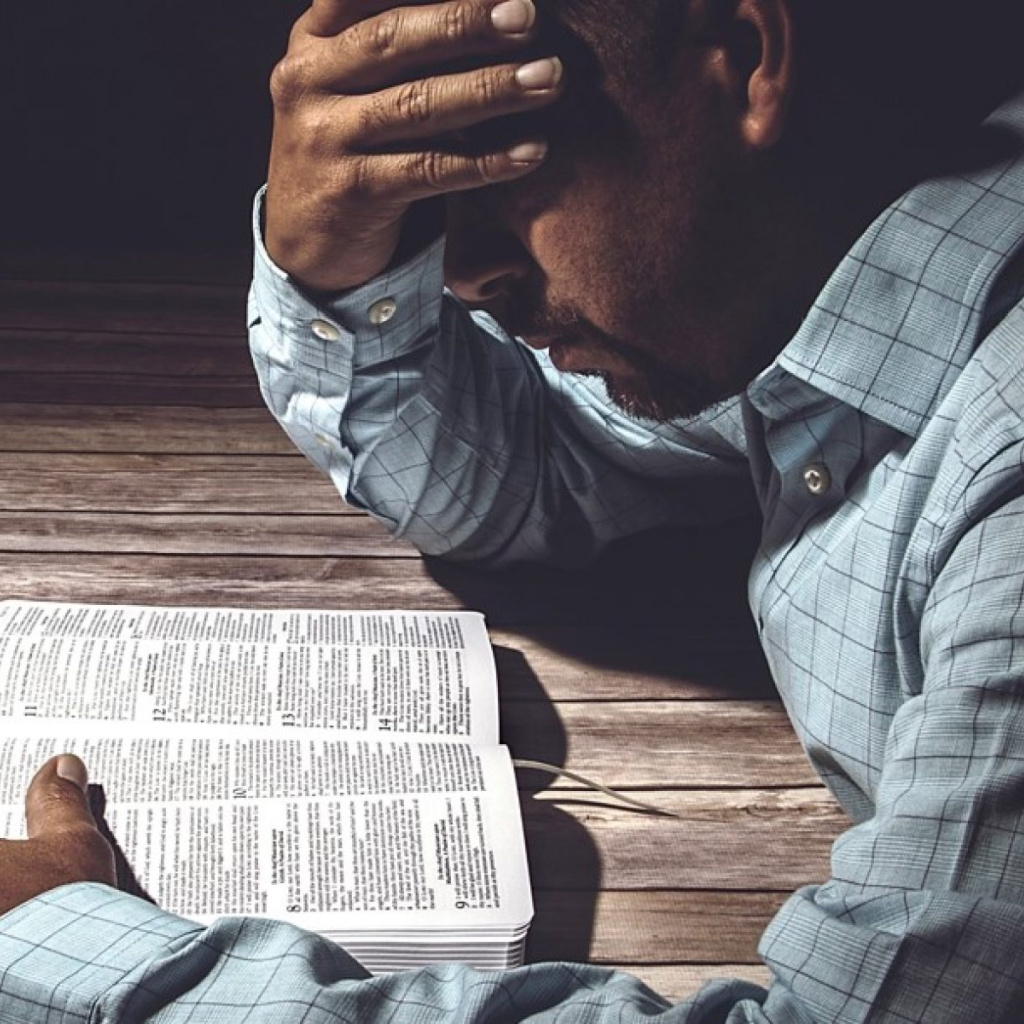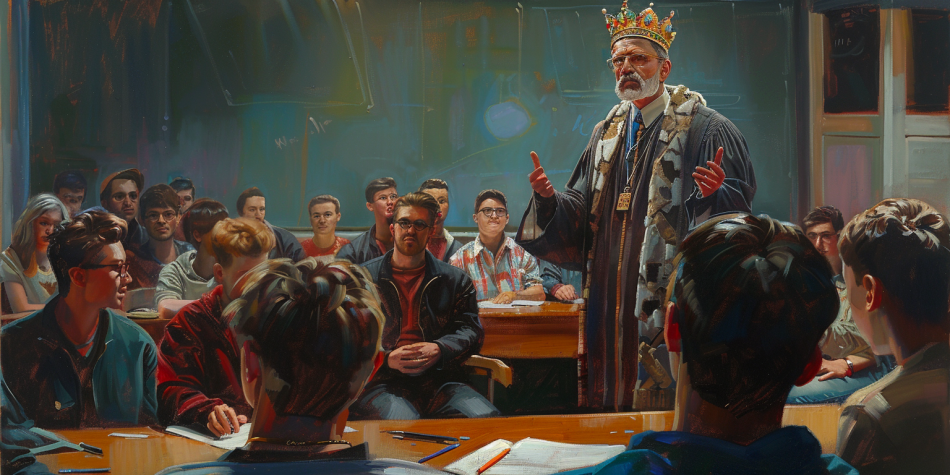
A crowned professor in a modern classroom, illustrating the conflation of power and knowledge in the crisis in higher education.

How Power Masquerades as Education

What truly defines education? Is it merely a tool for power, or is there a deeper pursuit of truth, wisdom, beauty, and virtue? Academia faces an ongoing battle for its soul.

It is no small irony that the modernist, scientistic perspective on education and the postmodern, critical theoretical approach share a fundamental conceit regarding the nature of power and knowledge, even with their significant philosophical differences and mutual disdain. Indeed, they seem to be united in the presumption that there is no meaningful distinction to be made between knowledge and power. Each is the mother of the other, each creating and sustaining the reality to which the other points. For the modernist, knowledge produces power, instantiates it, and permits its use. For the postmodernist, power produces knowledge and creates an inherently oppressive “truth” that provides some with freedom and others only bondage. Whichever side of the modern/postmodern coin one takes up, the central presumption made is that education is a vehicle for power and that power is, in the end, the only thing that truly matters, the only thing worth pursuing, and the only thing about which higher education should be concerned. 

Thus, higher education is rendered an essentially utilitarian matter insofar as knowledge is sought after (or maintained) not as a good in itself but rather as an instrument by which power and control are obtained, maintained, asserted, and employed in the pursuit of yet more power and control. With this perspective, knowledge cannot be seen as the complement of wisdom and beauty or as vital to the edification of the human soul and its flourishing. The fundamental and inescapably moral and spiritual context of both the pursuit of knowledge and of knowledge itself is disavowed at the outset by both the modernist and postmodernist approaches, predictably producing what some scholars have correctly identified as the contemporary “moral mess of higher education” and, thus, what others have convincingly argued constitutes “the death of learning.”

The “soul of the American university,” historian George Marsden argues, is at present in more than just profound disarray but actually in serious danger of ceasing to exist at all. Indeed, in large measure, the contemporary university has become an essentially soulless entity. Over the last century, we have witnessed what Marsden and other scholars have noted is the steady “decline of the secular university” as a center of moral orientation and instruction, a decline brought about by the university’s trivialization of its mission and (intentional) misunderstanding of its core purpose and meaning. Having been systematically unmoored from its founding (pre-modern, Christian) principles and spiritual core, the contemporary (i.e., modern and postmodern) university is a place of established unbelief. Even further, not just established unbelief in God but in the possibility of anything transcendent or soul-transforming, of belief in anything having anything more than simple utility in the service of entirely contingent human desires and self-selected ends. 

The university is now, to a stunning degree, a place where the pursuit of truth has been all but replaced by the pursuit of power. The moral summons to seek greater wisdom and develop virtuous character has been, in large measure, substituted with the self-serving quest for knowledge, and the power it affords, divorced from any substantive moral constraint. Indeed, as John Ralston Saul has noted, “the exercise of power, without the moderating influence of any ethical structure, [has rapidly become] the religion of these new elites.” Higher education has been rendered as either a purely technical enterprise of rational minds and amoral science or merely a breeding ground for permanent revolution and never-ending radical social change.

The contemporary university is a place of established unbelief.

The consequence of all of this is that the intellectual and spiritual atmosphere of higher education has become profoundly uninteresting and inhuman (even anti-human) because it has been emptied of its necessary commitment to moral substance, spiritual depth, enduring wisdom, ennobling beauty, and transcendent truth—the very things that give life to the university and sustain it as a meaningful institution. Such is the unavoidable result of the fact that both modernist and postmodernist visions are rooted in what is essentially a “theology of power” and an “ethic of nihilism.” The scientistic and the activistic worldviews are each haunted at every turn by their groundlessness, their fundamental inability to sustain their moral purpose and provide any transcendent meaning or purpose for anything at all. Each worldview is rooted, in its own particular way, in the basic assumptions of secular humanism. Thus, each seeks to describe the nature of human existence, culture, meaning, truth, knowledge, beauty, and morality in entirely immanent or “this-worldly” terms. Within a postmodern perspective, human beings and all they produce (i.e., art, culture, literature, science, etc.) are thought of as merely the contingent products of impersonal historical processes and arbitrary political structures. The modernist worldview, for its part, takes these very same things to be nothing more than the meaningless outcome of the deterministic operations of various blind, mechanical forces of nature.

In the end, whatever other disagreements the modern and the postmodern might entail, things such as truth, meaning, knowledge, and morality are little more than the socially or personally useful constructions of implacable history and impersonal nature. Truth and morality are important only insofar as they manifest some degree of instrumental value in the face of our ever-changing needs and desires in a fundamentally meaningless and purposeless world. The inevitable consequence of such thinking is that not only does the university become a soulless and morally listless entity, but so too does all of culture and social life. In fact, it seems that the only thing left for us to do once either modern or postmodern thought is fully embraced is to work out the most useful ways of dominating one another, the best ways to shout down, cancel, and, ultimately, eradicate one another. Such is, I am afraid, the all-too-predictable endpoint of the theology of power and the ethics of nihilism currently reigning in contemporary higher education. 

I wish to conclude here by suggesting that things in higher education need not be quite as bleak as they seem at the moment. It is not too late to reverse the downward spiral of nihilism and discord into which higher education has thrown itself. I will argue that for higher education to achieve its fullest and intended purpose, it must first be seen as an intrinsic and virtuous good necessary to sustain an intellectually productive and morally fruitful culture. However, for such a view to make sense, our understanding of the purpose and meaning of education must be grounded in a deeper and more fundamental vision of human beings and flourishing than either modernism or postmodernism can provide. Higher education—if it is to be both truly “higher” and genuinely “education”—must offer an account of what really is “the case” (i.e., the truth) about our human “being-in-the-world,” and one that spans all disciplinary endeavors, methodologies, and aspirations. Granted, modern and postmodern educators might argue that this is precisely what they are doing. However, in as much as each actively rejects the possibility of transcendent truth and dismisses the moral nature of human knowing and being, they both abdicate the only viable path that can meaningfully ground the mission of higher education and, thereby, avoid continued crisis, discord, nihilism, and anomie.

A Return to a Pre-Modern Education

A medieval scholar studies in a garden, symbolizing the holistic pursuit of knowledge, resolving the crisis of higher education
Knowledge can only be understood in its moral context

Significantly, what I am calling for here is a return to an essentially “pre-modern” understanding of the aims and meaning of education, one that is deeply attentive to learning in its moral, spiritual, intellectual, and practical totality—education as a matter of soul-formation. It is in this sense that I believe that higher education must serve more than just utilitarian ends or radical political agendas. For the university to fulfill its essential nature and purpose, it must be about the serious business of seeking and defending the true, the good, and the beautiful. It must also articulate (in as sophisticated and holistic a way as possible) the meaning of the good life as one of moral and intellectual excellence, virtue, and love.

Higher education has been emptied of its necessary commitment to moral substance.

This requires a firm recognition that, as Anthony Kronman puts it in his book The Assault on American Excellence, “some ways of living are better than others.” Additionally, as political philosopher Michael Sandel tells us, the “avowedly higher purpose [of higher education] is to prepare [students] to be morally reflective human beings and effective democratic citizens, capable of deliberating about the common good.” Echoing these sentiments, Stewart Goetz, a professor of philosophy and religion, reminds us that “the best way of being a human being includes the development of human capacities for intelligence, imagination, wit, etc. The more a person develops these capacities, the more fulfilled (perfected) he is as a human being.” In the end, Goetz continues, “The purpose of the university is to provide the liberating knowledge which enables the cultivation of human excellence.” However, such aims can only be achieved or even realistically aspired to if the pursuit of truth in both knowledge and wisdom, as well as practical reverence for the good and the beautiful, is taken seriously as the very reason for the university’s existence in the first place.

In addition to providing an academic context in which truth can be sought, reverenced and humbly served, the university has equally another vital cultural and intellectual function to fulfill. Truth—the aim of any serious educational enterprise—necessarily involves the coherent articulation of the meaningful implications of truth and, in so doing, the illumination of the moral and evaluative element at the heart of any and all truth claims. Thus, higher education qua education must be centrally concerned with articulating the meaning of truth and ethics, differentiated from the grounding nihilistic assumptions of modern and postmodern thought. 

In this view, then, higher education is understood to be an intrinsically and inescapably moral enterprise, one whose central aim must and can only be the illumination, expansion, and transformation of the human soul. Only by being so oriented can higher education achieve its essential purpose of cultivating a flourishing society nurtured and sustained by virtuous, knowledgeable, and wise men and women. As BYU professor Daniel Frost reminds us, “Far from being the enemy of academic study, intellectual and moral commitments make meaningful inquiry possible. Commitments do not frustrate the search for truth; they are, in fact, necessary for it to proceed at all.” Indeed, I believe that it is in light of this central reality that we can begin to tackle the most profound question confronting higher education:  What does it mean to be a person?

Higher education must serve more than just utilitarian ends.

It is only in earnestly seeking to address this question that all other intellectual work and ennobling activities of the university can be brought into sharp focus, regardless of the domestic interests or subject matter of particular disciplines. Higher education as the enlargement of the soul by pointing it toward the true, the good, and the beautiful is equally a fundamentally human and a divine enterprise. Higher education can become an experience whose realization is dependent on our maintaining a deep and abiding commitment to understanding, in as full and fruitful a manner as possible, what exactly it means to be a soul in the first place.

An Alternative Approach

Scholars build a book bridge over troubled waters, representing unity and the pursuit of knowledge overcoming the crisis in higher education.
Virtue-based learning is still possible

By way of an alternative to both the modern and postmodern conceptions of the purpose of higher education, the view I wish to defend is one rooted not only in an understanding of the nature of human nature as founded in a transcendent, divine reality but one which presumes human freedom to be constitutive of human existence itself, both its foundation and its aim. Indeed, the reality and the possibilities of human freedom are absolutely central to any meaningful conception of higher education. Only insofar as the academy endeavors to free us from ignorance and error, as well as towards a more fully expansive understanding of ourselves as moral beings whose lives have intrinsic worth, dignity, and purpose, can we even legitimately claim to be about the work of education in the first place.

In contrast, for the modernist and the postmodernist, while human freedom is spoken of, and often quite enthusiastically, in the final analysis, genuine freedom is denied by both. The scientistic presumption is that human beings are nothing more than particular parts of an all-encompassing causally efficacious, purposeless, and meaningless material universe and, thus, are beings whose lives possess only contingent worth and evanescent meaning. On the other hand, per the postmodern, critical theory view, freedom is an illusion foisted on beings who are, in reality, merely the arbitrarily constructed products of various impersonal structures and systems, the invisible and dominating operations of which are presumed to permeate all social, political, and cultural life and history. Genuine freedom, real purpose, and substantive and enduring meaning have no legitimate place in either of these conceptual formulations, and neither do such things as truth and morality.

Knowledge is always and only ever truly virtue.

Ultimately, then, when faced with the question “What is a person?,” both the modernist and the postmodernist must—if they are to be consistent with their own assumptions—answer: nothing much. Whether seen to be the site at which the impersonal forces of nature play themselves out or merely an intersection at which various systems of oppression happen to meet, neither perspective affords much meaning or any real freedom to the human person. Transience, contingency, and causal happenstance are the order of the day. Thus, the person as a moral agent, divinely invested with purpose and possibility, simply disappears into what C. S. Lewis trenchantly termed “the muddy heathen mysticisms which deny intellect all together.” For both the modernist and the postmodernist, freedom is presumed to be the product of knowledge and the power it affords.

Advocates of both perspectives declare their commitment to freedom through the stripping away of ignorance. In both cases, however, the reality they seek to unmask is one in which persons are reduced to simply being the playthings of all manner of impersonal forces, systems, structures, and material circumstances, subjects constructed and conditioned by the purposeless historical and biological happenstance. In place of ignorance, higher education in these models offers no real freedom but rather a painful awareness of our inescapable slavery to powerful and uncaring abstractions. In such educational visions, there is nothing truly human at work; there is no freedom to conform to the reality of the good, obey truth, or love beauty. Neither intellectual nor moral humility can find a “safe space” among the reductive schemes of either modern scientism or postmodern activism, as such attributes arise only in response to the call to goodness, virtue, and compassion. 

When the animating concern of higher education is the animating concern of truth, however, it becomes clear that not only is the academic endeavor to aim at an increase in knowledge but also the cultivation of wisdom and goodness. The cultivation of these attributes can only take place in a setting in which knowledge of ourselves and the truth of the world is never divorced from the moral and spiritual context of its discovery and application. Knowledge, in this view, is not power, nor is the search for knowledge the pursuit of power, but rather knowledge is always and only ever truly virtue, the correspondence of truth and action in the concreteness of one’s daily life and conduct. Beings intended to flourish in freedom, to be virtuous and wise, must be educated to aspire to and achieve the freedom and virtue they were intended to have. 

However, education must be such that truth and its moral implications are front and center in all our academic endeavors. Freedom, in this view, “is a function of our veracity; freedom does not mean arbitrary selection, but adherence to what is best.” In short, freedom is neither a comforting illusion foisted on us by evolutionary fiat or by the occult operations of unjust systems of socially constructed oppression, nor is it the exercise of arbitrary and unbounded will. Rather, freedom is found in “wanting what is truly good, not imposing what we want.” In a fundamental sense, it is the true, the good, the beautiful, and virtue itself, that grounds human freedom and makes moral aspiration both possible and genuinely meaningful. Indeed, as the Catholic philosopher D.C. Schindler has shown, “freedom is a condition for the continuing affirmation of the priority of the good.” In the end, then, it is not power that shall make us free, but only truth.


About the author

Edwin E. Gantt

Edwin E. Gantt is a Professor of Psychology at Brigham Young University. He is the author of numerous scholarly articles and books, including Taking Sides: Clashing Views on Psychological Issues and Who is Truth? Reframing Our Questions for a Richer Faith (co-authored with Dr. Jeffrey L. Thayne). He has a Ph.D. from Duquesne University.
On Key

You Might Also Like

Under the Banner of Heaven Episode 5, “The One Mighty and Strong”

Summary – Pyre is interrogating Sam, who shouts scripture at him about the “one mighty and strong.” Pyre uses false details about the murder to trick Sam into revealing that he isn’t the murderer. The police chief is getting ready to release the brothers, so Taba stalls him while Pyre talks to Robin about his brothers’ involvement in the “School of the Prophets” and gets him to reveal two names: Bernard Brady, a Provo businessman, and Prophet Onias. The detectives follow up with Bishop Low and his wife, located at the end of the last episode, asking them about the excommunication of Dan and Ron. The bishop is reluctant to reveal details because of clergy confidentiality but eventually reveals that Dan was excommunicated based on the testimony of his daughters that he attempted to forcibly take them as polygamous wives. We get a flashback to a heartbreaking scene where Matilda has sex with Dan to distract him as her daughters escape out a window in the middle of the night. Dan was excommunicated, and the girls were placed with a family in the ward (as the bishop refused to call CPS) but later ran away, and now they and their brother are missing. At his daughter’s baby blessing, Ron confronts the bishop about his brother’s excommunication, not knowing about Dan’s attempted polygamy and thinking that it’s about his political beliefs. Brenda has a conversation with Sister Low and Diana, indicating that both know that Ron is abusing her but only Brenda is willing to do anything about it. In fact, Sister Low feeds Diana a line about how her only duty is “creating a home and environment to sustain and support our Priesthood holder.” To Detective Pyre, the bishop claims to have followed church procedure but eventually encouraged Diana to leave and gave her money to do so. The detectives follow up on Robin’s lead about Bernard Brady by arriving at his house in the foothills of Provo with a warrant. We find out that the Bradys sheltered Ron when he was having a hard time. In a flashback, Ron receives a summons to a church disciplinary court and blames Diana for it. He punches her in the face and begins throwing the food she’s preparing on the floor, saying he’ll starve her into obedience. Diana grabs a kitchen knife and drives Ron from the house, telling him not to come back. Back in the present, Bernard admits to being in the School of the Prophets study group and driving miles to pick up Prophet Onias and the Laffertys but denies being further into the group than that. But when he sends his wife out of the room to make lemonade, he produces a notarized letter he sent to himself with details of the Laffertys’ hit list, including that Diana is on the list because she wrote a letter that got Ron excommunicated. The detectives rightly chastise him for not taking this information to the police earlier. Brady reveals that he knows the location of “the farm,” a Lafferty compound. With Allen’s help in drawing a map, the detectives plan to stake out the property in the morning. Detective Pyre returns home for FHE and finds that his wife and kids have been invited to the bishop’s house for the evening and are spending the night there. Pyre believes this is an attempt to keep an eye on his family and control the narrative about the case. The next morning on the way to the raid of the farm, Pyre questions Brady about the details of Ron’s excommunication, which we see in flashback. He is indeed excommunicated after lashing out at the church leaders about them not following the “correct” doctrines of the church. When Ron returns home, he finds that his teenage daughter has cut the markings out of his garments, which he puts on anyway with only a sports coat and jeans over the top. He says goodbye to his kids and leaves the home. When the farm is raided, the only people inside are three teenage girls, who we learn are from a polygamous compound in British Columbia and were brought down by Prophet Onias to be Ron’s wives. The girls show the detectives a cupboard they had been forbidden to touch, which the detectives open to reveal a single shirt belonging to Ron with some papers in the pocket, a hit list, and a revelation directed at Diana commanding her to repent and return to him. Allen is in disbelief that Ron could have written these things, but Brady confirms that Ron is a violent man. He explains that Ron fled to his parents’ home after his excommunication, where his mother confirms his calling as “the one mighty and strong” and says he’s only a heartbeat away from his rightful place. His father is lying sick in bed and asks Ron to call a doctor, but Ron recalls his cruelty to them as children and refuses. It’s implied that he indirectly caused his father’s death in order to take over the leadership of the family. Church History—This episode contains the most fabricated piece of church history in the show. When Bernard Brady reveals that Diana’s information led to Ron’s excommunication, he makes an analogy to Joseph Smith’s martyrdom. He claims that while Joseph was in hiding after destroying the press of the Nauvoo Expositor, Emma wrote a letter to Joseph encouraging him. John Taylor intercepts this letter and adds a line meant to make Joseph turn himself in, thus indirectly causing the prophet’s death. Taylor’s motive is to put Brigham Young at the head of the church, instead of Emma’s young son, in order to continue the doctrine of polygamy, which he and Brigham are already heavily involved in. Reputable historians both in and out of the church say there is no evidence to support this interpretation of events, though the succession crisis between Brigham Young and the ten-year-old Joseph Smith III is real and

“Deep” Norwegian Film About Nothing in the End

How does a community and the families within it respond to a nearly unspeakable accusation? How do you treat everyone with dignity? How do you suss out the truth? Do you need to? “Armand,” the Norwegian submission for The Academy Award’s best international feature film, sets out as though it is interested in answering those questions. The film opens with a young teacher, a principal, and a school staff member wondering what they are going to do. Armand has done something again. The parents are called in. The film’s premise is that Armand was accused of hitting Jon in the bathroom when Jon said he didn’t want to play with Armand. There are many additional revelations about the context, the relationship between Armand and Jon’s families, and the history of Armand’s family. There are accusations upon accusations that both indict and exonerate the boys and the adults around them. But these revelations eke out. It feels like filling up a mug from a leak in the sink. “If you want us to know what’s happening, just tell us,” I felt like shouting at the screen more than once. The film’s first act works well. The cinematography is ragged, framing its subjects well but always just off from what we’d expect. Too close, or the light is just wrong. It felt like how I imagine it would feel to have my child accused of something horrific.  And when the parents first start talking the tension is terrific. Those first few drops of exposition in the mug were thrilling. Oh there’s something happening here; it’s complicated and interesting.  Thea Lambrechts Vaulen, plays Sunna, a young teacher in over her head trying to manage the meeting between Armand’s mother, Elisabeth, played by Renate Reinsve, and Jon’s parents Sarah and Anders played by Ellen Dorrit Petersen and Endre Hellestveit.  Vaulen is particularly effective. She has been sent on a mission by her principal, Jarle, to make sure the whole thing blows over. Watching her struggle to navigate this while the parents are processing what’s been said is captivating. But it just keeps going.  The film’s entire second act consists of learning the basic facts of what has happened and the context around it. This is a complicated situation, and as a viewer I’m interested to see how the compelling characters navigate that situation. But the screenplay seems mostly interested in telling you the information. As though learning that Armand “plays doctor” at school is enough to compel me to the film’s ending. But once the audience finally understands the situation, the third act begins and flies wildly off the handle into surrealism, including two interpretive dance numbers, three over-the-top metaphors, and five straight minutes of Anders’ mother laughing.  The movie feels so desperate to be deep that it forgets to be about anything. It’s the first film of director Halfdan Ullmann Tøndel, so perhaps the bold ideas and beautiful cinematography will be wielded for a more worthwhile story next time. The film is entirely in Norwegian. And its English subtitles include a fair amount of profanity, though not an overwhelming amount. And the accusations that fly include suicide, alcoholism, and sexual assault. So these are adult themes. The film is R-rated, but not an egregious one, it pretty well all takes place in a parent-teacher conference.  I can’t imagine ever showing this to my kids. The themes are hard ones, and the film has nothing worthwhile to say about them. Two out of five stars. Armand releases in US theaters on February 14, 2025.

Subscribe To Our Weekly Newsletter

Stay up to date on the intersection of faith in the public square.

You have Successfully Subscribed!

Pin It on Pinterest

Share This