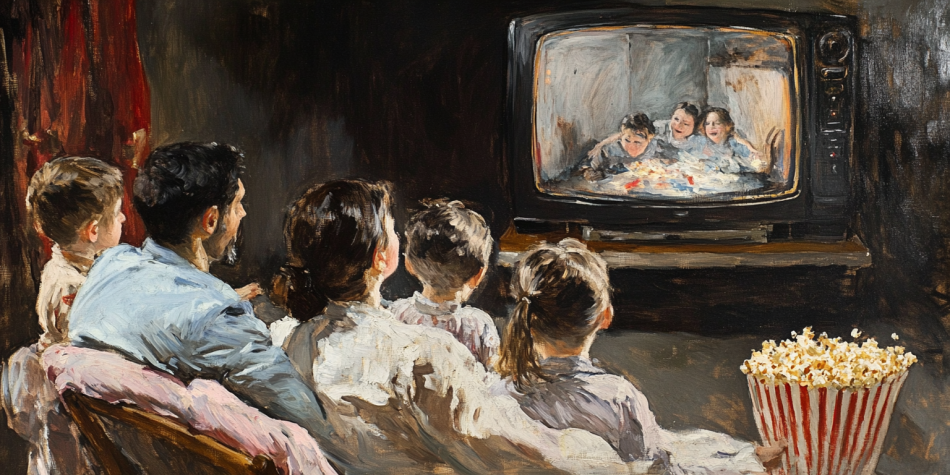
Family with Popcorn Watching an Old TV | Public Square Magazine | Mormon Stereotypes | Stereotypes About Mormon Families

When Representation Fails: Latter-day Saints and The Cost of Invisibility

How are Latter-day Saints misrepresented on TV? Prevailing stereotypes and lack of diversity persist in the media.

In the last three years, there have been 1676 scripted television series on network, cable, and streaming platforms. 

Of those shows, two of them had a main cast character who was depicted as a member of The Church of Jesus Christ of Latter-day Saints, or 0.1%. This is in contrast to the 1.7% of the US population that are members of The Church of Jesus Christ of Latter-day Saints.

Latter-day Saints are underrepresented as main characters on US scripted TV shows by 1700%.

This lack of representation contributes to attitudes that Latter-day Saints are foreign, cloistered, and unusual. 

One other effect of this lack of representation is that an undue burden is placed on the few Latter-day Saint characters in popular culture to represent the whole.

An undue burden is placed on the few Latter-day Saint characters in popular culture.

Latter-day Saints are far from the only religious minority in the United States to face frustrating depictions in popular media. Sikhs, Seventh-day Adventists, Mennonites, Jehovah’s Witnesses, Eastern Orthodox, and Unitarians, among others, are simply left out if not misrepresented.

Perhaps the religious group most impacted by their media representation over the last thirty years has been the Muslim community.

Muslims are rarely seen as the main characters in TV shows. They are almost always the other that our main character is operating against. These characters too often fall into three main stereotypes: the rich sheik, the exotic belly dancer, and the terrorist. 

The existence of these stock characters carries some negative effects. They paint public perceptions and limit the imagination of what a Muslim can be. 

However, the representation of Muslims on television in recent years also shows some hope. There has begun to be an increase in Muslim representation on television. Muslims make up about 1.1% of the US population and now make up about 1% of the characters on TV shows. As this representation has increased, the variety of characters they play has been able to increase. Peacock’s “We Are Lady Parts” is about the creation of a girl band; the members are all Muslim. Disney Plus’ “Ms. Marvel” has a Muslim protagonist whose participation in her religious faith is a part of the overall painting of her character. Cartoon Network’s “Young Justice” features another Muslim superhero. Netflix’s horror “Midnight Mass” features a Muslim police chief navigating his complex identity. And Hulu’s “Ramy” does a particularly noteworthy job of showing a Muslim character of faith.

This isn’t to say Muslim characters that are lacking don’t exist. They continue to be portrayed in stereotypical ways at disproportional rates. Sometimes shows will attempt “representation,” such as Netflix’s “Why Are You Like This,” which shows Muslim characters mainly betraying their Islamic identity. But while those stories may not be ideal for Muslim representation, they are part of a tapestry of portrayal that is finally starting to include some more honest and complex representations as well. These more honest portrayals are possible as the overall rate of representation has increased.

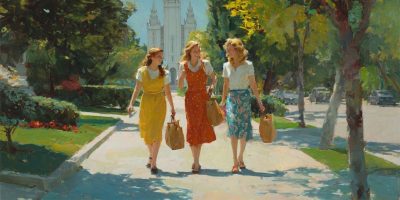
Latter-day Saint characters also tend to fall into familiar stock patterns, though naturally, they are different kinds of patterns. For Latter-day Saints, the most common characters are either:

1) Naive, repressed, and often family-focused
2) Rebellious against their strict upbringing
3) Secretive and violent

These patterns are common in depictions such as “The Book of Mormon Musical,” where the characters are displayed as naive. The secretive and violent stereotype was the most common early on, appearing even in Sherlock Holmes, and persists without any additional insight or nuance in Hulu’s recent “Under the Banner of Heaven.”

We were able to read a copy of the shooting script of an upcoming film starring two sister missionaries. We strongly advise you to avoid the film. One of the sisters fits the naive stereotype, while the other shows she’s rebelling by discussing her pornography usage in the film’s opening scene. (The final film will likely be different from the shooting script).

Apple+’s “Physical” has the prominent character John Breem, who fits into the repressed pattern. “Quantico” is an ABC procedural that had a Latter-day Saint in one episode. He was repressing the affair he had while a missionary (they also made sure to film his garments for good measure).

Netflix’s “Stranger Things” has probably given the most positive depiction of Latter-day Saints on television in the last ten years. But while it is positive, the depiction slots right into the family stereotype. 

Even the best, most nuanced depictions of Latter-day Saints, such as Cole, a doctor who appeared in seven episodes in the fourth season of “House” sixteen years ago, fall into these patterns. While he tries to follow his convictions on alcohol, he eventually gives in and drinks. 

The problem isn’t that these depictions are always negative, many of these stereotypes are good, just as a depiction of a rich sheik isn’t necessarily negative. It’s that when that’s all there is, the complex, honest reality of the Latter-day Saint experience goes missing. 

But similar to the experience of American Muslims, the answer is likely not to nitpick and fight against every stereotypical or negative depiction but rather to work toward an overall increase in representation, which will then give space for honest, in-depth representations to finally appear. This is especially true of Latter-day Saint women, who are even less represented.

The complex, honest reality of the Latter-day Saint experience goes missing.

If a Latter-day Saint were hoping to find a character to watch on TV that might represent their experiences and identity and googled “Latter-day Saint characters on TV shows,” you would get three from “Under the Banner of Heaven.” That’s it. (If you exchanged it for “Mormon” characters, you’d get two more listed, but both of those two are actually from other faith traditions.)

It’s not that we are calling on creators to never write Latter-day Saint characters who fall into those stereotypes but to write more honest Latter-day Saint characters overall. If we had seventeen times more Latter-day Saint characters on television appropriate to our overall representation, it wouldn’t matter if we had a few who were naive or rebellious since those types certainly exist among the diversity of our community.

One organization that perhaps has been the most effective in modeling this kind of advocacy is GLAAD. GLAAD is an LGBT+ advocacy organization. They began by advocating that newspapers use the term “gay” to refer to their community rather than “homosexual,” which they no longer preferred.

Over time, they began to consult with TV and film studios on representation efforts. In 2013, they released their first Studio Responsibility Index. They looked at the movies released by the major Hollywood studios and found that 14 of the 101 films released had LGBT+ characters. At the time of that report, 3.5% of Americans identified as LGBT+ or about twice as many as Latter-day Saints. By 2023, 100 of the 350 films released included LGBT+ characters. Based on their success, it’s not unreasonable to think that Latter-day Saints could reasonably appear in many more major film releases. 

If there were 50 films a year depicting Latter-day Saints, having one with ugly stereotypes about missionaries would hardly be a cause for major concern. The problem is that this upcoming film is not one of fifty; in fact, it will probably be the only major motion picture depicting Latter-day Saints this year.

So, while we are likely to hear people (rightfully) decry the inaccurate and vulgar depiction of these missionaries, what we need isn’t a couple of bland, inoffensive depictions. We need a rich diversity of depictions so that bad ones like this merely fade into the background.

About the author

Public Square Staff

Our core team, including our Editor in Chief, Editor at Large, Managing Editor, Associate Editor, and Social Media Director.
On Key

You Might Also Like

The Ordinary Saint’s Guide to Under the Banner of Heaven: Episode 4, “Church and State”

Summary — The episode begins with the detectives checking in on Bishop Low’s home, which they find ransacked and deserted. Pyre finds a letter written by Ron’s wife to the Prophet expressing concern about her husband’s refusal to pay taxes. The detective contacts the Church about the letter and is told the letter was handed down to one of the bishop’s counselors, LeConte Bascom, who works at the bank. Brother Bascom says he had to turn Ron down for a loan because his brother’s refusal to pay taxes made him a liability, though it’s heavily implied that the real reason is that his wife’s letter was seen as an embarrassment to the Church. In flashbacks, we see Dan marching in a Pioneer Day parade, shouting about the government’s illegal taxes, as well as smoking and kissing a woman who isn’t his wife. Dan’s father says he’s ashamed of his immoral behavior and anti-tax nonsense and advises him to study the scriptures to set himself back on the right path. This unfortunately drives Dan into researching more obscure history of the Church, including information on polygamy.  He makes a business trip down to Colorado City to visit the breakaway polygamist sect there and manages to get the name of a pro-polygamy pamphlet called “The Peace Maker.” He reads this pamphlet and brings up the idea to his wife Matilda, telling her she’s limiting his spiritual power if she doesn’t let him marry a second wife.  During this conversation, Dan is pulled over for speeding and refuses to cooperate with the officer, leading them on a police chase that ends with his arrest. At the jail, Dan’s brothers try to convince him to stop his resistance to the government. Ron feels it’s his responsibility to show Dan the error of his ways, but instead, Dan runs circles around him, leaving him speechless and admitting that he’s going to lose his business and home. Dan somehow turns this fact into evidence that his views are correct and ends up winning over Ron to his side. In the present, Detective Pyre is being leaned on by the Laffertys’ stake president to release them into his custody but refuses. The detectives have identified the car the killers were probably using and plan to hold a press conference to ask for tips when the police chief returns from vacation and demands that all mentions of fundamentalism Mormonism be scrubbed from the press briefing. (It’s implied he’s being leaned on by the Church.) Pyre tries to toe the line at the conference but eventually caves to a persistent reporter and admits that he thinks that the murders may have something to do with fundamentalist beliefs. The next day at church, the ward is shunning the Pyres, and a specific couple is assigned to keep an eye on their faith. Meanwhile, a police officer has located Bishop Low fly fishing in the mountains and safe. Church History — During Dan’s explanation of polygamy, we get flashbacks to the infamous scene where Emma finds out about the doctrine of polygamy for the first time and throws the revelation in the fire. Though church members will be familiar with this story, the tone is portrayed very differently than we are used to. Emma is shown as being absolutely skeptical of Joseph’s translation of the Book of Mormon and other prophetic acts, even though she firmly testified of the truth of these things even after her break with the Church after Joseph was murdered. Joseph is portrayed as proclaiming the doctrine of polygamy only for his own physical gratification, which is a common anti-Mormon trope with little evidence behind it. While it is true that one of Joseph’s wives was only 14, the facts behind the situation are more complex than portrayed in the show. The pamphlet “The Peace Maker” is portrayed by Dan Lafferty as an “essential LDS tract” written by Joseph Smith, and no one in the show ever corrects this perception. In fact, the tract was not written by Joseph Smith, and he repudiated it during his lifetime. This episode presents a slanted view of church history, giving only one side of the conversation and showing the modern church as trying to hush it up rather than having its own interpretation of events. Shibboleths — Pyre claims that writing a letter to the prophet is like writing to “Heavenly Father himself,” which is absolutely wrong. While members of the Church do revere the prophet and listen to his teachings, he is not God, and this equivalency is not one Saints would make (though outsiders think we do). The idea that doing business with fundamentalists is like “doing business with the mafia” is totally alien to me. They are regarded as somewhat of an oddity in Utah, but not dangerous like organized crime. One unusual phrase occurs when the stake president claims that the Laffertys need to be released into his custody for “healing prayer.” I honestly have no idea what this phrase refers to and have never heard it in an LDS context. And the formal type of shunning portrayed happening to the Pyres is not something we do. Though obviously, wards vary in their culture, there is no formal instruction not to talk to those who have questions. Rather, we are encouraged to keep being friends with those who are struggling with faith and support them however we can. Changing History — It is interesting to note that in the actual chain of events, it was Sister Low, not Bishop Low, who was on the Lafferty hit list. Sister Low was a Relief Society President who supported Dan’s wife as she sought a divorce. Why does the show change this? Perhaps the idea that the Church has female leaders doesn’t fit well with the show’s depiction of the oppression of women in the LDS church. Brenda Lafferty’s sister has also expressed her disappointment with the way the show is misconstruing her sister’s murder in pursuit of an

The Disinformation Board and Religious Freedom + Today’s Digest

Our daily rundown of the articles from around the web that we feel our readers would enjoy and appreciate. We hope to highlight the best of what’s around. Public Square Bulletin recommends: Will the ‘Disinformation Governance Board’ censor religious viewpoints? Jorge Gomez—Christian Post While the article does lean into something of the more hysterical concerns about the Department of Homeland Security’s new board for tracking disinformation campaigns, it does address one of the big questions that government leaders must reckon with as the board settles on its role: how will this intersect with religious freedom concerns? The Hard Left and Populist Right Agree on All the Wrong Things Stephan Jensen—Quillette The “culture wars” are often a topic for dread. But Stephan Jensen posits that we’ve become hoodwinked by extremes on both sides that have exaggerated concerns well beyond what is warranted to keep us in a constant state of unease. But he suggests that the sane center may be making a comeback as the war in Ukraine helps us focus on what’s truly important. Insta-Therapy: Helping Or Hurting? Seerut K. Chawla—Unorthodox Chawla suggests that the overly simplified versions of mental health that are bandied about on social media cause many more problems than they solve. She suggests that all too often that this culture problematizes normal life in order to create a problem that the influencer is uniquely suited to solve. Go Forth and Proselytise Peter Davidson—Literary Review This review of the book “Jesuits: A History” focuses on the Jesuits’ missionary efforts. Peter Davidson makes a clear argument that missionary work has historically provided great value. Davidson frames Markus Friedrich’s book in a way that is a direct challenge to those who seek to eliminate or devalue ongoing proselyting efforts. Jacob’s Dream Gospel for Kids The latest video from this official YouTube channel of the Church provides a fun activity for kids that helps frame the story of Jacob’s ladder about the covenant path.