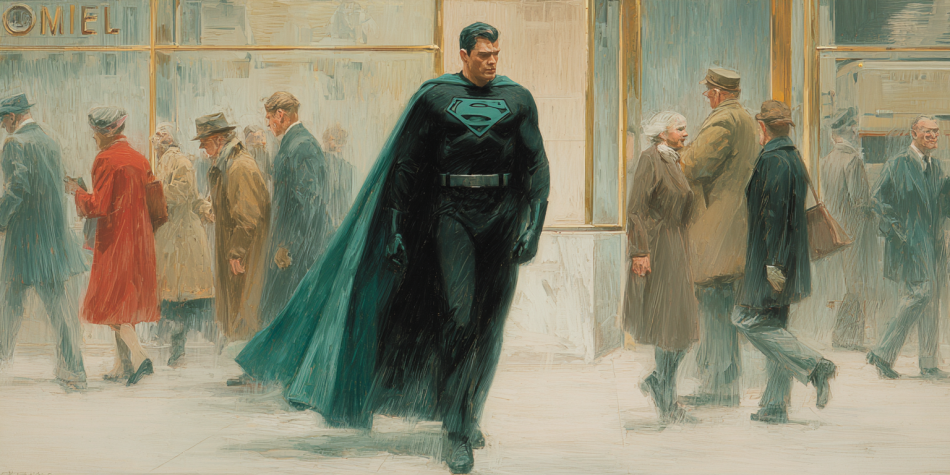

During the summer of 2025, we’ve seen a notable shift in the narrative style of superhero films.
Since 2002, superhero films have centered on origin stories—plots that trace heroes from ordinary individuals to extraordinary agents of justice and good. But James Gunn’s rebooted film Superman and the Marvel Cinematic Universe’s introduction of the Fantastic Four both notably start in the middle of their characters’ stories. These characters are fully formed, and their backstories are assumed and deemphasized.
This shift reflects more than just storytelling evolution; rather, it reflects a deeper cultural transformation in how we are responding to the crises around us, how we conceive of agency, and how we imagine heroism.
In the same way the origin story rose as a response to our cultural processing of 9/11, this shift away from them reflects the breakdown of shared national narratives and a desperate search for safety in an age of uncertainty.
Pre-9/11: Action Without Introspection
Before the events of September 11, 2001, American action cinema largely operated within a confident moral framework. The genre thrived on spectacle, propulsion, and clarity, rather than introspection or psychological depth. Heroes were rarely burdened with complexity; they were good simply because they were good. Audiences accepted this simplicity not as a narrative deficiency, but as a feature of the genre’s moral architecture. The focus was on what the hero would do, not why they felt compelled to do it. Even in the emerging superhero genre of the era … The villain was often the one with a backstory, not the hero.
Similarly, in Independence Day (1996), Captain Steven Hiller (Will Smith) is a hotshot fighter pilot who defends the planet from extraterrestrial annihilation. The film offers no biographical backstory to explain Hiller’s courage; it simply presents him as the kind of American who rises to meet the moment.
In addition, Top Gun (1986), with its swaggering fighter jocks and Cold War subtext, gives us Maverick (Tom Cruise), a thrill-seeking pilot who competes to be the best. Top Gun is notable because it does nod to the mysterious death of Maverick’s father, but it does so without mining the event for psychological motivation. It presents it not as formative for our character, but as part of his formed character. We never ask what made Maverick crave speed.
These characters are fully formed at their introductions. There is no demand for narrative justification or psychological realism.
Even in the emerging superhero genre of the era—where one might expect more elaborate treatments of identity and origin, in line with their comic book form—this tendency persisted. The villain was often the one with a backstory, not the hero. Tim Burton’s Batman (1989) gives Jack Nicholson’s Joker an origin as a mob enforcer named Jack Napier, whose disfigurement and descent into madness offer a form of explanation for his violence. Batman, in contrast, is defined primarily through action and mystique. In X-Men (2000), the audience is given a haunting origin for Magneto, who, as a child, survives Auschwitz and emerges with a militant view of mutant survival. The heroes—Cyclops, Storm, Jean Grey—are just there. Even Wolverine, the film’s breakout antihero, is more defined by his amnesia than a deeply explored past.
In places where we do see origin-like elements, they are treated as flashbacks after which we catch up with our heroes mid-story. We see this approach in the brief flashback to the murder of Bruce Wayne’s parents in the 1989 film. Perhaps the clearest example of this narrative economy can be found in Superman: The Movie (1978). The film opens with the destruction of Krypton and young Kal-El’s escape to Earth. But these sequences are delivered in brisk montage and are more interested in Zod, the villain. We quickly skip ahead to a point where Superman is already the embodiment of American virtue. For the first time, where our superhero came from wasn’t a footnote; it was the story itself.
Post-9/11: Origins as Ontology
In the years following 9/11, that changed. As American society absorbed the trauma of watching its symbols of power collapse live on television, it entered what we might call a hermeneutic age—an era defined by interpretation, inquiry, and a pervasive sense that nothing can be taken at face value. The cultural response was a desperate turn toward explanation, particularly in cinema.
The turn toward psychological realism and its expression—the origin story, arguably began with Spider-Man (2002). Released less than a year after 9/11, Sam Raimi’s film offered a superhero origin story steeped in trauma, guilt, and reluctant responsibility. Peter Parker isn’t simply bitten by a radioactive spider; he wrestles with the moral implications of power, the weight of his uncle’s death, and the crushing burden of his double life. The story insists on the interiority of its hero. And for the first time, where our superhero came from wasn’t a footnote; it was the story itself.
Christopher Nolan’s Batman Begins (2005) exemplifies this shift. Rather than drop us into the action, the film spends nearly an hour exploring Bruce Wayne’s childhood fears, the trauma of losing his parents, and his training with the League of Shadows. The film doesn’t hint at his backstory; it is his backstory. Batman becomes not merely a symbol of justice but a complex psychological case study. And while the latter two films don’t repeat his origin, they continue to build on the themes of what caused him to be who he is. In The Dark Knight (2008), the Joker is terrifying precisely because he is inexplicable.
This trend wasn’t confined to traditional superheroes. Consider Casino Royale (2006), which reboots James Bond not for the next adventure, as he had been rebooted four times before, but at the beginning of his story. Here, he doesn’t begin as the suave, infallible operative of earlier films, but as a man learning the emotional and moral costs of espionage. Even Sonic the Hedgehog got an origin story!
Iron Man (2008) launches the Marvel Cinematic Universe not with world-saving action, but with Tony Stark’s reckoning with the consequences of his own weapons empire. Every character must be wounded, conflicted, and from somewhere. It is no mistake that Tony Stark’s origin focuses more on his alcoholism and troubled romantic life, which could resonate with the audience, than on his extreme wealth.
As audiences, we wanted to feel like anyone could rise up and become the hero, and by seeing these heroes begin as people like us, we felt empowered, putting ourselves into their shoes. 9/11 showed that our external heroes could fail, and the intimate experience of seeing the tragedy in our own living rooms made each of us want to feel empowered. For all the fantasy special effects, these films were at their heart a playbook for how each audience member could become a hero. It’s no surprise that during this period, it was our least human superheroes that struggled to resonate with audiences, Superman Returns, Man of Steel, the first two Thor films, and Eternals. These characters didn’t become heroes; they were born as heroes, so audiences didn’t need them.

A New Kind of Hero Post-COVID
Today, we are no longer reeling from a singular, unifying trauma like 9/11. Instead, we inhabit an age of chronic disillusionment. The COVID-19 pandemic became not a rallying point but a breaking point—exposing fractures in our civic trust, political institutions, and even basic consensus about reality. Where the post-9/11 era yearned for heroes we could become, the pandemic era has left us longing for something else entirely: the comfort that someone, anyone, in a position of responsibility will simply do their job. We wanted to feel like anyone could rise up and become the hero, … people like us felt empowered …
We can see this anxiety in the fractured multi-verse style stories that began to take hold. Everything, Everywhere, All at Once (2022) captured this feeling in the prestige market, while it took over in Spider-Man: No Way Home (2021) and Dr. Strange in the Multiverse of Madness (2022). The progenitor of this trope, Spider-Man: Into the Spider-Verse (2018), went from novelty project to cultural behemoth post-COVID in 2023’s Across the Spider-Verse.
But while this reflected the moment in a way that clearly intrigued audiences, it didn’t speak to their desire for something soothing. Consequently, the appetite for the 9/11 generation of superheroes has waned. While the studio system kept producing more of the same, it was the throwback exceptions like Top Gun: Maverick (2022) that captured attention and rose to the top. This film succeeds precisely because it returns us to a world where competent people lead, where moral clarity is possible, and where action matters more than angst. Rooster doesn’t need an origin story; he needs to hit the target. And he does.
Audiences seem tired of watching characters endlessly become. They want to see them do their jobs.
This brings us to the superhero season of 2025. Although Marvel released Thunderbolts*, widely regarded as their best film in years, the reveal that it was another origin story about a superhero team ultimately turned off audiences, who then didn’t show up.
Audiences instead have shown up on the superhero front for Superman and The Fantastic Four: First Steps. We no longer want to be told that salvation lies within—we want to believe that there are people… who will show up and take care of what needs doing.
Both stories drop us into the action in media res, asking us to keep up with the characters who are already competent and decisive. We meet our newest Superman after a fight.
Superman is notable here because his story does hint at his origin, but the film’s plot involves how he manages and subverts that in the present moment. One of the film’s major themes is how his origin does not define him.
Both Clark Kent and Reed Richards have extreme powers—they have been entrusted by the people of their universes to protect them. Both of them fail and then [spoiler-alert] ultimately emerge victorious as they combine their deeply moral hearts with their advanced competences.
They care about people, so they protect them, and that’s a good enough reason.
Today, America wishes our leaders and institutions would do the same. In the absence of that, we go to the cinema to see our fantasies and salve our wounds.
The post-9/11 era transformed not just geopolitics but the grammar of our storytelling. American films, once comfortable in moral simplicity, turned inward, seeking explanations, origins, and ontological justifications for every mask, every motive. That desire was understandable. In times of trauma, we reach for coherence. But as our culture has moved into its next phase, it has grown weary of explanation and demands action. We do not always need to know why someone became a hero. Sometimes, it is enough that they are one.