
For a Latter-day Saint, I’m unusually interested in alcohol.
I’ve rarely felt tempted to drink it; I know myself well enough to know it wouldn’t end well—when the Word of Wisdom speaks to “the weak and the weakest of all saints,” I smile and say thankfully, “That’s me.” And yet the names of unfamiliar spirits can send me down Wikipedia rabbit holes, seeking strange knowledge like the difference between “liquors” and “liqueurs,” or ales and lagers, and why James Bond drinks his martinis shaken, not stirred.
It’s the culture of the thing that attracts me: the history, the creativity; the vineyards from the Renaissance still run by the same families and the beers hand-brewed by monks; it’s the way a beverage (Scotch, bourbon, absinthe) can represent a place or a people or an era; it’s all the bottles in all the cellars of the world, filled decades ago by men now dead, waiting to be opened and emptied in an evening.
And we teetotalers get … Sprite? No, thanks. I’ll just have water.
This essay isn’t about alcohol. It’s about storytelling, and my vehicle for conveying my thoughts is Star Wars’ Andor, about to begin its second season on Disney Plus. Few pop culture tropes are as tiring as “that show you love, but dark.”
And then, a bit later, I realized something interesting was going on.
If you haven’t watched Andor, ask yourself: how would Hollywood usually treat these deaths? The guards were bad guys. They worked for the Empire, if only indirectly, and they were telling the protagonist at gunpoint that he had to give them money or go to jail. If they were in the original Star Wars trilogy, the movie would make sure you forgot them immediately—their dialogue would be limited to “Stop right there!” or “You rebel scum,” they’d be wearing helmets to cover their faces, and their voices would be distorted to help you pretend they’re not human. For allegedly antifascist art like Star Wars, it’s an awfully fascist way to treat people.
In Andor, these guys have faces, and their deaths have consequences.
While our protagonist anxiously builds a false alibi, we learn there are detectives on the case—two of them, the inspector and his deputy. The deputy has stayed up all night gathering evidence and thinks he can find the killer in a matter of days, but his boss is about to leave for a performance review where he has to report his crime statistics to the Empire. He knows what will happen if he ends his report with, “And by the way, two of my own were bumped off last night.”
The inspectors’ dialogue deserves an essay of its own. It’s an argument between youth and age, zeal and world wisdom, between an Imperial true believer and a very mild sort of Rebellion—it’s even a philosophical contest between deontology and consequentialism—and it’s all carried off with a mixture of wit and realism I can’t remember Star Wars ever achieving before. Both inspectors make good points; each is self-serving in ways he won’t admit, and if you think it’s obvious which decision they should make, then you probably haven’t thought the thing through.
And remember, these are the bad guys—low-ranking bad guys, no less, invested with agency, intelligence, and humanity. And they’re not the only ones.
Prison guards? They have faces, too. We see their sadism, yes, but also their fear of their victims and their mundane frustrations with being understaffed at work.
Imperial soldiers? We see their disappointment with bad assignments and their hope for a better life; we see their heroism, as when an Imperial colonel dies trying to save civilians.
Even in the Empire’s Gestapo, we see humanity: a rare woman in the officer corps, determined and talented, her eyes locked on whatever floats beyond the glass ceiling; a senior officer, undoubtedly a wicked war criminal but also a very good boss; a man—just one would-be righteous man—who’s realized what he’s involved in and desperately wants out.
We’ve come a long way from “These aren’t the droids we’re looking for.”
Now, back to alcohol.
There was a golden age of TV recently, or so I’ve been told. The mostly episodic shows of my childhood were replaced by a new era in which entire multi-season series were planned out before their pilots aired. Successful shows could become something like 40-hour movies, and writers used them to develop characters and themes in ways no visual medium had ever allowed before.
The golden age’s brightest gems could usually be found on HBO, whose The Sopranos and The Wire often appear as numbers 1 and 2 in rankings of the best TV shows of all time, with AMC’s Breaking Bad also in the conversation. If you follow publications that review pop culture, you could probably name another dozen acclaimed series from the era: Mad Men, parts of Game of Thrones, Deadwood, Six Feet Under, Girls, Fleabag, The Americans, and so on. Why is it so hard for a Latter-day Saint grown-up to find a grown-up movie?
And we teetotalers get … Marvel? Disney? I love Encanto and Coco, but I get tired of choosing between movies for children and movies for perpetual adolescents; why is it so hard for a Latter-day Saint grown-up to find a grown-up movie?
No—really. I know some of you just rolled your eyes: “Where does this guy get off calling my favorite movies adolescent?”
But ask yourself how the typical PG-13 blockbuster presents the world lately, and especially its protagonist. He’s usually young and attractive—I say “he,” but “strong female characters” often fit the type—and he’s defined by two things: some special gift and some dream or destiny implied by the gift.
The gift and destiny define the story, too: maybe the protagonist knows his destiny, and the story will tell how he and his gift overcame the haters and doubters to attain it; or maybe he doesn’t know his destiny, and the story will tell how he discovers it. Either way, the decisive moment comes when the protagonist chooses once and for all to believe in his destiny and believe in himself.
What time of life does that story symbolize, if not adolescence, the age of discovering your talents and choosing your career? The story’s not about children, who define themselves by what they love and not yet by gifts and destinies; it’s not about the elderly, who have only one grand destiny left and yet often say they’re in the happiest time of their lives. It’s certainly not about the middle-aged, who are defined less by gifts than by burdens, and the many people who depend on them.
No: today’s typical blockbuster, in part for the most practical of box-office reasons, is about the most self-centered decade of American life: 15 to 24, the age when childhood dependency is ending and adult commitments aren’t yet formed—when you can choose whatever future you wish, and anything seems possible if you just want it hard enough. In fact, it’s the age portrayed by the original Star Wars, the age of Luke yearning to escape his uncle’s farm and “Do or do not, there is no try.”
There’s nobody like that in Andor.
In Andor, the rebels’ leader is daring and devious, but he can’t fight or even know what’s going on without his network of guerrillas and informers, any one of whom, if caught, could mean the end of him and all his schemes. The rebels’ financial backer has plenty of money, but she needs help to cover up what she’s doing; the Empire is closing in, and we watch in heartbreaking real time as she discovers she has already sacrificed her family to the cause.
Like human beings, Andor’s characters need each other. Like grown-ups, they know it. And so, when they interact—speak, touch, trust, doubt, betray—it actually matters.
Does it make each character less important not to be self-sufficient, not to make a difference by himself—not to have the one gift to rule them all?
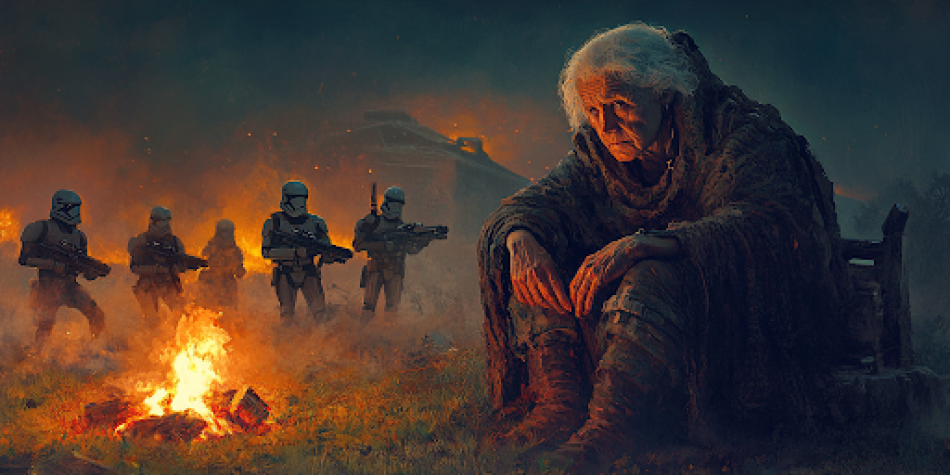
Much the opposite. Let me ask you: when was the last time you saw a movie or series whose hero was elderly? I don’t mean a show with Harrison Ford or Samuel L. Jackson in his mid-70s, with directors and stunt coordinators straining the limits of their art to pretend he can still beat everyone up. I mean an old person behaving like an old person; in fact, I mean the true hero of Andor, the protagonist’s mother, Maarva, a sick old woman hobbling about on a cane.
She hasn’t always hobbled. In a flashback, we see her in an adventurous middle age, stealing salvage from a crashed ship minutes before the navy arrives and then risking her life to rescue an orphan from certain death. Later we hear she was the president of some big civic organization. But those days are long past when the show starts, and now she spends most of her time resting in a chair, nagging her aimless son when he’s present and fretting while he’s away.
Most blockbusters that included such a hero—and there aren’t many—would force her through the same adolescent character arc as their protagonist. Her incapacity is all in her mind! She just needs to believe in herself! Then she can prove she’s still got it, that she’s not so old after all.
Maarva might be the first elderly character I’ve seen whose heroism doesn’t require her to become young again, who conquers with the powers appropriate to old age. It’s her experience and wisdom—and even her day-to-day uselessness—that let her see the truth while her younger friends, blinded by daily cares, treat Imperial occupation as just one more of life’s hassles to be put up with and outlasted. And when she speaks, it’s the love she’s earned through a lifetime of service that makes her friends listen.
Not that they want to, not at first; at first, they don’t know whether to laugh or cry. What she’s taking on is so comically beyond her strength and so likely to cost them her life—forget spies and stormtroopers; if she doesn’t stay warm and take her medicine, she’s not going to last long enough to be captured. But once again, she sees what they don’t: the worth of what’s left of her life and the worth of what she can do with it. Someday, our culture won’t ask us to choose between childishness and wickedness.
* * *
Alcohol won’t always be dangerous. I don’t know whether its nature will change or ours will, but there will come a day when the saints and their Master drink of the fruit of the vine in their Father’s Kingdom, and no alcoholism or drunk driving or domestic violence will follow.
Someday, storytelling will be safe, too. Someday, “adult” won’t mean “pornographic,” and “mature” won’t mean “nihilistic”; someday, our culture won’t ask us to choose between childishness and wickedness.
In the meantime, though, I’ll be grateful that healthy grown-up stories aren’t quite as rare as Word of Wisdom–compliant grown-up drinks, even if, for the moment, our culture shows little interest in either. Star Wars looks set to move on as if Andor had never happened, and I expect it to keep spinning out mostly bad, mostly adolescent stories as long as people will still watch them, after which it may well be replaced by something still worse and more adolescent. (Probably something distributed on TikTok.)
But so what? I don’t have to watch all that. And if Andor’s moral revolution in Star Wars was doomed to fail, at least it had—like Maarva—the wisdom to know it should still try.