Do you believe in God? How do you know?
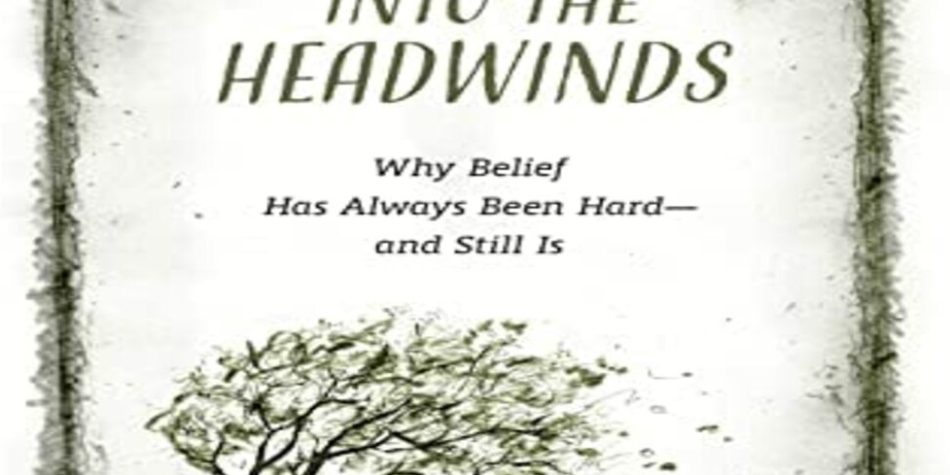
In their new book, Into the Headwinds: Why Belief Has Always Been Hard―and Still Is (Eerdman’s Publishing), Terryl and Nathaniel Givens recount a story about a friend who was sincerely convinced the Second Coming would take place within twenty years. Yet, why was he actively contributing to a retirement fund that would not be accessible until some twenty years after he believed the world, as we know it, would end? The Givenses make a strong case for an unsettling possibility: many of us sincerely profess beliefs we don’t actually hold, and we can’t recognize the hollowness of those beliefs until they cost us something. The way to know what we really believe is to evaluate the costs we are willing to pay, as revealed by our choices, for those beliefs.
Drawing on the work of moral psychologists and economists, the Givenses argue that belief formation is often driven more by utility than accuracy; in other words, we unwittingly adopt beliefs because they satisfy certain needs rather than because they reflect an impartial review of available evidence. Some beliefs carry an immediate cost if we get them wrong, such as beliefs about which plants are safe to eat. Perhaps by design, there’s no such immediate urgency for some of the most important questions. In the authors’ words, “Delusional practical beliefs are expensive. But if you’re fundamentally mistaken in your belief about seeming abstractions like the nature of God or the reality of heaven or hell, no immediate real-world repercussions will reshape those beliefs.”
Thus, the larger problem is not only that our beliefs serve certain ends rather than the evidence; it’s that we don’t know it and cannot correct it. The Givenses cite an example related by prominent Christian writer and pastor Timothy Keller, who was diagnosed in 2020 with terminal cancer:
Writing for the Atlantic, he described how even though he had preached about faith and death and just completed a book about the subject called On Death, he was “still caught unprepared.” “I found myself thinking, What? No! I can’t die,” he wrote … Hearing himself say these words, he realized the following: “This delusion had been the actual operating principle of my heart.”
Keller found himself unable to accept his own mortality because convictions about the afterlife had been more philosophical abstractions than concrete reality. Despite being a kind of expert on death and dying, his actual belief had been in a false sense of his own immortality.
According to the Givenses, the way to know what we really believe is to evaluate the costs we are willing to pay, as revealed by our choices, for those beliefs. “Asking a person to tithe … is the kind of choice that cuts through superficial professions to discover the beating heart behind belief” because “only through a lifetime of making searing choices among variously priced alternatives can we differentiate—even to ourselves—fictitious beliefs from real beliefs, values we think we embrace from values that are the real engine behind our actions and life commitments.” For belief to be something more than a product of our upbringing, our culture, or some other social or emotional necessity, it has to cost us something within those spheres.
The Givenses, therefore, assert that secularism is not the cause of waning Christian belief and values; rather, it is revealing to us the real-life costs we’re willing to pay for them. Because Christianity has been the default worldview in the west for some time, those beliefs and values carried relatively less risk—they were, in a sense, cheap. Secularism and other cultural shifts mean that our cultural momentum no longer favors Christian belief and the “high costs of belief select for true believers.” This is where faith stops being a set of mental abstractions and becomes a living process that draws out our sincerity, humility, commitment, and courage.
Herein lies one of Into the Headwinds’ most valuable contributions: it draws our focus away from threats to Christian belief and towards the opportunities of swimming against the cultural current.
All believers will eventually find themselves holding convictions that have become costly to maintain in the face of cultural and personal headwinds, but there’s good news: this is when the real work of discipleship can begin. Especially in such testing times, in order to maintain those convictions, they have to be internalized, and that’s where we will find ourselves sincerely reaching for Heaven. This is where faith stops being a set of mental abstractions and becomes a living process that draws out our sincerity, humility, commitment, and courage. When belief requires behavior, God-like characteristics are formed.
The hopeful message of Into the Headwinds is that when belief becomes hard, it also becomes meaningful.