
This article is part of a four‑part series that draws from insights in our forthcoming book, Exemplary, Strong Black Marriages & Families (Routledge, in press).
My journey as a researcher of strong African American families of faith begins with a short story about my paternal grandmother. As a highly religious, praise-dancing, Bible-quoting woman of faith, my grandmother based her every thought and decision on a religious foundation. After being diagnosed with colon cancer, she faithfully tucked her prescriptions into her Bible in lieu of having the prescriptions filled. If she was here today, my grandmother would argue that she won that battle against cancer. She would emphasize that she was faithful to the end, and she trusted that God would have healed her, if it was His will for her to be healed on this Earth. However, for a 16-year-old kid who just wanted his grandmother, her death left me with more questions than answers. Unbeknownst to me at the time, her death would plant in me a seed to understand religion and its role in Black families.
I knew that I wanted to research religion.
One day, while sitting in Loren’s office during our weekly Monday meetings, and while expressing my frustration with my dissertation proposal, he revealed that he had something for me. Handing me a massive 4-inch binder with over 1,000 pages of narrative interview data, Loren asked me if I would like to read the interviews of the married, strong Black couples that he had researched for over a decade. I read all 1,000 pages of interviews over a single weekend. I was fascinated! The stories of these marriages were so rich, so detailed, and so sacred. I was amazed that it could even be considered “research.” The role of religion in building a strong marriage was central to each interview, and this further ignited my desire to understand religion in Black families. The Monday after I had been handed a binder too big to fit in my bookbag, I asked Loren if I could utilize the interviews on strong Black families to examine how religious coping had contributed to their strong marriages. He enthusiastically agreed. We have now been research partners for 13 years.
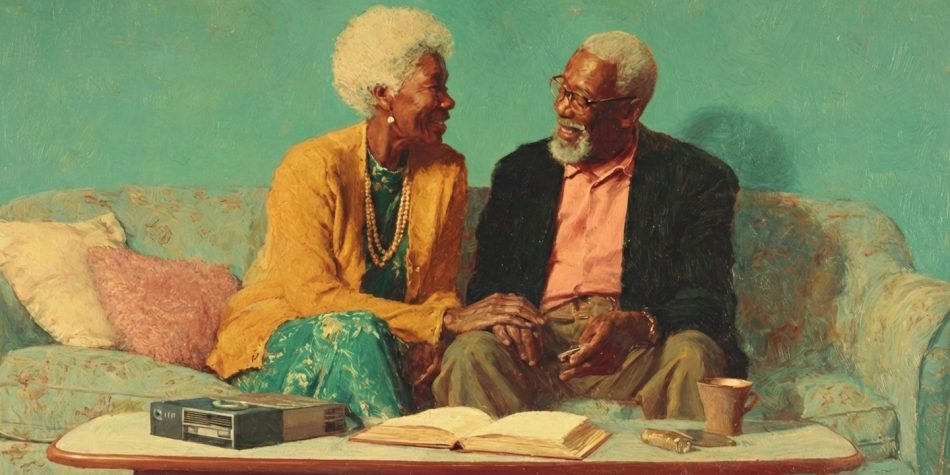
Despite my desire to study strong Black marriages, I was not necessarily surrounded by these types of relationships growing up. Neither of my grandmothers were in long-term marriages. In addition, my parents divorced around the time I graduated from high school. My parents had separated long before their divorce, so most of my memories of “family” came from looking at old pictures and seeing us all smiling together. Growing up, the best example I had of a strong marriage was a set of my great-grandparents, who were married for about 60 years before the death of my great grandfather, Paw-Paw. Paw-Paw was a minister in Southern Louisiana. He was deeply grounded in his faith, and he raised my highly-religious, praise-dancing, Bible-quoting grandmother that I mentioned earlier. I never thought much about my great-grandparents’ marriage, nor did I have a real opportunity to understand it because I only observed it as a child. However, I do know that they shared many similarities with the married, strong Black couples I have interviewed for my research. They saw their marriage as a sacred bond. As the grandchildren of slaves who were legally unable to marry, they were determined to honor their marital vows and build a family on faith and religious beliefs. I wish that I had been able to witness more of my great-grandparents’ marriage, but I am also thankful because I recognize the privilege of having a strong Black marriage in my family’s history.
The stories of these marriages were so rich.
When I ask Black couples who have been married for up to 60 years how they have done it, I am documenting their experiences for the many Black people who, like me, have rarely (or never) witnessed a strong Black marriage. I am documenting their experiences for the many Black couples who, like my wife Tasha and me, are still figuring out how to grow closer together each day. I am documenting their experiences for the many Black communities around the world that, like mine, are burdened by external stressors (such as financial strain, racism, and incarceration) that constantly threaten the stability of the Black family. Every moment, every interaction, and every opportunity has carried a purpose that has brought me exactly where I am, doing exactly what I am called to do at this moment, which is studying strong Black families and loving the journey.
Never in my wildest dreams did I think that my conversations with Dr. Loren Marks and a weekend with 1,000 pages of narrative data would change my life. Yet, they have. Each time I speak about my research, Black communities and families share with me that there is a need—an unquenchable thirst—for stories of Black couples deeply grounded in faith and unwaveringly dedicated to marriage. I have been a witness and recorder of profoundly sacred family moments where husbands have poured out their hearts to their wives and wives have found comfort in the arms of their husbands. I have been invited to vow renewals, wedding anniversaries, and family dinners. A few months ago, I received word from a husband I had interviewed that his wife had recently died. He thought enough of our interview to let me know the news. For me, that was deeply powerful, and as I revisited their interview, I thanked God for allowing me to share in such a sacred experience.
They saw their marriage as a sacred bond.
I am indebted to Public Square Magazine, as they will be running three additional articles during Black History Month to highlight our team’s work with Black families. I urge you to stay tuned as you hear directly from the voices of strong Black families this month. These articles will focus on: (1) serving others, (2) using faith to cope with racism, and (3) the power of positive humor. As you engage these stories, I invite you not simply to read them, but to receive them. Allow the lived faith of these families to speak to you, to teach you, and to bless you and those around you. These stories are not ours to own, only to share. They are reminders that Black love grounded in faith can be profoundly powerful— capable of overcoming even the highest hurdles attempting to impede familial stability. May their faith strengthen yours, and may we continue to go forward as one people, as brothers and sisters, just as civil rights leader John Lewis urged us to do.