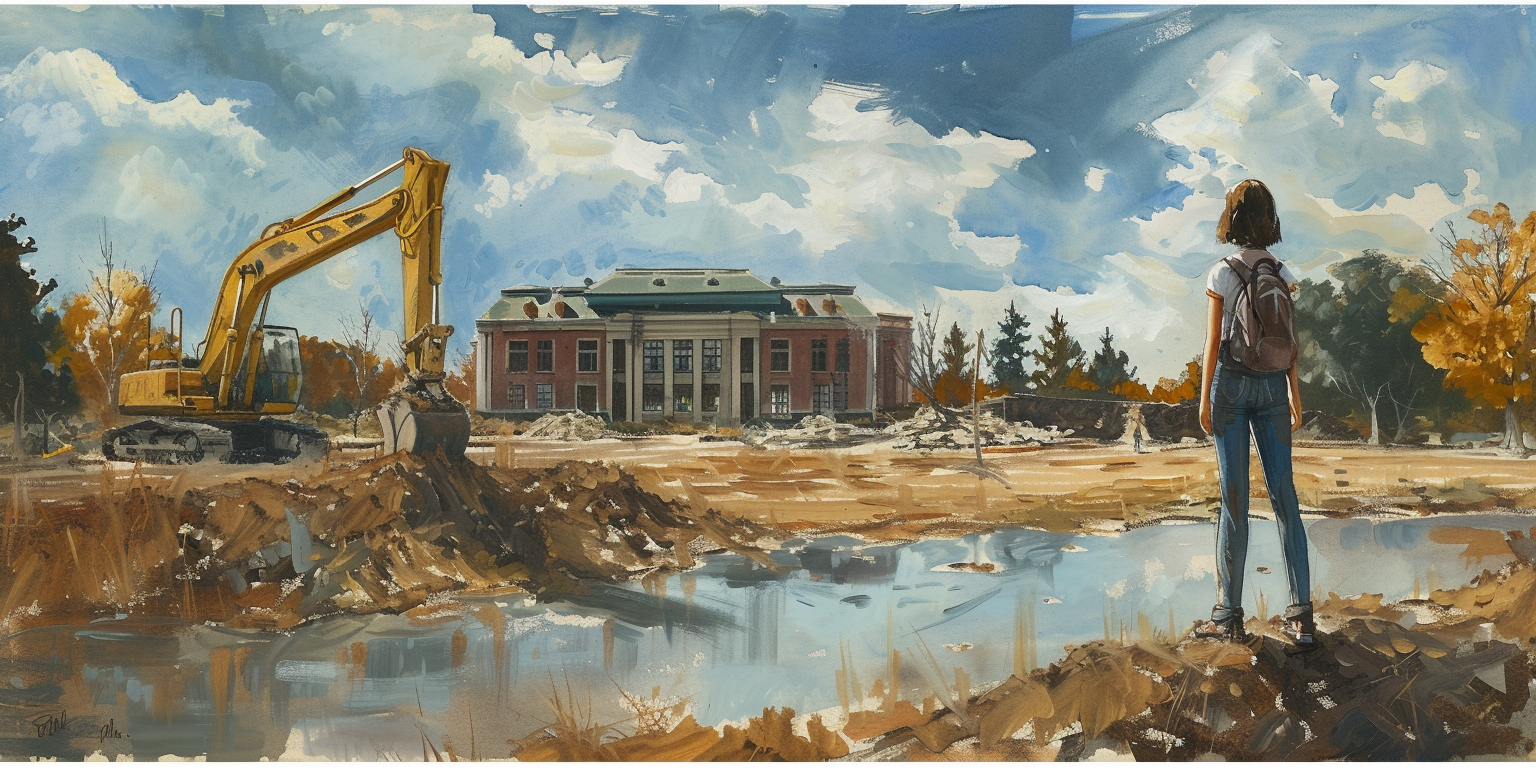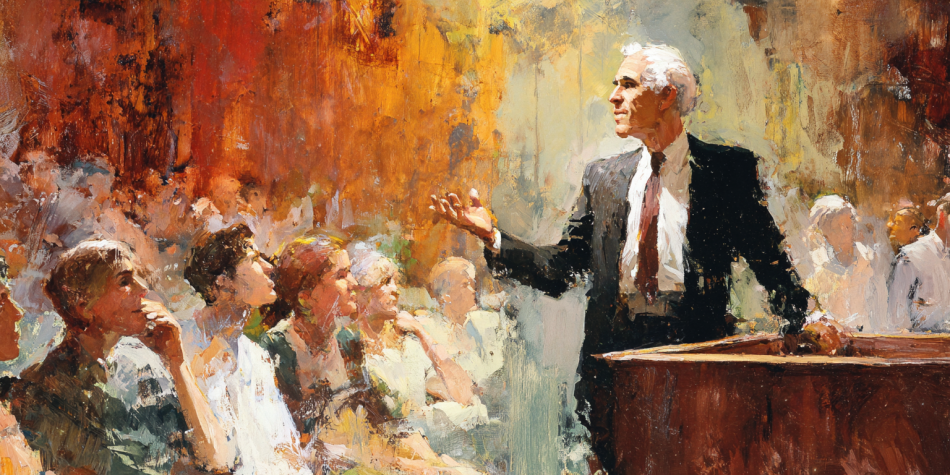
A modern-day prophet in a chapel setting speaks with warmth and firmness to a small group, reflecting how modern-day prophets adapt tone but preserve truth.

What Changed in Prophetic Language, And What Never Will

Has prophetic language softened? Yes, tone adapts to culture, but doctrine remains exacting and unchanged.

Download Print-Friendly Version

Reading The Miracle of Forgiveness surprised me. I grew up hearing this book used as the quintessential example of gospel bluntness. I also craved that kind of no-nonsense approach to gospel standards and admired it when I encountered it in leaders. Still, even with a high tolerance for directness, I was taken aback by how forthright President Spencer W. Kimball could be. His moral calls were unambiguous, his language arresting. It raised a sincere question: why does prophetic language feel less fiery today? Some say our leaders are too soft now. Others say prophets of the past were too harsh. Which is it?

History shows that prophetic tone has never been static. In the 19th century, Brigham Young’s rugged style fit the demands of frontier survival. President Joseph F. Smith spoke with the gravity of one who had personally suffered persecution and loss. In the mid-20th century, President Kimball’s direct calls to repentance reflected a culture where plain talk was considered a virtue. Today, President Russell M. Nelson often uses the language of invitation: “Think Celestial,” “gain spiritual momentum,” “let God prevail.” The tone feels warmer, but the content is still exacting. Part of the reason for these shifts may lie in a rhythm we see repeatedly in scripture and history. Prophets often speak with great boldness before a prophecy is fulfilled—Noah warning of the flood, Abinadi confronting King Noah’s court. In our own day, decades of clear prophetic warnings about the disintegration of the family may now be giving way to counsel aimed at fortifying those who will listen, even if some interpret that change in focus as a departure from truth rather than prophecy fulfilled. To draw from Noah again, after the flood came and went, his messaging (to those left) likely shifted. Not because eternal truths changed, but because the priorities changed.

History shows that prophetic tone has never been static.

Some suggest this more modern shift means the doctrine has changed. However, prophets do not bend doctrine to cultural winds. As the Lord Himself declared, “whether by mine own voice or by the voice of my servants, it is the same” (Doctrine and Covenants 1:38). What may look like softening is more accurately divine accommodation: God, in His mercy, guiding His servants to frame truth in ways that can be received by His children today.

 A style that felt normal to a 1940s farmer might feel abrasive now. Research in Communication Accommodation Theory, developed by Howard Giles in the 1970s, shows that effective communicators instinctively adapt their tone, pacing, and style to their audience to maximize receptivity. Prophets, like other inspired leaders, may adjust their delivery so the message can reach hearts without being rejected at the outset.

There is also a broader cultural shift toward sensitivity in public discourse. Pew Research surveys over the past decade show that Americans increasingly prioritize “respectful” language and are more likely to view blunt speech as offensive rather than refreshingly honest. Younger generations, in particular, tend to value empathy cues and “emotional safety” in messaging. Whether this is a positive or negative development is up for interpretation. But against that backdrop, it is not surprising that prophetic language has evolved to meet listeners where they are without abandoning eternal truth. 

President Ezra Taft Benson captured the heart of this when he said, “The living prophet is more important to us than a dead prophet. God’s revelations to Adam did not instruct Noah how to build the ark. Noah needed his own revelation. Therefore, the most important prophet, so far as you and I are concerned, is the one living in our day and age to whom the Lord is currently revealing His will for us.” The prophets of the past spoke to the needs of their time; the prophet now speaks to ours. Both deserve to be heard in their own context.

The prophets of the past spoke to the needs of their time; the prophet now speaks to ours. Both deserve to be heard in their own context.

The challenge is that tone and clarity are not the same thing. A gentler delivery can be mistaken for doctrinal compromise, especially on sensitive topics. Take, for example, the Church’s consistent teaching that marriage between a man and a woman is ordained of God and that sexual relations are reserved for that covenant. In earlier decades, such teachings were often delivered with explicit warnings and firm rebukes. Today, they are framed within invitations to live higher laws, sometimes without extended discussion of consequences. The language is pastoral, yet the doctrinal definition of marriage remains precise and unchanged.

Language naturally evolves, and prophetic word choice evolves with it. Linguistic research by George Lakoff has shown that small shifts in framing can dramatically influence how a message is received, even when the core meaning is the same. Words like “virtue” and “chastity” still appear, but “sexual purity” or “moral cleanliness” are more common. Even subtle substitutions, such as using “home” in place of “family” in certain contexts, may broaden the resonance of a message to those in varied circumstances while still preserving the underlying doctrine.

There are risks in every approach. If prophetic rebuke feels too sharp, some will dismiss it as unkind. If it feels too gentle, others may miss the urgency. The greater danger, in either case, is to focus so much on the delivery that we fail to hear the substance. Dismissing Brigham Young’s counsel because of his rough edges, or ignoring President Nelson’s because it comes with compassion—both risk missing the voice of the Lord.

The living prophet will always be the most relevant voice for our time.

Scripture shows that the Lord’s messengers have always adapted their delivery to their audience. Alma addressed the Zoramites with doctrinal correction suited to their pride and misunderstanding, while King Benjamin spoke to a humble, covenant-ready people with promises of joy. Paul reasoned with the Jews from the scriptures, but with the Athenians he appealed to their altar “to the Unknown God” and quoted their own poets. In each case, the message was the same, but the approach reflected the hearers’ readiness.

Modern prophets do the same. President Gordon B. Hinckley’s hallmark optimism fit a global Church coming into public view. President Thomas S. Monson’s warmth and personal storytelling reflected a desire to strengthen individual hearts. President Nelson’s steady call to “hear Him” combines encouragement with a clear articulation of covenantal obligations. Seen together, these patterns suggest not a departure from truth but a consistent application of prophetic stewardship — to declare God’s will in ways the current generation is most able to receive.

The living prophet will always be the most relevant voice for our time. Comparisons across decades can be illuminating, but they can also distract from the revelation God is giving now. Truth is truth, whether it comes as a thundering rebuke or a tender invitation. The question that matters most is not whether we prefer the tone, but whether we will act on the counsel. Ultimately, the Lord directs His servants in how they deliver His word. Tone shifts may reflect both changing circumstances and divine wisdom in preparing His people for what lies ahead.

The next time we hear a prophetic message, it may help to listen with two questions in mind: What is God asking me to do? And am I willing to do it? The answers will matter far more than whether the words stirred us like a trumpet blast or drew us in like a quiet voice.

About the author

Skyler Sorensen

Skyler Sorensen is a husband and father of three whose first son, Milo, died from complications related to premature birth. Skyler is open about his mixed-orientation marriage to his wife, Amanda, and shares his perspective on faith, identity, and discipleship on social media. He is also the author of Exclude Not Thyself: Thriving as a Covenant-Keeping, Gay Latter-day Saint.
On Key

You Might Also Like

A reflection on violence in film

Gladiator II is a serviceable historical epic. If you loved Gladiator, you’ll like Gladiator II. Gladiator II opens as Rome is about to siege the “last free city in Africa.” Our nameless hero loses valiantly with his wife dying in the battle, and he is brought to be a slave in Rome. But if our hero can perform well enough as a gladiator, he can buy his own freedom. And with that, we’re off. The beats of this film will be familiar, with a massive twist only halfway through that changes the stakes for everyone. Our hero is really the son of our hero from the last movie! Which means he has a legitimate claim to the throne of Rome. The movie tries to follow three different stories. Our hero (Paul Mescal) is trying to win his freedom and avenge his wife’s death. Acacius (Pedro Pascal), the general of the armies, wants respite and time with his wife; he also wants to lead a coup against the emperors. Macrinus (Denzel Washington) wants to work his way up in Roman power through political scheming. And then on top of all of that, we are told that our hero must deal with his father’s legacy and discover who he truly is.  It’s a lot, even for an epic, and the screenplay is not nearly tight enough to keep all the storylines coherent and moving. We are led to believe that Macrinus is successful in maneuvering to the top of Roman society because of his exceptional political skill, and Denzel Washington’s delicious performance makes that believable, but all we actually see him do is win a bet and carry out an assassination. Pedro Pascal’s excellent work as the weary general does some of the work in helping reconcile the contradictions in his character, but a look on his face here or there has to carry a lot that a simple conversation could have fleshed out.  Perhaps the reason the script doesn’t have time to breathe is also its biggest contradiction. There is something grotesque about watching audiences cheer on the brutal violence taking place in the film. And yet, the entire film is centered on having us, the audience, watch one set piece of over-the-top violence after another. We don’t get to see Macrinus manipulate the Roman senate because, instead, we need to see our hero fighting with CGI rhinos or CGI sharks. There is a place for violence in a moral movie. It can be helpful to attune our senses to recoil from violence or recognize the rare places it is justified. But the violence on display in Gladiator II is so relentless and gratuitous that it dulls the senses instead.  This is not to diminish the craftsmanship that has been used to bring this world and its many battle scenes to light. Rome feels broad and alive in true epic fashion, and it’s easy to get swept away into its world—with the exception of a few uncharacteristic pieces of clunky CGI work. The opening battle sequence is perhaps the best ever put to screen.  The best part of Gladiator II was its opening. A 1950s style opening credits are shown over a lavish dreamy animated retelling of the first film. Everything about it screams that something epic is about to be shown. But throughout the movie I stayed fixated on what it could have been. What if it had been more focused on the characters I cared about? What if it didn’t try to connect so much plot to the previous film and let this story stand on its own merits? What if they had expanded it to a TV miniseries so that its many plot points had space to breathe? In the end, despite some good acting and a beautiful setting, the movie just left so much to be wanted.  Gladiator II is R-rated. It is not appropriate for children or, in my estimation, most adults. At its core, this film has a moral message: life is hard, but it’s worth fighting for. But the way it’s presented on screen does more to drag down the spirit than to lift it up. Two and a half out of five stars. Gladiator II opens nationwide November 22, 2024.

How We Heal

The division is growing. And the American people are weary. But the truth of forgiveness and reconciliation is no less available and promising. One mediator’s perspective.