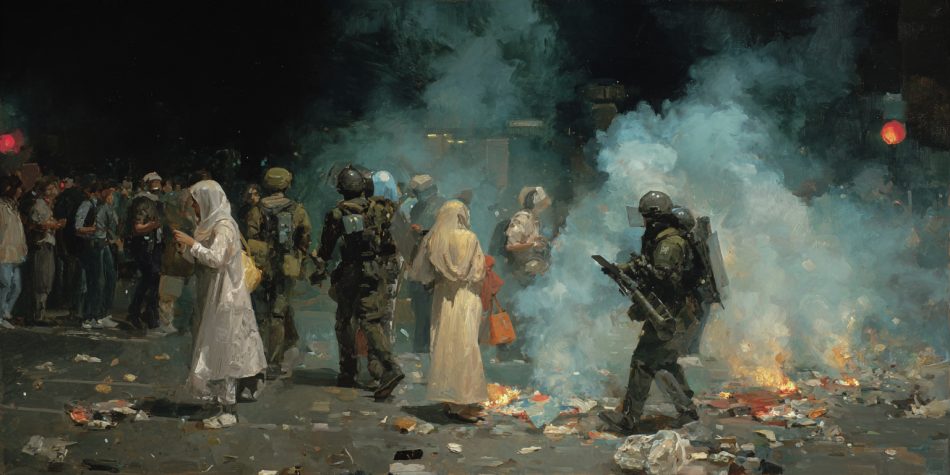
Imagine living in a country where the internet is cut, phone service disappears, and contact with the outside world is severed. Gunfire echoes through the streets. People scream. Bodies appear. No one knows who will be next or whether anyone beyond the borders even knows what is happening.
This is not a metaphor.
This is the lived reality for millions of Iranians during periods of nationwide internet shutdowns. These blackouts are not technical failures or temporary security measures. They are deliberate instruments of control, designed to suppress coordination, erase evidence, and delay international response. Repression combined with enforced invisibility has become a defining feature of modern authoritarian governance.
Confronted with this reality, many observers turn instinctively to international law. Surely there must be institutions, treaties, or legal mechanisms capable of protecting civilians when their own government becomes the threat. The post–World War II order was built precisely to prevent such abuses.
Yet that expectation misunderstands how international law actually functions.
International law is largely declarative rather than coercive. Its enforcement depends on state consent, diplomatic pressure, reputational costs, and political will. These mechanisms fail precisely when a regime is willing to use violence against its own population and absorb international condemnation. This is not an anomaly in the system; it is the system.
International law is largely declarative rather than coercive.
The UN Security Council institutionalized this contradiction. Designed to preserve stability among major powers, it granted veto authority to states whose cooperation was deemed essential, even when those states later became enablers or perpetrators of repression. Today, Russia and China routinely block meaningful action against internal atrocities. Their support for regimes such as Iran’s is not ideological sympathy alone; it is strategic. Iran provides energy access, sanctions-evasion networks, regional leverage, and a partner in balancing U.S. influence. Venezuela plays a comparable role in the Western Hemisphere.
These cases illustrate a broader reality: the rules-based order has limited capacity to act against well-protected sovereign violators.
This raises a question that policymakers often avoid confronting directly. In a system where rules lack enforcement, and where power is frequently the only effective constraint on actors who violate those rules, how should the use of power itself be evaluated?
Debates about foreign intervention are often framed through the lens of Iraq or Afghanistan, as though the primary lesson of the past two decades was that intervention is inherently illegitimate. That framing obscures a more uncomfortable truth. Intervention is often not the cause of systemic failure, it is the consequence of it.
Power restrains power. When enforcement collapses, restraint does not emerge organically; it is imposed, or it does not exist at all. The relevant question, therefore, is not whether foreign intervention is dangerous—it always is—but why the international system repeatedly produces conditions in which intervention becomes the only remaining option.
Vacuums are not filled by law, but by rival powers.
From this perspective, U.S. efforts to limit Nicolás Maduro’s hold on power or to support the Iranian people’s aspirations for transition reflect a tacit recognition that vacuums are not filled by law, but by rival powers. We must be intellectually honest about the nature of these rivals. While no global power is beyond reproach, there is a fundamental difference in the architecture of influence. The Western model, led by the United States, operates within a framework—however flawed—that views the state as a servant to the people. In contrast, the strategic partnership between Russia, China, and Iran views the people as a resource to be managed, silenced, or erased to ensure the survival of the state.
As an Iranian, I see the support for a peaceful political transition not as an “infringement” on a nation, but as the enforcement of a higher law: the right to exist visibly and safely. If the 20th-century order was built to protect states from one another, the 21st-century order must be built to protect people from the state when that state turns predator. Accepting this is not cynicism; it is realism. The question is no longer whether the rules-based order will be tested—but how many times it must fail before we realize that a law that cannot be enforced is not a law at all, but a license for the powerful to be cruel.