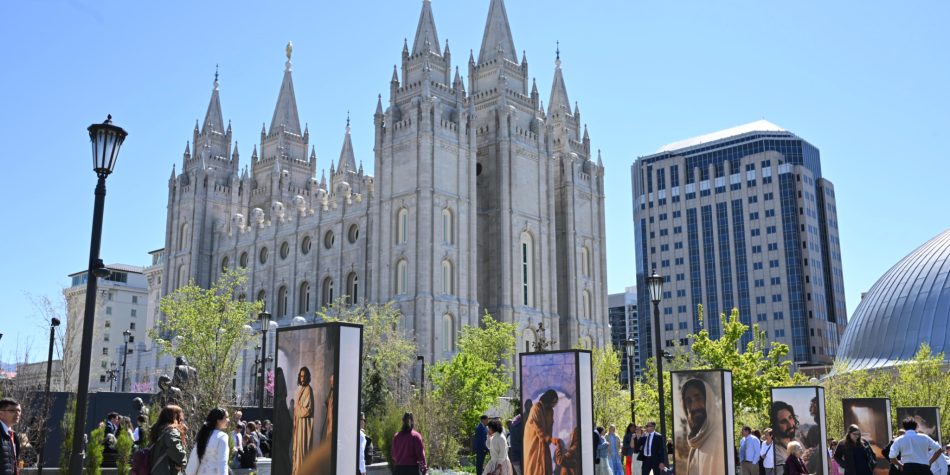
Visitors gather at Temple Square in Salt Lake City, Utah, for the April 2026 General Conference of the Church of Jesus Christ of Latter-day Saints.

Enduring in Charity: General Conference Round-Up

Amid stories of grief and endurance, conference teachings returned to charity, holiness, and the work of peace.

Blessed Are the Peacemakers 

Danny Frost

President Dallin H. Oaks again turned to the topic of peacemaking—a key part of his teachings, as well as those of President Russell M. Nelson. The repeated prophetic calls for peacemaking suggest that this is one of the key issues of our time. Christians should know better than to indulge in the contempt and hostility that are all around us. 

I appreciated how President Oaks indicated that peacemaking often means doing several things well at once: showing love and compassion for those who are different from us even as we stand up for the truth as we understand it. President Oaks also emphasized that personal virtue must be at the core of enduring peace. He noted that missionaries act as peacemakers when they “preach repentance from personal corruption, greed, and oppression, because only by individual reformation can an entire society eventually rise above such evils.” 

Peacemaking can include many other things such as bishops’ efforts to help marriages and resolve personal conflicts, service to others, reducing suffering, increasing understanding between groups, and raising children (including foster children). Peacemakers heal and uplift. President Oaks’ closing words are a powerful invitation to be better peacemakers: “Let us follow Him by forgoing contention and by using the language and methods of peacemakers. In our families and other personal relationships, let us avoid what is harsh and hateful. Let us seek to be holy, like our Savior.” 

Charity and Enduring to the End

Anna Bryner

Elder David A. Bednar delivered a great insight about how “enduring to the end is linked inextricably to the spiritual gift of charity.” He taught that “charity is the very essence of the end toward which we are enduring: becoming new creatures in Christ.” In other words, charity is not only a spiritual gift that will help us endure to the end, but the very substance of the kind of person we are to become: one who “suffereth long, and is kind, and envieth not, and is not puffed up, seeketh not her own, is not easily provoked, thinketh no evil, and rejoiceth not in iniquity but rejoiceth in the truth, beareth all things, believeth all things, hopeth all things, endureth all things.”

I thought Elder Bednar’s talk paired well with President Dallin H. Oaks’ talk about relating to one another as children of God. This is the practical work of charity—to allow Christ’s love and righteous desires to fill our hearts and transform the way we interact with others. Peacemaking can start in each of our hearts as we seek the spiritual gift of charity from the Father.

Faith Through the Highs and Lows

Lauren Yarro

President Emily Belle Freeman shared a powerful perspective that both our good days and our hard days are part of God’s plan. In her talk, she uses Peter’s story to show that faith isn’t built in one defining moment, but over time through both the highs and the lows of life. Peter had moments of bold testimony and moments of fear and failure, and he still became who the Lord needed him to be. President Freeman reminds us that Christ is not distant in our hardest moments. He is right there with us, strengthening us and reminding us that our worst days are not the end of our story.

I needed the reminder that both the best days and the worst days are shaping us into who the Lord needs us to become. She taught that holding onto the eternal truths and the promised blessings of the gospel of Jesus Christ allows us to draw upon the power of God in our lives. Her closing reminder was that “joy is not the absence of sorrow in your life. It is the presence of Jesus Christ in your life.” 

Ministering in the Savior’s Way

Amanda Freebairn

This general conference was a reminder to me of the many storms the people around us are facing. Elder Ronald A. Rasband shared about the short life of his grandson who was born with chromosomal abnormalities. President Emily Belle Freeman explained that recently, during the excitement of planning her daughter’s wedding, her beloved husband found out his cancer had returned. Elder Thierry K. Motumbo told the story of losing four children. 

But along with these heartbreaking stories emerged a theme of love and ministering, and the impact ministering can have on the lives of those we minister to. 

Sister Kristen Yee shared that her father, who had been at one point emotionally abusive, began to heal through the Savior when a ministering couple invited him to attend the temple weekly. She also explained that “ministering by the Spirit invites the Spirit into our lives and the lives of those we minister to. I often find peace, clarity, healing and purpose when I minister. I find the Savior when I minister. This is by divine design.” 

Both President Dallin H. Oaks and Sister Yee testified that through the Savior, we can come to love in ways that we never thought possible. Elder Patrick Kearon said since his calling to the Quorum of the Twelve Apostles, “I’ve learned that I can love even more…We don’t serve people we really love, rather, we come to love people as we serve them.” 

President D. Todd Christofferson taught that as we cultivate the pure love of Christ, lift and minister to others, and exercise devotion to the will of God, we can little by little enact change in the world.

“We tend to underestimate the influence of Christlike individuals in the world. But working one by one has always been Jesus’ approach to a changing society and establishing his kingdom. It is the aggregation of individual choices over time that forms and changes societies for good or ill. No one of us alone can change the world but each of us can have an influence in the world.”


About the author

Public Square Staff

Our core team, including our Editor, Managing Editor, Communications and Media Directors, Visual Display Director and Copy Editor.
On Key

You Might Also Like

Is it Time for Latter-day Saints to Support Same-Sex Marriage?

I wanted to thank Blair Hodges for calling attention to an article we ran earlier this year by Professor Robert P. George.  Blair has been a frequent critic of the magazine, and we appreciate his engagement and efforts in drawing attention to the work we’re doing. As one of the pre-eminent political philosophers working today, Professor George’s decision to publish with us was a major sign of legitimacy.  Hodge’s article was, in many ways, perceptive. He noticed that Professor George, and by extension, many of our editors here, is concerned that many people, especially religious people, struggle to justify their beliefs about family, marriage, and sexuality through anything other than appeals to religious authority. (We kindly disagree that these positions are anti-LGBT+ as Blair describes them.) And he’s right about that motivation. Church leaders have been very clear about the doctrine of the family for more than a generation, as we highlighted earlier this year. But where the cultural messaging on sexuality is so dominant, it’s easy for Latter-day Saints to feel overwhelmed and struggle to explain to others why they accept what prophet leaders of the Church of Jesus Christ teach what they do.   And Hodges is right that we hope to make a difference in this regard with our work. But otherwise, his article falls into the same traps of many before him that George and others have largely dealt with. Conflating “Hyper-Individualism” with “Expressive-Individualism” Hodges attempts to address George’s concern with individualism. But he makes a category error. Individualism, as Hodges uses it, seems to be a synonym for selfish. Individualism, as George uses it, means how we define the individual. These are two substantially different concepts. On this basis, Hodges raises concerns about hyper-individualism (hyper-selfish)—pointing out this issue is no more relevant to LGBT+ issues than to anyone else. That’s a fine argument to make, but it really has nothing to do with the point George makes. His point being, how we define the individual is of crucial importance to issues of sexuality. Because today the predominant cultural approach to defining the self is expressive individualism. Expressive individualism is a philosophy that holds that who we are is defined by what we feel we are at our psychological core. And that the greatest good is expressing that psychological core to the world, including through our behavior.  As described by Carl Trueman in his recent book The Rise and Triumph of the Modern Self, this idea has its roots in the work of Romantic philosophers like Jean-Jaques Rousseau and like-minded poets, literary figures, and artists of the 18th and 19th centuries, but largely took off in the 1960s at the beginning of the sexual revolution. Expressive individualism has substantially become our culture’s default approach to defining identity. But many Christians push back on this idea as we choose to make our central identities based on a different foundation.  As articulated by President Nelson in a recent devotional for young adults, he explained that the three identities we should prioritize (and not allow to be obscured) are 1) Child of God 2) Child of the Covenant 3) Disciple of Christ As Latter-day Saints, then, we choose to make those our central identities and base our choices on that foundation.  Hodges also suspects that “queerness would be less ‘central’ to a person’s identity the less social pressure and regulation they’d face about it.”  But what does Hodges mean by less central? If identity powerfully influences the choices we make, then the less central an identity, the less influence it has over our choices. These choices include why, how, when, and with whom someone has sexual relations. Prioritizing disciple of Christ and child of the covenant as identities, as Russell M. Nelson suggests, would lead to different choices about sex than prioritizing sexuality as identity. Love and Disagreement One of Hodges’ main requests is that George “spent more time saying how a person can be loving towards someone while also condemning an important part of their identity.” In our view, this is a tired argument in an already wearisome conversation. Sexuality is not an inevitably central part of identity.  Our editorial team falls across the political spectrum. In each of our lives, we have people who love us despite having serious concerns with that political part of our identity.  Our editorial team are all Latter-day Saints. In each of our lives, we have people who love us despite harboring serious questions about the important religious part of our identity. We’ve also felt loved by people who thought it was a dangerous and outdated idea not to have sex until marriage, constituting an important part of all our sexual identities. But Hodges’ argument suggests it’s somehow impossible to love someone while having honest concerns about how they prioritize the sexual part of their identity.  But of course, it’s not. Not only is it possible, but Christian believers are under clear command to love those we disagree with.  It’s those who demand “you can’t love me unless you agree with my paradigm for identity” that are preaching an extreme and radically alternative  approach to tolerance in a pluralistic society, not those who say, “I love you, but I disagree.” That has been the durable default of pluralistic tolerance that has helped make our diverse nation possible. Race and Sexuality Blair also goes to the old tired well of comparing race and sexuality. This is a comparison that many civil rights activists have rejected.  Dr. Alveda King, Martin Luther King Jr.’s niece, and William Avon Keen, president of the Southern Christian Leadership Conference of Virginia, the organization Martin Luther King Jr. started, have rejected the connection between sexuality and race in civil rights.  In fact, George takes on Blair’s point at length in his article in Harvard’s Journal of Law and Public Policy: Revisionists today miss this central question—what is marriage? when they equate traditional marriage laws with laws banning interracial marriage. … But the analogy fails: antimiscegenation was about whom to

A Gospel Foundation for Common Ground on Social Justice

Social justice has become a point of aching division in America, and even among Latter-day Saints—with different sides claiming Jesus’s message as justifying their own view. Could that same gospel, however, offer some ways to find vital common ground instead?