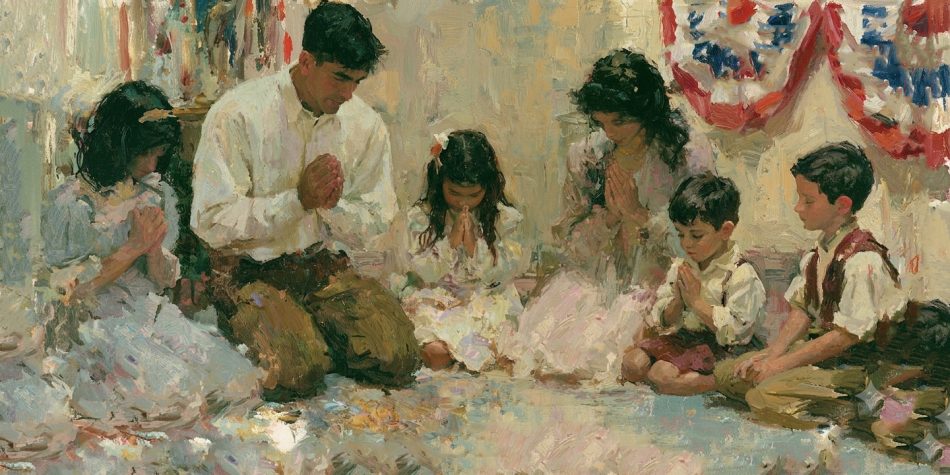
As we approach the July 5 fast “to express gratitude for religious liberty and to pray that it be strengthened throughout the world,” it may help to exercise our faith by praying with specificity. Here are five areas of religious liberty worthy of our focused prayers.
- We can pray for religious prisoners of conscience.
Like Joseph Smith in Liberty Jail, many today are imprisoned for their faith. Others are tortured, disappeared, or sentenced under unjust laws. In China, Seylihan Rozi, a Uyghur Muslim mother, was sentenced to 17 years for teaching the Qur’an to her children and a neighbor. In Iran, Joseph Shahbazian, a Christian pastor, was convicted of praying with others and celebrating Christmas. In Russia, Ivan Neverov, a Jehovah’s Witness, received seven years for holding religious meetings. And in Nigeria, Yahaya Sharif-Aminu, a Sufi Muslim musician, has spent more than six years in prison facing the possibility of the death penalty for sharing song lyrics deemed blasphemous.
We can pray for these prisoners and their families—and even for their captors—that hearts may soften, prisoners may be treated with dignity, and unjust laws may change.
- We can also pray for religious communities facing genocide and mass violence. Our own history of extermination orders and forced exile should make Latter-day Saints especially tender toward those whose faith has made them targets of violence. Uyghur Muslims in China have endured mass detention, forced labor, and the systematic destruction of families and mosques. Christians in Nigeria continue to be murdered, kidnapped, and driven from their villages. Armenian Christians have been forced from their ancestral lands. And Rohingya Muslims have been driven from Myanmar into desperate refugee camps.
We can pray for the displaced to find safety and compassion, for the violent to be restrained, and for those who are suffering to be strengthened.
- We can pray as well for democratic countries where religious liberty is weakening. In Japan, courts dissolved the Unification Church and seized its assets. In France, strict secularism has forced Muslim girls to choose between receiving an education and keeping their religious commitment to cover their hair. In Canada, recent legislation removed the longstanding religious speech defense, raising concerns that good faith religious expression could now be prosecuted as hate speech. And here in the United States, where religious liberty is core to our national identity, the picture is sobering: by my calculations from Pew Research Center’s data, the U.S. ranks 90th out of 198 for freedom from government restrictions on religion—and 91st for social hostilities. The threats range from legal pressure to lethal violence: pandemic-era limits on worship, conscience conflicts for religious professionals and institutions, and deadly attacks on Jewish, Muslim, and other faith communities—including Latter-day Saints in Grand Blanc.
We can pray that free nations—especially our own—will have the humility to recognize our shortcomings, and will have the courage to live up to our ideals and strengthen religious liberty.
- The darkness is real, but so are the people shining a light. We can pray for the defenders of religious freedom. Through the First Freedom Foundation, I have the privilege of working with young leaders like Hewan Omer of the Free Yezidi Foundation, who serves genocide survivors in Iraq; Twesigye Leonard, a secular humanist in Uganda, who trains lawyers to defend religious liberty where non-Christians are often persecuted; and Mohammad Rahaman in Nepal, who is working to guide his country’s powerful youth movement toward principled advocacy rather than division. Others cannot be named for their safety. Like America’s founders, they are often young, under-resourced, and facing overwhelming opposition—yet they continue to defend religious freedom for all, even as they receive bombs at their doors.
Pray that they will be strengthened, protected, and sustained in hope.
- Finally, we can pray for courage in ourselves. Religious freedom is not only a right to defend; it is a duty to extend. It is easy to support the rights of those we agree with. It takes far more courage to stand for the conscience of our adversaries. President Dallin H. Oaks has taught that the freedom and protection we seek must not be “for ourselves alone.”
We must pray for the strength to defend religious freedom for friend and foe alike.
As we fast, let us remember those whose poverty, hunger, and displacement are the direct result of religious persecution—refugees driven from their homes, families denied work or education, and believers forced to choose between conscience and survival.
May our hearts be softened toward the persecuted, our courage be strengthened to defend religious liberty for all of God’s children, and our offerings of prayer, sacrifice, and action be accepted by the Lord.