rainbow (2)

A New Kind of LGBT+ Advocacy?

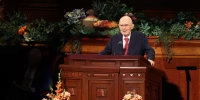
In the wake of Elder Holland’s BYU talk, I can’t help but wonder—what would LGBT+ Advocacy “bathed in the light of the gospel” look like?

For the first time in my life, I’ve recently started to train myself to run.  Having never really run before, I currently divide my 30-minute cardio exercise into intervals of 4-minute walks and 2-minute runs.  As challenging as it is, if a trainer were to tell me to course correct in some way, it wouldn’t be difficult because only one-third of my time is spent actually running (and even then it’s more like a sad jog).  However, if I were more advanced in my training, perhaps running the entire 30 minutes and at a faster pace, a course correction would be jarring.  I would experience something akin to whiplash having to change direction when I am so confidently and ably headed on my chosen path.

Similarly, many faithful members of The Church of Jesus Christ of Latter-day Saints experienced a sort of whiplash after Elder Holland requested a course correction from BYU’s faculty and staff last Monday.  For those whose advocacy of the LGBT+ community is at its early stages, it may have been easier to hear and accept his counsel.  But for members of the LGBT+ community and those who are vigorous and passionate allies, it was jarring and painful—so much so that misinterpretations of his intent and request abound in opinion pieces found in the popular and social media.

Perhaps BYU’s uniqueness means that, for instance, LGBT+ advocacy on campus should persist but that it should be fundamentally different than it is elsewhere because it is bathed in the light of the Gospel.

Certainly, given that Elder Holland’s remarks came in a meeting during which BYU President Worthen announced the creation of BYU’s new Office of Belonging (a move sanctioned by the Board of Trustees, on which Elder Holland sits), his intent was not to call for musket fire against inclusion (or the LGBT+ community at large) as some have mistakenly argued.  And so, it becomes necessary to acknowledge the whiplash and begin trying to understand what caused it and how to begin healing from it.  That healing can in part be found by resisting the tendency to hone in on one section, comment, or example and instead carefully examine the entirety of Elder Holland’s talk.  Additionally, watching and listening to—rather than reading—his talk can help promote healing.  Given that an estimated 70% of communication is nonverbal, reading the text risks missing Elder Holland’s evident love and tenderness for LGBT+ students as he spoke. 

Speaking to BYU personnel, Elder Holland’s overall message was to remember the unique nature of the University, live accordingly, and nurture it.  Unlike other institutions, whose purpose is to search out and teach disciplinary truths, BYU’s purpose is to do so bathed in the light of the Gospel.  Affirming that all truth comes from God, BYU leaders have always encouraged a seamless integration of Gospel and Church doctrine with disciplinary discovery.  In his address, Elder Holland highlighted that “our integrity demands that our lives ‘be absolutely consistent with and characteristic of the restored gospel of Jesus Christ’” and emphasized the need to “stay in harmony with the Lord’s anointed.”  Acknowledging that there will always be debate at the university, Elder Holland’s purpose was to course correct any behaviors that were inconsistent with these two tenets.

It is true that Elder Holland referred to Elder Oaks’ previous analogy of musket fire in defending the doctrines of marriage and sexual behavior.  However, his remarks on how LGBT+ issues are handled, comprising only 5 of 30+ paragraphs, were simply illustrative of a broader issue, namely that BYU personnel sometimes unintentionally and perhaps even intentionally aim musket fire at the Church and doctrine.  And doing so threatens BYU’s unique nature and mission by leaving many students confused and conflicted, with their faith challenged, yet not strengthened.  Instead, on LGBT+ and other issues, Elder Holland encouraged us to take a course of action that will help fulfill Isaiah’s prophecy to “beat [our] swords into plowshares, and [our] spears into pruninghooks” (Isaiah 2:4).

This course correction Elder Holland initiated is more difficult for some than others.  Those running full force in certain directions are experiencing whiplash and angst about what this means.  Some feel untrusted, that their efforts are unvalued, and worry about those in the LGBT+ community who feel rejected.  And because his emphasis was on what is or is not to be done, and not on how to do it, many are left frustrated by a seemingly ambiguous call.  Yet, Elder Holland’s counsel to search President Kimball’s 1975 address for references to BYU’s unique nature along with his own words highlight that BYU’s mission—to assist individuals in their quest for perfection and eternal life—specifically calls for BYU personnel’s collective efforts to strengthen students and promote healing in unique ways.  

Perhaps BYU’s uniqueness means that, for instance, LGBT+ advocacy on campus should persist but that it should be fundamentally different than it is elsewhere because it is bathed in the light of the Gospel.  He said “there are better ways to move toward crucially important goals in these very difficult matters—ways that show empathy and understanding for everyone while maintaining loyalty to prophetic leadership and devotion to revealed doctrine.”  Whereas efforts on other campuses or around the world are evidenced by “flag-waving” and “parade-holding,” efforts at BYU should be grounded in and reflect the combined truths that “Surely the Lord God will do nothing, but he revealeth his secret unto his servants the prophets” (Amos 3:7) and “All human beings—male and female—are created in the image of God.  Each is a beloved spirit son or daughter of heavenly parents, and as such, each has a divine nature and destiny” (The Family Proclamation).

Speaking to BYU personnel, Elder Holland’s overall message was to remember the unique nature of the University, live accordingly, and nurture it.

So what do unique efforts look like?  How can those at BYU be allies to the LGBT+ community and engage with the numerous other difficult issues facing the world in a way that is bathed in the light of the Gospel?  As is with most prophetic counsel, I believe this requires each person at BYU to humbly seek personal revelation and assess his/her contribution—and potential contribution—to the uniqueness that is BYU.  For some, this will mean changing the very way they run.  For others, changing their end goal may be necessary.  And still, for others, it will require starting to run—however uncomfortable or challenging it may be.  Whatever adjustments are earnestly, empathetically, and faithfully made, they are sure to contribute to Elder Holland’s vision that “[BYU] must be the greatest university in the world.”

About the author

Angela Bradford

Angela Bradford is an Associate Professor of Marriage and Family Therapy at BYU. She serves on the editorial board of the "Family Relations" journal. She has a Ph.D. in Human Development from Auburn University.
On Key

You Might Also Like

Under the Banner of Heaven Episode 3 Discussion and What’s True?

Summary – The episode opens with Detective Pyre leading a group of officers up the mountain to rescue Taba, who is completely fine and sitting on the ground outside one of the cabins. (The episode doesn’t explain how he got there after having a gun pointed at his face at the end of episode 2.) Pyre calls for more backup and finds a little girl wandering in the woods, lost and scared. The officers apprehend her and she tells Pyre about how things function up at the “fort” and about “Uncle Allen and Auntie Brenda” when her mother Sara arrives. Pyre questions Sara about Brenda’s experiences in the temple. The episode then depicts the beginning of an endowment session in a pretty good imitation of the garden room in the Salt Lake Temple. Brenda shares with her sisters-in-law her worries about making a covenant to “surrender” to her husband. One of the signs is shown as well as the penalty motion. Sara claims the end of the world is nigh, that her husband Sam’s job is to separate the wheat from the tares, and that Brenda was subject to the doctrine of blood atonement. A large squadron of police officers prepares to storm the Lafferty “fort,” when Pyre realizes that the situation resembles the Haun’s Mill Massacre and decides to instead approach unarmed. A wild-looking Sam and his family are taken into custody while one man escapes into the woods.  Meanwhile, Pyre’s mother with dementia is recovered after she wandered out during the twin’s birthday party. We see a flashback to Father Lafferty confronting Dan about refusing to pay taxes and beating him with his belt. The next day, Dan receives a “revelation” that he is the rightful leader of the family. In the present, Pyre and his wife take the girls to their baptismal interview with their bishop, and Pyre stays behind to discuss his mother’s health with the bishop. He also brings up how his current case ties into difficult church history topics, which the bishop encourages him to “put on a shelf.” At home later, Pyre and his wife fight about whether to postpone the girls’ baptism until after the case is closed.  At the police station, Sam Lafferty is ranting and raving. Pyre corners Allen about his criminal record due to unpaid parking tickets. He shares how his brothers pressured him into it, and as a result, he was arrested and missed Brenda’s graduation from BYU. Brenda’s anger about this led her to confront Dan about his beliefs (which involve a lot of strange reasoning about the constitution and separation of powers), and during the confrontation, Dan reveals his plan to run for sheriff and eventually pull down most government institutions from the inside. Allen ties this story to Brigham Young encouraging Joseph Smith to fight persecution, but Allen says he made a deal with Brenda that he would leave their influence if she gave up her career to start a family.  Pyre and Tab interrogate Sam Lafferty, who claims to be the Lord’s destroying angel, murdering those who are on his “holy list.” Robin Lafferty, still in custody, overhears Sam’s rants and demands to know if Brenda and her daughter are okay. Pyre shows him pictures of their deaths and Robin breaks, revealing that the Lafferty’s are likely also planning an attack on their bishop and stake president, who tried to stop their apostasy. Flashback to Brenda finding out she is pregnant and deciding to try to help the Lafferty family back onto the path of the mainstream church. Church History – This episode has a violent depiction of the Haun’s Mill Massacre, which most members will readily recognize. Less well known is the obscure early church concept of blood atonement, which the Lafferty’s appear to believe is still in force and to be enacted by them. Allen also pins violence in the early church on Brigham Young’s influence on Joseph Smith, with Emma Smith being against it. This neatly parallels the Lafferty situation, but it’s a significant simplification of the complex web of influences and responses to constant violence against the early Saints. We also get a mention of Joseph Smith running for president, which from my understanding he mostly did to draw attention to the plight of the church rather than expecting to win and reform the government. The show also alludes to the alleged assassination attempt on Governor Boggs by Porter Rockwell. Shibboleths – Sara Lafferty asks Pyre if he “follows his covenants.” This phrasing is off: LDS members would say “keep your covenants” or “honor your covenants.” (A search for the phrase “follow the covenants” on the church website yields only one result.) In the temple, Robin’s wife remarks on the importance of “keeping our agency strong,” another formulation that makes no sense. To Latter-day Saints, agency means the God-given ability to choose. This isn’t something we can strengthen, but an inherent condition of mortality. During their fight, Sister Pyre worries that delaying the baptism will shame her in front of their “congregation.” Members would never use this word, especially in private. We exclusively refer to our congregation as a “ward.” Her concern about people wondering if her daughters “failed” their interview seems off as well. Finally, let’s talk about LDS family size. Several times in this episode we get references to “at least 10” or “dozens” of kids as though this is the typical size of an LDS family. But in actuality, in 1980, only 12% of Utahns had a family of 6 people or more, and only a fraction of that 12% would have 10+ children. The wards I have lived in have maybe one family that has more than 5 kids. It’s just not that typical. I Don’t Love to See the Temple – Alright, here we are at the biggest controversy of the series: the decision to portray sacred temple ordinances. The temple scene takes place from timestamp 14:00 to 17:00. Only three minutes long, yet

Are Demographics Destiny for Latter-day Saints?

Lutheran demographer Lyman Stone wrote for the Institute of Family Studies today a fascinating article about fertility rates between religious groups. His main takeaway is that the religious have much higher fertility rates: But in the back half of his article, he discusses if the fertility rate of different religious groups is high enough to maintain stability. While Stone lumps Latter-day Saints in with many other groups, so doesn’t dig into his numbers in this article, but his article suggests that if current trends remain, Latter-day Saints should expect to see decreases between 10%-40%.      

A father and child reflect on the nature of God through scripture study, reflecting the latter-day saint answer to the question "Is God nonbinary?"

Is God Nonbinary?

God’s Fatherhood is not merely metaphorical in the restored gospel of Jesus Christ.