Elder Bednar at National Press Club + Today’s Digest

Our daily rundown of the articles from around the web that we feel our readers would enjoy and appreciate. We hope to highlight the best of what’s around.

Public Square Bulletin recommends:

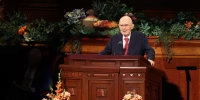
NPC Headliner Luncheon: Elder David A. Bednar

Elder David A. Bednar, an apostle of The Church of Jesus Christ of Latter-day Saints, presents to the National Press Club about the Church and how it helps people both from the outside in, but especially from the inside out and fields questions on many controversial subjects in a Q&A including why people leave religion. The Q&A begins at forty-two minutes.

Why do people abandon religion?

Moshe Taragin—The Jerusalem Post

While the conversation of leaving religion affects many denominations, this article from The Jerusalem Post looks at the question generally but from the perspective of Judaism. Certainly a worthy addition to the conversation.

Is God a Therapist?

Carl Trueman—First Things

In his latest, Carl Trueman laments our “childish age” and the way it oversimplifies God. He relishes in the hard complicated God that is worthy of worship.

Elder Perkins shares common values at a groundbreaking conference in Saudi Arabia

Mary Richards—Church News

The Muslim World League held its first-ever forum on Common Values of Religious Followers. The Church, which recently announced its first temple in the Middle East, has not had a leader speak in Saudia Arabia since the G-20 summit in 2020.

How an Army ethicist works to mold moral soldiers

Mary Beth McCauley—The Christian Science Monitor

A fascinating deep dive into the Baptist chaplain who is a leading figure in war ethics. The article looks at his background, beliefs, and day-to-day work teaching ethics to new recruits.

On Key

You Might Also Like

Navigating Darkness with Faith: A Review of “All the Light We Cannot See”

Netflix’s “All the Light We Cannot See,” adapted from Anthony Doerr’s Pulitzer Prize-winning novel, is a limited series that does more than recount the familiar tragedies of World War II. It delves into the poignant journey of a blind French girl, Marie-Laure, and a morally conflicted German soldier, Werner, whose stories intertwine amidst the war’s chaos. Marie-Laure’s blindness is a powerful metaphor for the spiritual and moral darkness that pervades a world at war. Her character embodies resilience and courage, often associated with the faithful in times of trial. As she navigates the literal darkness of her blindness and the figurative darkness of Nazi-occupied France, Marie-Laure’s journey can be seen as a testament to the strength found in vulnerability and the light of the human spirit that persists in the darkest times. Werner’s storyline provides a compelling narrative about the conflict between duty and conscience. His struggle is a representation of a universal moral question: How does one maintain integrity in the face of systemic evil? The show does not shy away from depicting the harrowing choices that individuals must make, often under duress, which resonates with an audience that appreciates the exploration of ethical dilemmas and the redemptive power of repentance and atonement. The show’s mature rating attests to its unflinching portrayal of the era’s brutality and the complex nature of its characters’ choices. However, it’s the underlying themes of hope, sacrifice, and redemption that will resonate most deeply with the faithful Latter-day Saints. The series, while a dramatic portrayal, also prompts introspection about the divine light we seek and the unseen battles we fight within ourselves and our societies. We recognize the value in stories that challenge us to consider our own moral compasses. “All the Light We Cannot See” does just that, encouraging a discourse on the nature of faith, the potency of unseen strength, and the eternal battle between light and darkness. It is a series that not only captivates but enlightens, urging its audience to reflect on the unseen lights that guide us through our own tribulations.