At Christmas, we often speak of intangible things. Hope, joy, peace, love—these are the rightful themes of the season. But we should not forget that it is in the tangible, corporeal reality of the Christ child that we find the embodied hope in which we rejoice.
We take it for granted—but we shouldn’t—that Jesus came into the world as a baby. As far as I can tell, all of His other interactions with mortals, before and after His earthly ministry, were in mature form—either as a spirit before He was born, or in His resurrected body after His death. While on earth, His public ministry occurred when He was grown, as did His suffering, death, and Resurrection on our behalf.
These are the themes of the season.
I suppose there are many reasons. For one, Jesus was never above the law—He came to earth through birth the way we all do and now understands what it’s like. But perhaps another is this: Jesus’s physical development, from boy to man, both enabled His spiritual progression and symbolized the progression our spirits, too, are capable of. That should give us hope!
The starting point of infancy is perhaps not pointless at all. Progression is the eternal plan—physical and spiritual. In every way, the life of Jesus was an example for us—even in showing that minute, day-to-day development, which may sometimes seem slow, insignificant, or even undiscernable, is actually eternally significant.
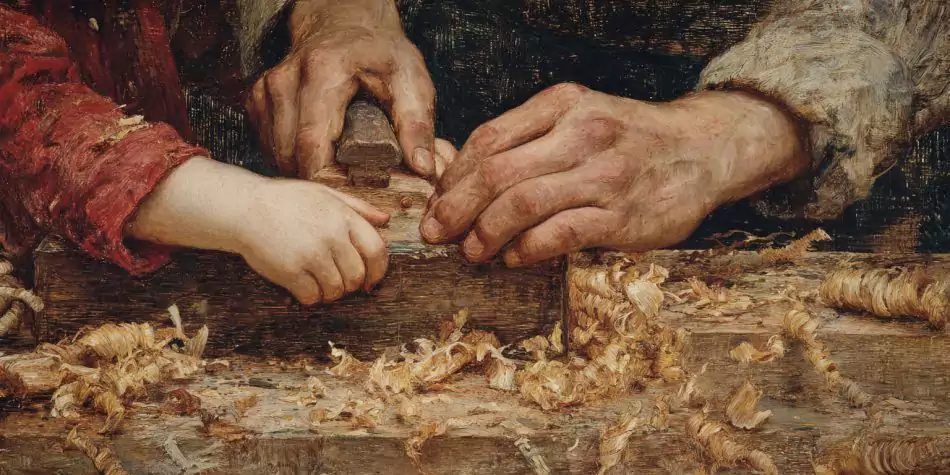
We know so little of Jesus the boy and Jesus the teenager. Aside from the events of His birth and His temple-teaching experience, His youth is typically summarized by this verse in Luke: “Jesus increased in wisdom and stature, and in favour with God and man.”
Although little is said of this time of His life, He must have experienced the joys of play, the challenges of being little, and the difficult transition from oblivious childhood innocence to chosen innocence. The physical reality of growing up and developing accountability is a sacred thing to which Jesus Christ can relate.
Perhaps it was through His physical development that His great spiritual development could occur. While Jesus was developing from boy to man, He was also developing spiritual intelligence and glory. Even He, the Lamb without blemish, “received not of the [Father’s] fulness [of glory] at the first, but received grace for grace, until he received a fulness.” Doctrine and Covenants 93 anchors this progression in embodiment: “spirit and element,” when they are inseparably connected, receive a “fulness of joy.”
How can it be that even Christ “received grace for grace”? I am not sure we fully know. But we do know that the full stature of our spiritual maturity is more than to merely be innocent. It is to grow in our capacity to live by light and truth—so much so that truth and its light are found in us, increasing our oneness with the Godhead. It is one thing to be welcomed back into God’s arms; it’s another to be remade in His likeness. But both involve teaching the body to act at the behest of the spirit. Jesus was justified on His own by never transgressing the Father’s law. In John 10, Christ models humble submission to the Father—saying it was the Father who sanctified Him and gave Him His glory.
There is something very comforting in knowing that even Jesus “received grace for grace” as He lived in His mortal body. For one, it suggests the probable disposition of the Father toward His children. If even the Father’s Only Begotten Son progressed toward His glory, surely the Father takes a long view, and not an immediate one, of our spiritual progress. Like parents who patiently help their babies develop new abilities without condemning them for their previous inabilities, the Father helps us develop new capacities that expand our agency and therefore our potential to be like Him.
The knowledge of “grace for grace” also gives us great comfort in how we relate to Jesus. He knows what it is like to spiritually strive in a physical body for more holiness from the Father. He knows what it is like to develop accountability and then to face the challenge of temptation it brings. He knows what it is to be helpless and vulnerable, to experience the innocent feelings of childhood and then to face the difficult mortal struggles and realities we confront as we mature.
We can take comfort in knowing that “grace for grace” is real for us. Lest we believe it was only for Jesus, He explicitly tells us otherwise: “For if you keep my commandments you shall receive of his fulness, and be glorified in me as I am in the Father; therefore, I say unto you, you shall receive grace for grace.”
He knows what it is to be helpless.
The baby Jesus embodies our hope to become. Baby Jesus’s physical existence prefigured the physical Resurrection He would bring. And it is the union of our physical and spiritual bodies, reborn through resurrection, through which we will receive the fulness of joy.
So as we contemplate His miraculous birth, let us remember the miracle that, in the first place, He was born at all. In His choosing to enter mortality as a baby, we find the hope that we all may grow grace for grace to become like Him.