unnamed (31) (1)

Joy As Though He Had Already Come

Does Christ have to be in our very midst for us to feel the joy of His presence?

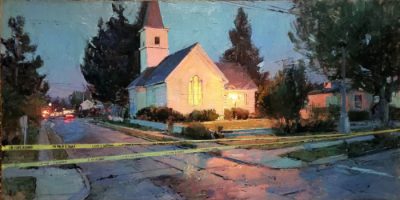
Not long ago I had a dream. I was in a crowded mid-sized town with a soul full of worry and care. It was 2021 after all, plus I had my own personal demons as well, as we all do. The entire town was about the same as I regarding their emotional statenot so completely burdened by concern that we could not function (though a few of us could not, as is always the case). But we were, as a town, tilting towards darkness. The darkness of too much worry about the future, of things getting worse, not better, of the sun setting not rising, of climate catastrophes, of divisions, of personal failures, of broken lives, shattered families, of ruined dreams and institutions, all these things growing not shrinking. And, to top it all off, we all knew (or could know), the intimate details of catastrophes anywhere and everywhere in the wide world, because of the technology we nervously and constantly hold in our hands.

So here we wereliving generally well, yes, mostly not hungry or cold, trying-to-be-happy but still too burdened. We were, yes, so very sad.

It became evident to me that I was very joyful and much enlivened and lightened this particular day of my dreamthe darkness lifting, a peace encircling me as it had not since I was at a family reunion when 10 years old. And it was clearly understood why: simplythe news was that Jesus was in town.

I knew when I saw Him I would fall, collapse really, at His feet and He would know me and throw everything off my weary shoulders. With Him there as the singular object of my adoration and concentration, I would be saved from myself, my worry, my failures, my darkness, my guilt, my pride, my enmity.

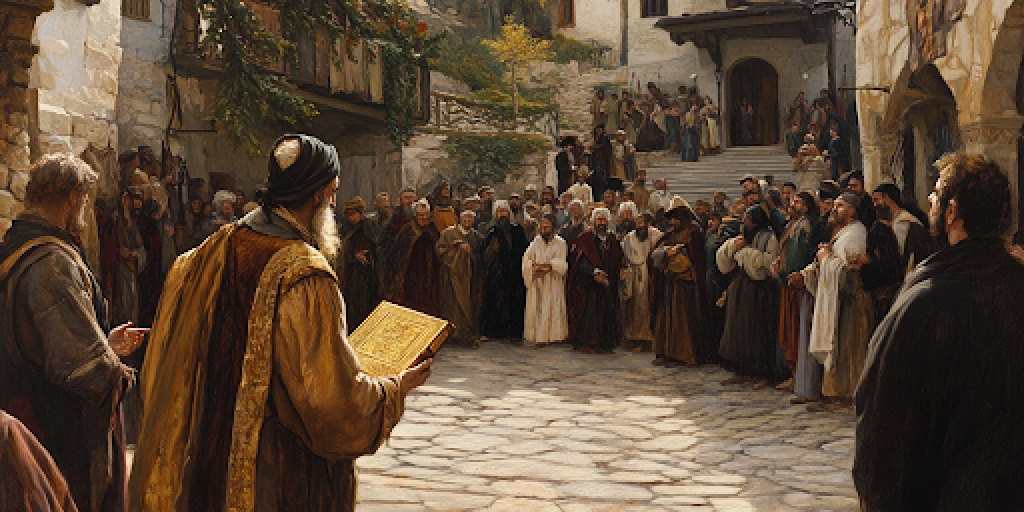
And so I began to hurry through the streets and alleys of the town, excitedly sharing the news so that others wouldn’t have to be sad but could be happyproblems not gone but the soul strong enough to endure them. I would talk to my friends, acquaintances, and strangersin the street, in restaurants where I would sit down with them to eat, at the library, schoolyards, stores, barbershops, but mostly in the streets because I noted that I was in an awful hurry. Just as it had been so obvious to me that anticipating visiting soon with Jesus brought me a lightness and joy now, so it was becoming obvious to everyone with whom I spoke. No arguing, no doubting, no wondering, just elation and joy, for one and all. There was a clarity and ease and believability in the words I spoke, and which were now being spoken by others who had heard. That was new, and it was nice.

I really wanted to tell everyone in the town, and I also wanted to get to Him, to get to the part of town where people were already with Him. I had heard He was on the far side of the town, and I took note. Far away, but not too far.

I also noticed that there were no barriers and no hindrances to talking about Jesus being on the other side of town and encouraging everyone to go see Him. It seemed natural to me and to everyone else. No racial, educational, socio-economic, ethnicity, class, or religious differences inhibited me, or anyone else, as they often do, despite my best efforts, to talk about Jesus. It was, for lack of a better phrase, a free-for-all of happy anticipation most of us felt about going to see Jesus who would somehow release joy to overtake us and our lives.

Towards the end of the day, there came some astonishing news through the grapevine: Jesus was actually not in our town. In fact, He had never been there. This contradicted all that I, and now most of the town’s inhabitants, had been so looking forward to. And yet, strangely enough, it was not heartbreaking. 

This lesson was pressed upon my mind: the dream was about covenants Christ offer us. He does not have to be here; they are enough. 

Part of the message from the angel sent to ancient King Benjamin was this:  “And the Lord God hath sent his holy prophets among all the children of men, to declare these things to every kindred, nation, and tongue, that thereby whosoever should believe that Christ should come, the same might receive remission of their sins, and rejoice with exceedingly great joy, even as though he had already come among them.” (emphasis my own).

As this messenger explained to the good-hearted king, he had been sent to declare this unto him, “that thou mayest rejoice; and that thou mayest declare unto thy people, that they may also be filled with joy.”

And so, what profound gift does Christ offer in 2022 to a weary, hyper-connected, distracted, divided, hungry, homeless, abused, pained, unbelieving, frenetic, addicted, militarized, doubting, sophisticated, materialistic, secular, proud, lonely, traumatized, angry, refugee-engulfed, world? Covenants. His Covenants. His Covenants that He made and that He enlivened and upon which He has laid His hands and that He has connected to the earth and God’s children by angels’ hands. Through these He asks us to do and be holy things, and we promise to so do and to so be, and in the cyclical trying and failing and promising again of it all, peace in Christ can engulf us – the places and people of our broken world. For Christmas 2022 may the attempt at unwrapping and holding close one of these Covenants in Christ be a favorite gift, that you and I both give to others and receive for ourselves.

About the author

Chris Stevenson

Chris Stevenson is the President and Co-Founder of the National Museum of American Religion. He co-founded the Community Levee Association, which champions virtue to the American experiment. He wrote "Letters from an American Husband and Father."
On Key

You Might Also Like

The Ordinary Saint’s Guide to Under the Banner of Heaven: Episode 4, “Church and State”

Summary — The episode begins with the detectives checking in on Bishop Low’s home, which they find ransacked and deserted. Pyre finds a letter written by Ron’s wife to the Prophet expressing concern about her husband’s refusal to pay taxes. The detective contacts the Church about the letter and is told the letter was handed down to one of the bishop’s counselors, LeConte Bascom, who works at the bank. Brother Bascom says he had to turn Ron down for a loan because his brother’s refusal to pay taxes made him a liability, though it’s heavily implied that the real reason is that his wife’s letter was seen as an embarrassment to the Church. In flashbacks, we see Dan marching in a Pioneer Day parade, shouting about the government’s illegal taxes, as well as smoking and kissing a woman who isn’t his wife. Dan’s father says he’s ashamed of his immoral behavior and anti-tax nonsense and advises him to study the scriptures to set himself back on the right path. This unfortunately drives Dan into researching more obscure history of the Church, including information on polygamy.  He makes a business trip down to Colorado City to visit the breakaway polygamist sect there and manages to get the name of a pro-polygamy pamphlet called “The Peace Maker.” He reads this pamphlet and brings up the idea to his wife Matilda, telling her she’s limiting his spiritual power if she doesn’t let him marry a second wife.  During this conversation, Dan is pulled over for speeding and refuses to cooperate with the officer, leading them on a police chase that ends with his arrest. At the jail, Dan’s brothers try to convince him to stop his resistance to the government. Ron feels it’s his responsibility to show Dan the error of his ways, but instead, Dan runs circles around him, leaving him speechless and admitting that he’s going to lose his business and home. Dan somehow turns this fact into evidence that his views are correct and ends up winning over Ron to his side. In the present, Detective Pyre is being leaned on by the Laffertys’ stake president to release them into his custody but refuses. The detectives have identified the car the killers were probably using and plan to hold a press conference to ask for tips when the police chief returns from vacation and demands that all mentions of fundamentalism Mormonism be scrubbed from the press briefing. (It’s implied he’s being leaned on by the Church.) Pyre tries to toe the line at the conference but eventually caves to a persistent reporter and admits that he thinks that the murders may have something to do with fundamentalist beliefs. The next day at church, the ward is shunning the Pyres, and a specific couple is assigned to keep an eye on their faith. Meanwhile, a police officer has located Bishop Low fly fishing in the mountains and safe. Church History — During Dan’s explanation of polygamy, we get flashbacks to the infamous scene where Emma finds out about the doctrine of polygamy for the first time and throws the revelation in the fire. Though church members will be familiar with this story, the tone is portrayed very differently than we are used to. Emma is shown as being absolutely skeptical of Joseph’s translation of the Book of Mormon and other prophetic acts, even though she firmly testified of the truth of these things even after her break with the Church after Joseph was murdered. Joseph is portrayed as proclaiming the doctrine of polygamy only for his own physical gratification, which is a common anti-Mormon trope with little evidence behind it. While it is true that one of Joseph’s wives was only 14, the facts behind the situation are more complex than portrayed in the show. The pamphlet “The Peace Maker” is portrayed by Dan Lafferty as an “essential LDS tract” written by Joseph Smith, and no one in the show ever corrects this perception. In fact, the tract was not written by Joseph Smith, and he repudiated it during his lifetime. This episode presents a slanted view of church history, giving only one side of the conversation and showing the modern church as trying to hush it up rather than having its own interpretation of events. Shibboleths — Pyre claims that writing a letter to the prophet is like writing to “Heavenly Father himself,” which is absolutely wrong. While members of the Church do revere the prophet and listen to his teachings, he is not God, and this equivalency is not one Saints would make (though outsiders think we do). The idea that doing business with fundamentalists is like “doing business with the mafia” is totally alien to me. They are regarded as somewhat of an oddity in Utah, but not dangerous like organized crime. One unusual phrase occurs when the stake president claims that the Laffertys need to be released into his custody for “healing prayer.” I honestly have no idea what this phrase refers to and have never heard it in an LDS context. And the formal type of shunning portrayed happening to the Pyres is not something we do. Though obviously, wards vary in their culture, there is no formal instruction not to talk to those who have questions. Rather, we are encouraged to keep being friends with those who are struggling with faith and support them however we can. Changing History — It is interesting to note that in the actual chain of events, it was Sister Low, not Bishop Low, who was on the Lafferty hit list. Sister Low was a Relief Society President who supported Dan’s wife as she sought a divorce. Why does the show change this? Perhaps the idea that the Church has female leaders doesn’t fit well with the show’s depiction of the oppression of women in the LDS church. Brenda Lafferty’s sister has also expressed her disappointment with the way the show is misconstruing her sister’s murder in pursuit of an

Disagreement is Not Disunion

The inauguration of our new president is almost a week old. There’s one especially striking moment from his speech that can’t and shouldn’t yet slip from our memories.

Do We Still Need Religion+ Today’s Digest

Our daily rundown of the articles from around the web that we feel our readers would enjoy and appreciate. We hope to highlight the best of what’s around. Public Square Bulletin recommends: Do We Still Need Religion Robin Dunbar – The Guardian In our increasingly secular age, does religion still have a place? Robin Dunbar argues that a vibrant religious life is essential for society, and plays a foundational role in the arts and sciences. The Constitutional Roots of Ketanji Brown Jackson’s Public Faith Justin Collings & Hal Boyd – Religion & Politics Supreme Court nominee, Ketanji Brown Jackson’s faith played a prominent role in her recent confirmation hearings. Her answers, which echo the feelings of most Americans, place personal faith and religious freedom as among the highest of our civic virtues. The Rise of the ‘Umms’ Mike Moore – Christianity Today COVID-19 reshaped our national religious landscape. Mike Moore turns his focus on a group—individuals of strong faith who don’t currently have a church—and asks what happens to them next. Looking for God in Our Everyday Lives Wallace Goddard – Meridian Magazine One of the great promises of the Restoration is the accessibility of Heaven. Are we doing enough to look for God’s influence in our lives? Religious Liberty Tested in Finland Anders Lundberg – Law & Liberty Two Finish Christians have been brought up on charges for advocating for a traditional Christian view of marriage. Swedish lawyers, Anders Lundberg looks at how religious liberty is developing in the Nordic nations.    

Subscribe To Our Weekly Newsletter

Stay up to date on the intersection of faith in the public square.

You have Successfully Subscribed!