
Christopher Nolan’s “The Odyssey” is about a warrior trying to leave war behind. And perhaps the movie’s reception suggests that many of us are ready to do the same.
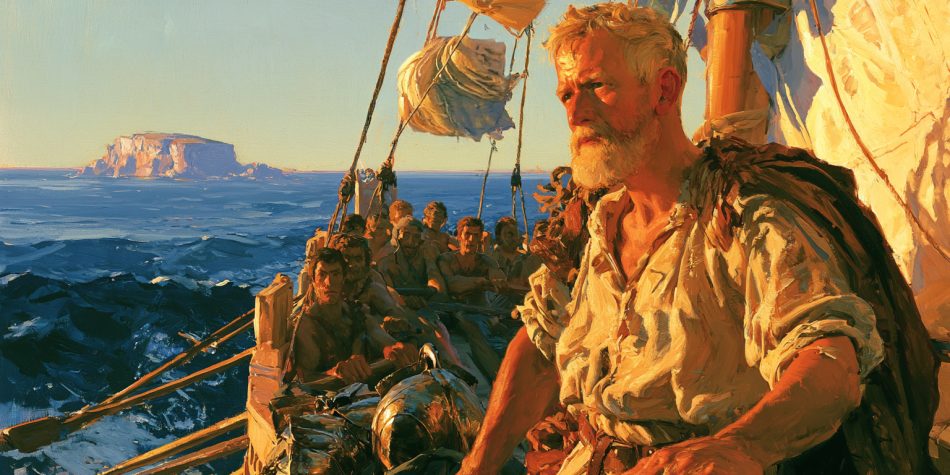
When the movie opens, the Trojan War is already over. Odysseus remains a warrior, and much of his survival depends on his warrior instincts. But despite the monsters, storms, and stratagems he faces, the central question of the tale is not whether he can win another battle. It’s whether he can make it home.
One of the major thematic differences between Nolan’s new treatment of the story and the tale it is based on is how Odysseus feels about war. In the original, Odysseus leaves the war as a braggadocious victor.
In Nolan’s adaptation, the background to Odysseus’ travels is his desire to distance himself from the war, reckon with the choices he made, and prepare to return home—a place where he will be asked to be a husband, father, king, and community member. At home he will not only need his warrior virtues but also tenderness, patience, fidelity, and mercy.
In this telling, “The Odyssey” is not just the continuing adventures of Odysseus; it is a metaphor for his struggle to leave war and return home psychologically and emotionally. For all its spectacle, the film is preoccupied with the aftermath of war. Reviewers have recognized this antiwar current and its interest in postwar trauma, guilt, and moral transformation.
That theme may also explain why the public response to “The Odyssey” feels more significant than that of a mere commercially successful summer blockbuster. Before the movie was ever released, it had been drafted into another war, a cultural war. And then, much to the surprise of the people who live and breathe that war, the public largely declined the fight.
A Movie and a Battlefield
Long before anyone had seen “The Odyssey,” the culture warriors were dissecting it. Some commentators complained about the casting of Lupita Nyong’o as Helen of Troy. Others complained about Elliot Page’s casting. Some critics complained that the film was ignoring historical coherence in exchange for progressive signaling. Others sought to boycott the film because it was not sufficiently deferential to the concerns of Morocco, Western Sahara, and Dakhla—a conflict described, depending on whom you ask, as either an occupation or a border dispute.
The method of war began to consume the very things we were trying to protect.
These controversies were drawn into the same totalizing machinery. The public was encouraged to determine the moral meaning of a movie before seeing it. Some people even tried to get us to pretend that Lupita Nyong’o is ugly. The culture warriors wanted to make the film a referendum—the next notch on the belt for either cancel-culture accountability or “go woke, go broke” pushback.
Then audiences saw it.
“The Odyssey” earned $264.1 million worldwide during its opening weekend. It’s the largest live-action opening of the year, the largest nominal-dollar opening of Christopher Nolan’s career, and a break in what had seemed like a very down summer for the movie industry.
Audiences gave the film an A CinemaScore, and its Rotten Tomatoes audience score stood at 97 percent at the time of writing. Demand was so strong that some theaters added overnight and early-morning screenings.
Obviously, there were still dissenters. Many of the people who profit from our continued outrage doubled down. But most of the actual audience just watched a movie. The controversy stopped being the main story, and the movie started to be.
The Culture War
This is not to say that culture-war issues are unimportant. Many of the disputes involve issues of real importance.
Perhaps we are sick of so many of the things that make life worth living becoming another test of tribal allegiance.
Whether films are normalizing the eradication of gender matters. But the question doesn’t need to be totalizing.
And maybe it’s OK that Christopher Nolan asked his old friend to be in his movie, regardless of whether we agree with the decisions that friend has made.
Maybe we can feel real concern for the current situation of the Sahrawi people without making this film bear the weight of the entire controversy just because of its filming locations.
These concerns, along with the hundreds of others, should not simply be wished away. And I’m certainly not calling for us to surrender on them in the hope that doing so will create peace. The tragedy was that the method of war began to consume the very things we were trying to protect. The conflict stopped being about whether ideas were right or wrong and became about whether people were good or bad. Every casting choice was framed as existential. It divided families, friendships, congregations, communities, and nations. Having the wrong opinion was not a conflict to work through, but a danger to be squashed. Our ideological opponents were reduced to avatars to humiliate.
And because war needs soldiers, first our news media and then our social media began using propaganda to enlist us. And many of us have. We’ve fought about Dr. Seuss, gas stoves, Mr. Potato Head, the OK symbol, the green M&M, the Cracker Barrel menu, the Little Mermaid’s hair, elves’ skin tone, Gillette razors, Looney Tunes, Keurig coffee makers, the Chinese word for “that,” the police dog in “PAW Patrol,” and dozens and dozens more.
“The Odyssey” was shaping up to be the next battlefield. The battle lines had been drawn. And then we just didn’t. We let it go. We went and watched a fun movie. And we probably watched it while sitting in a theater with someone who believed some of the wrong things.
Toward Ithaca
Coming home is its own discipline.
I don’t mean to overreact. One successful movie does not mean the culture wars are ending. It does not mean we are beginning to exit our bubbles or see the other side as fully human.
But it’s not nothing.
Maybe it’s just a temporary “Christmas Day truce” because the movie really is that good. Or maybe “The Odyssey” is revealing a change in appetite, a change of heart.
Perhaps we are tired of being told what we are allowed to enjoy. Perhaps we are sick of so many of the things that make life worth living becoming another test of tribal allegiance. And maybe we’re tired of living in a world where nothing can simply be.
Our culture did not resolve the disputes surrounding the movie. One side did not emerge victorious. It did something smaller. It didn’t give the final word to the culture war.
Odysseus’ journey reminds us that wars end before warriors learn how to live in peace. Coming home is its own discipline. It requires us to lay aside identities formed entirely through opposition and recover the relationships that conflict pushed to the margins.
We have not reached Ithaca. Our disagreements remain. Many of them matter, some deeply.
But perhaps we are beginning to understand that a meaningful life cannot be built entirely around fighting them.