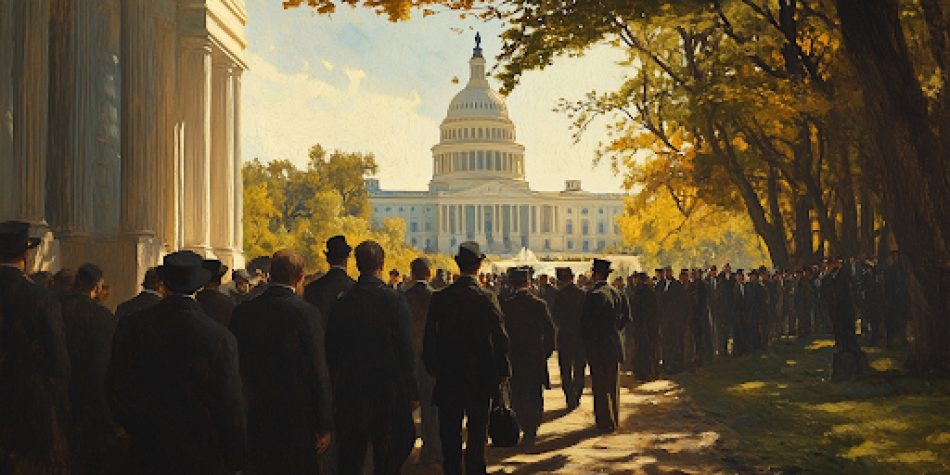
Group of People Near the Capitol Building | Why Were The Reconstruction Amendments Important?

States’ Rights, Federal Powers, and The Struggle for Liberty

How did the 13th, 14th, and 15th amendments transform the US Government? To maintain civil rights, they granted more power to the federal government.

On July 4, 2023, just over a year ago, I wrote about what I learned about the Constitution while studying to become a U.S. citizen. Over a dozen of my friends who read that article asked all sorts of questions on how the Fourteenth Amendment allowed the Federal government, not state governments, to become the trustworthy guardians of the First Amendment’s freedoms. This is what they found most interesting and novel. 

To this end, what I found profound when I studied the history of this great country is that few Americans understood how the Thirteenth, Fourteenth, and Fifteenth Amendments radically changed the Constitution, augmented the need for compromise, and safeguarded the Bill of Rights. Iowa, where I have lived for 20-plus years, like the state of Utah (where I lived from 1991 – 1998), is politically conservative and are both advocates of state rights over Federal rights. Many people in Utah and Iowa believe in originalism that the U.S. Constitution should be interpreted as it was understood at its adoption—written in 1787 and ratified in 1788. It is a belief in the original Constitution that State rights eclipse federal rights.

The Thirteenth, Fourteenth, and Fifteenth Amendments radically changed the Constitution.

Section 3 of the 14th Amendment has recently received much media coverage due to the Colorado Supreme Court declaring Donald Trump ineligible for the White House via the insurrection clause and the recent U.S. Supreme Court unanimous decision to overturn the Colorado Supreme Court decision. Yet, I believe few Americans understand how these three amendments transformed the Constitution. This may be why Dr. David Strauss, a distinguished Professor of Law at the University of Chicago, argued that the Constitution is a living document that changes; it is not a rigid, unimodal document from 1787. If the original Constitution had not changed, women would still not be able to vote! State rights, as originally framed in the Constitution, have transformed.

In the past year, I have spent more time learning about the social context that gave birth to these three amendments by reading Eric Foner’s books The Second Founding: How the Civil War and Reconstruction Remade the Constitution and Reconstruction: America’s Unfinished Revolution, 1863-1877.  Dr. Foner is DeWitt Clinton Professor Emeritus of History affiliated with Columbia University, whose academic work specializes in the Civil War and Reconstruction, slavery, and 19th-century America.

Learning more about the historical context of these three amendments made me realize that compromise is the psychological soul of the Constitution and how vital it is for healthy interactions, including healthy disagreements, between the Federal government and State governments. As Dr. Foner explains, the Thirteenth, Fourteenth, and Fifteenth Amendments lessened state rights and gave prominence to Federal rights.

After the Civil War, the Wade-Davis Bill (1864) created a framework for Reconstruction and the re-admittance of the Confederate States to the Union, and most Confederate leaders were able to return home. Lincoln, his cabinet, and Congress knew that if states still held greater power than the federal government, Confederate states would go back to having black slaves. The creation of these three amendments allowed black people to have rights and allowed the Bill of Rights to flourish, thus making democracy genuinely blossom. Dr. Forner, in The Second Founding, states 

. . . the application of the Bill of Rights to the States has come via the Fourteenth Amendment’s Due Process Clause . . . Thanks to incorporation, the states are now required to act in accordance with the fundamental liberties enumerated in the Bill of Rights, tremendously expanding the ability for all Americans to protect their civil liberties against abridgment by state and local authorities. 

Akhil Amar, one of the most cited constitutional scholars from Yale Law School, clearly pinpoints in his 2021 book The Words That Made Us, and perhaps more so in his 1998 book The Bill of Rights, that the federal government became more trustworthy guardians of the first amendment freedoms than state government during the reconstruction period in American history. As Dr. Amar adds, immediately after ratifying the Fourteenth and Fifteenth Amendments, the federal government initiated civil rights legislation banning segregation in public places, including within state governments, that still perpetuated the beliefs that African Americans were less-than-human slaves.

It seems like the federal government is often viewed as the “bad guy.”

In states like Iowa and Utah, where more citizens generally believe in the priority of state rights, it seems like the federal government is often viewed as the “bad guy.” For example, I have many friends within The Church of Jesus Christ of Latter-day Saints who believe the federal government was “the bad guy” when they cite the example of Joseph Smith’s visit with U.S. President Martin Van Buren in 1839. This meeting was organized to redress the federal government for wrongs inflicted on the Latter-day Saints in the state of Missouri. President Van Buren followed the constitutional philosophy of that era, stating that Congress had no jurisdiction in the matter but that church members should take their case to the State of Missouri government or courts. Joseph Smith may have envisioned what the Constitution would eventually become after the Civil War, where the federal government allowed the essential freedoms detailed in the Bill of Rights, including freedom of religion.

While there are many examples of the federal government doing harm, the creation of the Thirteenth, Fourteenth, and Fifteenth Amendments exemplify some of the good work it has done in protecting civil liberties. Certainly, in preventing Confederate states from continuing slavery, the federal government protected fundamental rights much better than certain States. 

What makes the U.S. Constitution so amazing is that it permits freedom of viewpoint, negotiation, and cognitive elasticity, which gives breath to creativity. This includes the interplay between state and federal governments, and good public policy can emerge when a middle ground is found. Our mentality judging between state and federal governments does not have to be an “us” versus “them” mentality. Just as there can be harm in both, there can also be good in both the federal and state governments, and good things can happen when they set aside differences and work together.


About the author

Rodney Dieser

Rodney B. Dieser, Ph.D., LMHC, is the author of seven books and over 100 academic articles. His writings have appeared in the USA Today, Chicago Tribune, Lancet Psychiatry, and Mayo Clinic Proceedings and in past Deseret News articles. He is a Professor in Health, Recreation, and Community Services at the University of Northern Iowa. He works 10 hours a week as a Licensed Mental Health Counselor at Wartburg College, a private Lutheran liberal arts college in Waverly, Iowa. He lives in Cedar Falls, Iowa, and the views expressed here are solely his own.
On Key

You Might Also Like

“Deep” Norwegian Film About Nothing in the End

How does a community and the families within it respond to a nearly unspeakable accusation? How do you treat everyone with dignity? How do you suss out the truth? Do you need to? “Armand,” the Norwegian submission for The Academy Award’s best international feature film, sets out as though it is interested in answering those questions. The film opens with a young teacher, a principal, and a school staff member wondering what they are going to do. Armand has done something again. The parents are called in. The film’s premise is that Armand was accused of hitting Jon in the bathroom when Jon said he didn’t want to play with Armand. There are many additional revelations about the context, the relationship between Armand and Jon’s families, and the history of Armand’s family. There are accusations upon accusations that both indict and exonerate the boys and the adults around them. But these revelations eke out. It feels like filling up a mug from a leak in the sink. “If you want us to know what’s happening, just tell us,” I felt like shouting at the screen more than once. The film’s first act works well. The cinematography is ragged, framing its subjects well but always just off from what we’d expect. Too close, or the light is just wrong. It felt like how I imagine it would feel to have my child accused of something horrific.  And when the parents first start talking the tension is terrific. Those first few drops of exposition in the mug were thrilling. Oh there’s something happening here; it’s complicated and interesting.  Thea Lambrechts Vaulen, plays Sunna, a young teacher in over her head trying to manage the meeting between Armand’s mother, Elisabeth, played by Renate Reinsve, and Jon’s parents Sarah and Anders played by Ellen Dorrit Petersen and Endre Hellestveit.  Vaulen is particularly effective. She has been sent on a mission by her principal, Jarle, to make sure the whole thing blows over. Watching her struggle to navigate this while the parents are processing what’s been said is captivating. But it just keeps going.  The film’s entire second act consists of learning the basic facts of what has happened and the context around it. This is a complicated situation, and as a viewer I’m interested to see how the compelling characters navigate that situation. But the screenplay seems mostly interested in telling you the information. As though learning that Armand “plays doctor” at school is enough to compel me to the film’s ending. But once the audience finally understands the situation, the third act begins and flies wildly off the handle into surrealism, including two interpretive dance numbers, three over-the-top metaphors, and five straight minutes of Anders’ mother laughing.  The movie feels so desperate to be deep that it forgets to be about anything. It’s the first film of director Halfdan Ullmann Tøndel, so perhaps the bold ideas and beautiful cinematography will be wielded for a more worthwhile story next time. The film is entirely in Norwegian. And its English subtitles include a fair amount of profanity, though not an overwhelming amount. And the accusations that fly include suicide, alcoholism, and sexual assault. So these are adult themes. The film is R-rated, but not an egregious one, it pretty well all takes place in a parent-teacher conference.  I can’t imagine ever showing this to my kids. The themes are hard ones, and the film has nothing worthwhile to say about them. Two out of five stars. Armand releases in US theaters on February 14, 2025.

Ben Pacini and Marian Edmonds-Allen on Covenantal Pluralism

Covenantal Pluralism

Marian Edmonds-Allen and I discuss “covenantal pluralism” which can fix LGBTQ+ and faith divides. We review her history, and religion helping LGBTQ+ rights.