
Fathers and mothers do not provide exactly the same type of parenting; they have complementary strengths and responsibilities. Sometimes children need experiences best provided by a father, such as adventure or disciplined intervention. Sometimes they need experiences best provided by a mother, such as sustained, careful nurturing. Latter-day Saints believe we have Heavenly Parents—Heavenly Father and Heavenly Mother—and that many mortal patterns also hold true in heaven. Why not parental gender roles?
Brigham Young taught, “As far as we can compare eternal things with earthly things that lie within the scope of our understanding, so far we can understand them.” In that spirit, I propose a parallel: mortality as a ‘dad mode’ adventure, where the Father naturally has a more salient role. Additionally, we can understand Heavenly Mother by considering life before and after an adventure with Dad.
So what is “dad mode?”
In our family, the normal potty training routine involves loving explanation and nurturing guidance, primarily from mom. For one of our kids, this persistently failed. Switching to ‘dad mode’ solved the problem—Dad physically restrained the child on the potty until the task was completed in the proper location. There was wailing and gnashing of teeth during the process, but the child learned by experience that the assigned task was possible and was praised for completing it. From then on, potty training was largely successful — the child quickly forgot the ordeal, but retained the skill.
The brief ‘dad mode’ intervention looked and sounded painful. Mom would not normally pursue this kind of approach, but she was aware of it, agreed it was necessary, and did not bail the kid out. Appealing to mom during this process would not have been productive. Dad was running the show, and Mom supported his approach. Mom handled most of the teaching before and after this intervention, though not during it.
Life often feels like “dad mode.”
disciplines those whom he loves and chastises every child whom he accepts … God is treating you as children, for what child is there whom a parent does not discipline?” (Hebrews 12:6-7, NRSV). Life often feels like “dad mode.”
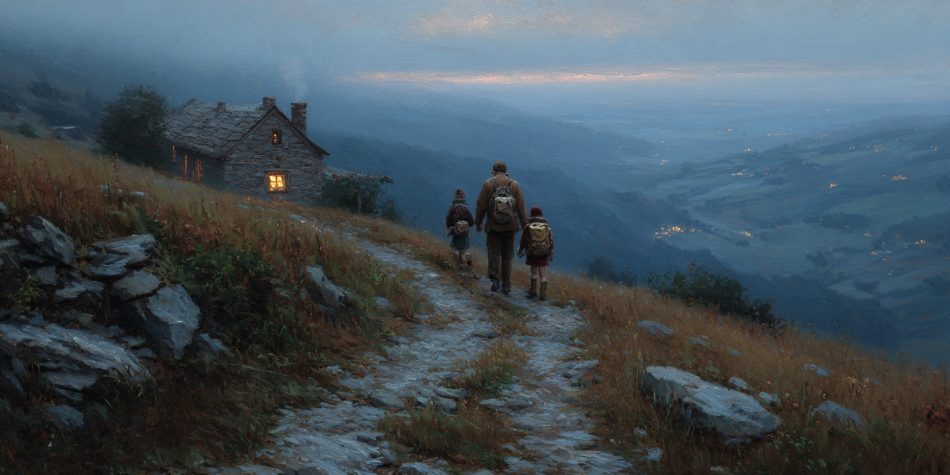
Taking kids backpacking offers another “dad mode” example. The itinerary is set by Dad; the kids aren’t really competent to judge such things. Sometimes they get to keep hiking, even on sore feet. Dad distributes the pack weight and typically does not reassign it; doing so would set a poor precedent and weaken the kids. So the kids struggle. They get stronger. They learn something about themselves. And then mom welcomes everyone back with a feast, having stayed home, cared for the baby, and done a thousand other things. Afterward, even the kid who cried for a mile talks unprompted about what a great experience the trip was.
This also has gospel parallels. Heavenly Father is obviously prepared to send people off on literal wilderness adventures: consider Adam, Abraham, Moses, the brother of Jared, Lehi, Nephi, Ammon, Elijah, and Christ, as well as later community treks such as Zion’s Camp and the pioneer migrations. Children in the Church sing that we can all be pioneers, and youth go on pioneer trek reenactments. And Eve deserves praise for starting all of the adventures. Embarking on adventures is in our spiritual DNA.
As Paul writes, “We rejoice in our sufferings, knowing that suffering produces endurance, and endurance produces character, and character produces hope, and hope does not put us to shame, because God’s love has been poured into our hearts through the Holy Spirit who has been given to us.”
The “dad mode” wilderness adventure analogy can go further. Consider: what level of guidance and communication is appropriate for a young man on a wilderness adventure? He needs the tools and information to succeed, yet he learns most in the context of a legitimate challenge, which might not be best served by easy or excessive communication.
Heaven is centered on perfected homes.
Taken together, these patterns suggest that Heavenly Father presides over a high-stakes, sometimes grueling ‘dad-mode’ adventure. We agreed to go to the camp, and we’re in for it now! Heavenly Mother approves, yet seems to leave the management of this enterprise primarily in the Father’s hands. Then what is She doing? Presumably, everything else: managing and enjoying the whole domestic enterprise of heaven, and helping children in every other phase of their development.
A common caricature reduces motherhood to giving birth, and perhaps keeping children alive until they can be placed in the care of a business and/or government. Maybe there’s a Mother’s Day card involved, once a year, until social media convinces the kid that mom is “toxic.” Did I mention the pain and exhaustion?
If you combine this diminished view of motherhood with the obvious fact that Heavenly Mother is not front-and-center here on Adventure Camp Earth, you might imagine that eternal motherhood is a frustratingly limited role, primarily centered on giving birth. But mortality is only a tiny fraction of our existence, and this caricature of motherhood is only a tiny fraction of what it should be. True motherhood engages with every aspect of life, and continues through the child’s whole life—and to heaven.
I suspect heavenly motherhood is more like being a grandmother than a mother of a newborn. It will presumably involve interacting with offspring at a wide variety of developmental stages (including premortal and postmortal), and taking joy in their milestones. We will have plenty of time—just as God has time to hear every prayer and count every sparrow—and money will be no object. It sounds similar to an ideal retirement, with no aging and a perfected body.
And all of this happens in a place—a home. The hymn says, “Home can be a heaven on earth,” and I say heaven is centered on perfected homes. Domesticity is hard to capture—it isn’t just the cookies in the oven, or the smile when you come in, or the familiar beauty of the decorations. It isn’t just catching up, or playing a game, or conspiring against the world. It’s not just the feeling of loving welcome, the feeling of the Holy Spirit, the feeling of coming home to a perfect refuge. But there’s some mixture of all these things, and more, that makes a home heavenly, or makes a heavenly home. And the best homes have a mother at their core.
Joseph Smith taught that “that same sociality which exists among us here will exist among us [in heaven], only it will be coupled with eternal glory, which glory we do not now enjoy.” So we should expect that our grandmother’s house will be a heavenly institution—arguably the heavenly institution.
And while blissful domesticity reigns above, here we are on a “dad mode” adventure. It isn’t quite a representative picture of what came before or what comes after; it involves less mom and more hard knocks. But it’s temporary, and it’s good for us. And soon enough, our Mother will lovingly welcome us home.