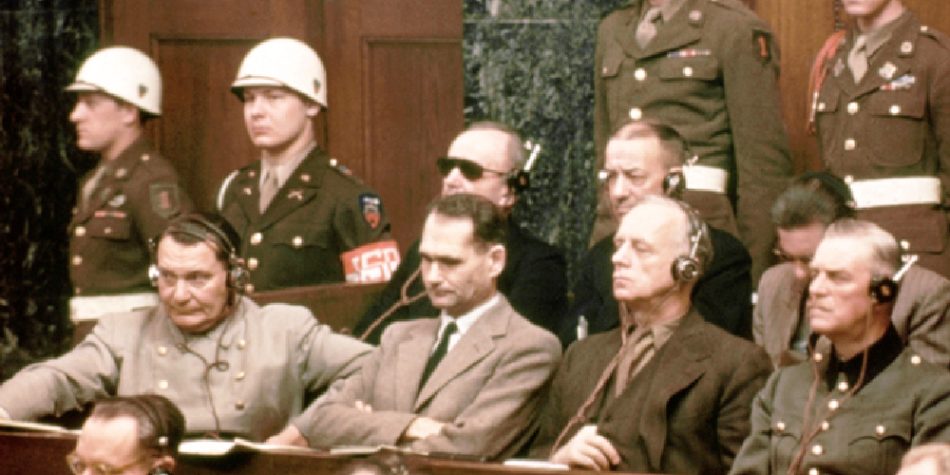
Most Nazis weren’t monsters. Naziism was monstrous, yes, and the Nazi Party; probably as monstrous a party and ideology as have ever existed. But no organization of eight million people is composed mostly of Himmlers and Mengeles: there aren’t (thank God) enough Himmlers and Mengeles for that. The Nazi Party included Gestapo thugs and SS sadists and megalomaniacs bent on world domination. It also included half of Germany’s medical doctors.
Why did ordinary people join the Nazi Party? Harder question: why did apparently better-than-ordinary people join the Nazi Party? Scientists and artists, healers and philosophers and priests? And how culpable are such people, in particular the ones who didn’t know their party was murdering millions of Jews and dissidents but who, at most, closed their eyes to the warning signs? They didn’t man the ovens and gas chambers, and not one of them, by himself, could have changed what happened, but without them collectively there could have been no Holocaust. How should they be judged?
It may surprise you to hear there is an Oscar-winning Hollywood film asking something like that question. Judgment at Nuremberg, released in 1961, was inspired by the American military court that tried sixteen German prosecutors and judges for crimes against humanity. The movie version has just four defendants and focuses especially on one of them, the fictional but realistic Dr. Ernst Janning, who had been an internationally respected jurist and scholar before the Nazis took power. Dr. Janning is on trial for sentencing a Jewish man to death for sexual relations with an Aryan girl when there was no evidence any sexual relations had ever actually occurred.
The movie pulls no punches—not from either corner of the ring. The prosecutors’ argument features real-life footage of naked corpses being bulldozed into mass graves. It points its finger squarely at Doctor Janning: you did this, you and everyone who committed crimes for this genocidal regime. The defense hits back just as hard. What about Buck v. Bell and eugenics in America? What about Hiroshima and Nagasaki? If the men who dropped the atomic bombs are justified by their patriotism and obedience to a democratically elected government, then why not Dr. Janning, who acted out of the same motives? It has been a long time since retribution was the sole lodestar of American criminal law.
What should be his sentence?
In All Things New: Rethinking Sin, Salvation, and Everything in Between, Fiona and Terryl Givens briefly criticize the American criminal justice system for its retributive spirit, allegedly grown out of America’s ancestral Reformation theology: “This system operates on the assumption that doing justice means to inflict punishment, which is understood as violence” (Quoting Denny Weaver, “Violence in Christian Theology”). This may seem a small point, but I think it’s actually a key to the whole book.
“To suppose retribution for evil acts is to be found in [God] is abominable”—the Givenses cite these words to a seventh-century Christian, and it seems they agree with him. Many of their chapters aim in one way or another to refute the idea that God punishes sinners, from the obvious chapters about sin and judgment to some surprising ones like “Obedience.” They call to mind a Joseph Smith quote I’ve often heard about God’s mercy, though the Givenses don’t actually quote it themselves: “Our Heavenly Father is more liberal in his views, and boundless in his mercies and blessings, than we are ready to believe or receive.”
In contrast to this merciful image of God, the Givenses say the conventional understanding of justice is “mean-spirited” because it “often conceals a human thirst for retribution” and “we use it as a form of self-validation.” According to the Givenses, if we desire to see the guilty punished, then we are suffering from “elder-brother-of-the-prodigal-son syndrome,” and from a “petty indignation” that our inferiors are getting better than they deserve.
As a lawyer, I am professionally interested in the Givenses being wrong about this. I don’t practice criminal law, but even in civil litigation, punishment and retribution undergird everything I do. When I want evidence for a case, I send a “subpoena”—literally sub poena, “under punishment”—a document I sign as an officer of the court commanding some innocent party to do as I ask or else. And as a law clerk, I did in fact work on criminal cases and played a (minor) role in affirming several convictions, including at least one sentence of life without parole. If the Givenses are right, then it would seem I have been a willing party to cruelty, to a vengeful Augustinian infliction of a proud society’s wrath on a wounded soul that instead needed healing.
It has been a long time, however, since retribution was the sole lodestar of American criminal law. If you’ve ever heard of a “correctional facility” or a “corrections officer,” you’ve encountered the work of reformers who thought criminal justice should “correct” criminals and help them become law-abiding citizens. Since the nineteenth century, these reformers have applied ever-developing statistical and psychological techniques to identify and work with people at risk of committing further crimes. They made prison sentences flexible, so as to release people early who no longer threatened society, and they introduced alternatives to prison: probation, parole, halfway houses, special rehabilitative drug courts. I expect millions of people have benefited from their efforts.
This rehabilitation project has some award-winning movies of its own: A Clockwork Orange and One Flew Over the Cuckoo’s Nest.
To make the point more prosaically: if you decide punishment is not about retribution at all, that its entire goal is to make the criminal into a better person whether he wants to be one or not, then you’re treating the criminal as a means to an end that he did not choose himself. And once you’ve decided to do that, then why not use the best brainwashing tools at your disposal: aversion therapy, drugs, a lobotomy, whatever it takes? The answer can’t be that your patient didn’t consent to that treatment. He didn’t consent to be your patient in the first place.
In fact, rehabilitation’s critics have asked, if criminal justice is solely about improving people’s character, then why wait for them to commit crimes? Surely plenty of non-criminals also need improvement.
However, as long as punishment is fundamentally about retribution, the focus is on the criminal’s own free will. What wrong did you commit? Did you intend to commit it? And how responsible were you—were there extenuating circumstances? Through such questions, retributive justice seeks to determine your level of culpability and give you the punishment you are owed as a consequence of your choice: the punishment you chose for yourself by choosing to commit your crime.
And so we return to my earlier question about the fictional Doctor Janning, who chose to condemn an innocent man to death. What should be his sentence?
Let’s switch to real life. By 1961 when Judgment at Nuremberg debuted, not a single Nazi convicted by the American military tribunal was still imprisoned. (The same was not true of the more famous international Nuremberg tribunal.) A small fraction of the American tribunal’s convicts had been executed, but most had received sentences of less than ten years or been released early on one pretext or another. An example: one defendant was a doctor who, for research purposes, subjected concentration camp inmates to low air pressure or made them drink saltwater, killing dozens of them. He was sentenced to twenty years’ imprisonment, then transferred to the U.S. to advise scientists in the American space program, and then released after only ten years. Another example: the CEO of IG Farben, a company that used concentration camp inmates as slaves and supplied the gas for the gas chambers—a company that built a factory next door to Auschwitz for convenience—was sentenced to four years with credit for time served. If you believe humans are sometimes morally obligated to punish wrongdoers, then why shouldn’t the same obligation apply to God?
If, after considering these points, you still think the short sentences and early releases were unjust, then let me suggest that you believe punishment is sometimes morally necessary even if it has no practical benefit for anyone—in other words, you likely believe in retributive justice. And if you believe humans are sometimes morally obligated to punish wrongdoers, then why shouldn’t the same obligation apply to God?
Let me go one step further. If God ever has a moral duty to punish wrongdoers, do you suppose He regrets doing it? Or resents it? Obviously, there is a sense in which He never wants to punish anyone: He wants everyone to repent and be saved so that punishment will be unnecessary; wants it so much that He Himself willingly bore the full punishment for everyone whether they repent or not. As He says in the Doctrine and Covenants,
I, God, have suffered these things for all, that they might not suffer if they would repent. … Which suffering caused myself, even God, the greatest of all, to tremble because of pain, and to bleed at every pore, and to suffer both body and spirit—and would that I might not drink the bitter cup, and shrink.
But, for the ones who reject repentance and persist in sin, would He find some way to escape punishing them if He could? Or does He believe in His punishments and desire to carry them out because it’s the right thing to do?
Remember for a moment that quote from Joseph Smith about God’s mercy. Here’s how it continues: “Our Heavenly Father is more liberal in his views, and boundless in his mercies and blessings, than we are ready to believe or receive, and, at the same time, is more terrible to the workers of iniquity, more awful in the executions of his punishments, and more ready to detect every false way than we are apt to suppose him to be …” (Source: Joseph Smith Papers, emphasis added).
Yes, God wept for Noah’s wicked contemporaries in Moses 7, but what did He do in Moses 8?
Even the Nazis were still people—all of them children of God, even the ones who were also monsters. They were not perfectly culpable for their sins, because practically no one is, for all the reasons the Givenses explain. It is one of the glorious teachings of the Restored Gospel that, in the end, even their debt will finally be paid and even they will become clean and inherit a kingdom of glory, reconciled with their former victims in a far-distant day when their crimes no longer mean much of anything to anybody.
But in the meantime, a just God is respecting their free will by giving them the just consequence of their choices. I suspect they don’t like it very much. Unless we repent, neither will we.