cdcunningham_A_golden_statue_of_the_angel_moroni_trumpeting_his_40a17b32-fcf1-4a88-86de-d1558442cb53

Associated Press Embarrasses Itself in Conference Coverage

AP's coverage of the Latter-day Saints misses the mark, showcasing bias and a lack of religious literacy

The Associated Press (AP) one of the most influential news organizations in the United States published an article about the most recent general conference of The Church of Jesus Christ of Latter-day Saints. 

The result is a disaster of journalistic credibility. This article makes it clear the AP is unfit to publish authoritative news about the Church, at least until it makes significant changes in its processes.

Rod Dreher, the influential writer and editor, quipped in response to the AP’s most recent article, ”I thought this was a Babylon Bee headline.” That reaction has become a bit too common in responses to coverage of The Church of Jesus Christ of Latter-day Saints in national media. But it’s usually aimed at publications with established editorial bents, like Rolling Stone Magazine. That the AP has joined its ranks is sad.
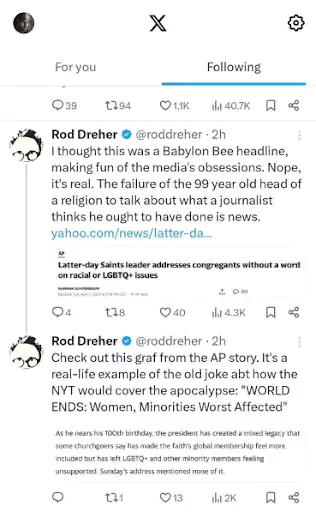
The AP article had the headline, “Latter-day Saints leader addresses congregants without a word on racial or LGBTQ+ issues.” Dreher remarked, “I thought this was a Babylon Bee headline, making fun of the media’s obsessions. Nope, it’s real. The failure of the 99-year-old head of a religion to talk about what a journalist thinks he ought to have done is news.” 

That’s right. The Associated Press published a “news” story about what wasn’t discussed in the conference.

Leaders of the Church of Jesus Christ also didn’t speak about the War in Gaza, the population crisis in South Korea, how well the Armenian dram is performing against the dollar, or Javier Bardem’s stunning performance in Dune Part Two.

What she produced is about what you would expect from a person in her position.

What they did talk about was becoming more like Jesus Christ, praying, and attending temple services. Given that millions of people heard these messages and will leave the weekend with a newfound focus on self-improvement, you might mistakenly believe that those messages are worthy of coverage. But alas, apparently to the AP, the only story worthy of coverage is how the Church intersected (or rather didn’t) with the pet issues of their reporters.

Perhaps most egregiously, the headline is factually inaccurate! During Nelson’s remarks on Sunday afternoon, he said, “[God] invites all to come unto Him—black and white, bond and free, male and female; … all are alike unto God.” He explicitly mentioned race in his remarks. Not to mention the dozens of remarks that touched on issues of love, charity, and truth, which explains, even if not directly, how the Church approaches LGBT+ issues.

And this is not merely bad coverage by Hannah Schoenbaum who wrote the article. Schoenbaum’s entire beat is covering LGBT+ issues at state houses. The editor who assigned Schoenbaum to the conference did so, knowing precisely what would come out of the narrow point of view of her coverage specialty. 

As the saying goes, If the only tool you have is a hammer, you tend to see every problem as a nail. Or, in this case, all you can see is there are no nails, ignoring both the beauty and actual news that is there. 

Please, don’t focus your ire on Schoenbaum. What she produced is about what you would expect from a person in her position. The true blame lies at the feet of the journalistic system that put her in the position to fail. Does the AP truly not have a single journalist in Utah who is religiously literate? Until they get one, perhaps they shouldn’t try and cover explicitly religious events. They simply don’t have the right personnel to do it right, as Schoenbaum demonstrates.

Schoenbaum lacks a fair bit of religious literacy in her article. She uses language foreign to the Latter-day Saint tradition, such as  “Church’s leadership panel,” “Nelson’s top adviser,” or “heretics.” She also makes the statement, that the priesthood exclusion was “a policy in the belief that black skin was a curse,” which is at best controversial, without any mention of the fact that neither the Church nor most of its members endorse this version of history. 

However, the article is not only bad in its framing and its lack of religious literacy. It was written to be a straight news story and is peppered with negative editorializing of the faith. She mentions Nelson’s work of reasserting the Church’s full name but describes it as a “sharp shift.” Then adds a frequent line used by critics of President Nelson about the previous ‘I’m a Mormon’ campaign but she states it as a simple fact in her own voice, not attributing it to critics. She doesn’t mention any of the reasons that have been used to support the request.

She describes temples as “lavish,” a description that may feel apt to those who are critical of the temple but not one that would feel appropriate to the Church or its many members. 

She brings in a wild non sequitur about a speech given by a different church leader at BYU and says it’s “known as the ‘musket fire speech’” without clarifying that it is only known this way by those attempting to discredit the remarks.

Schoenbaum additionally claims there are “ongoing tensions between church leadership and LGBTQ+ members” without mentioning the many LGBT+ members who are at home in the Church and do not feel the “tension” she assumes in her statement.

What she produced is about what you would expect from a person in her position.

Schoenbaum quotes three people—two speaking as professors and one speaking as a critic of the Church. Notably missing from her coverage of Nelson’s birthday and general conference is anyone speaking in celebration of his birthday, anyone who has benefited from his ministry, or any one of the millions of Latter-day Saints who listened to the conference.

Schoenbaum frequently covers the Utah legislature, so in case she gets the assignment next October as well, let me pass along some directions from the capital. One block south, one block west. That’s it. That’s the conference center. It’s so easy to find from the capital anyone can do it. And if you can manage the ten-minute walk, there are tens of thousands of sources who would be more than happy to talk to you about what was said at conference, rather than what was not said. 

The problem, of course, is that it wouldn’t fit with the narrative that was predestined for this story from the second it was conceived. 

This kind of deeply flawed coverage is antagonistic to Latter-day Saints. And because it was published by the Associated Press it will be reprinted to media markets across the country. In most of those markets, Latter-day Saints are religious minorities. The narratives imposed on these stories are used by those in these markets trying to stop Latter-day Saints from being able to build places of worship. And this agitation over the different worldview of Latter-day Saints from the broader culture over sexuality inspires vandalism and other hate crimes. 

Come on, AP. Latter-day Saints are actual, real people. And we deserve to be treated like it. This coverage is embarrassing for you. Do better.

Correction: The 16th paragraph has been corrected. It previously said Schoenbaum didn’t interview anyone “celebrating” his birthday, it has been changed to read “speaking in celebration of his birthday.”


About the author

C.D. Cunningham

C.D. Cunningham is a founder and editor-at-large of Public Square magazine.
On Key

You Might Also Like

Dune: Part Two

I can’t wait to watch Dune: Part Two with my kids. Dune: Part Two is so good it lodges itself (and retroactively lifts its predecessor) into the pantheon of great epic movie trilogies. Depending on whether or not the third and final installment can stick the landing, I suspect it will be spoken of in the same breath as Lord of The Rings, The Dark Knight, and Star Wars.   Like the first two of those trilogies, however, the film is not right for young children. Dune deals with serious themes such as drug use, religion, violence, colonialism, gender, and terrorism. It does so in a way that avoids the overly simplistic explanations appropriate for younger kids, but that is honest and thought-provoking. The film provides easy access to difficult conversations with teens while telling a thrilling story, and adults will leave feeling satisfied and contemplative about some of the film’s broader implications.  The film picks up in the aftermath of the Harkonnen’s capture of Arrakis from House Atreides, and Paul Atreides (Timothée Chalamet) taking a place among the local Freman. For a part two, the film is remarkably well contained with a clear beginning, middle, and end. I wouldn’t recommend coming into this film without watching the first, but if you did, you would certainly enjoy the story on its own merits.  For Latter-day Saints, the film’s most poignant themes revolve around the nature and abuse of power. Among the Fremen, Paul is believed to be the Mahdi, a Messianic figure they expect will return them to control of their lands. Paul is torn between seeking vengeance for the defeat of his family and moving on by integrating into the Fremen society. The faction of Fremen who view Paul as the Mahdi complicates this by holding out the opportunity for the power he needs to seek out revenge. The ethics of how Paul wields that potential power are among the most potent themes of the film, one sure to be further explored in the trilogy’s final installment. The director, Denis Villeneuve, is in top form here. His shots are each expertly crafted art pieces on their own merits. They lend weight to the themes he’s exploring, and he weaves them together like a composer weaving together the themes of a symphony. He even includes an extended black-and-white motif that just works. You don’t even question it.  The script is well paced. It never lags like sometimes happened in the first installment, but also gives plenty of space for its beats to breathe. It’s never confusing, but also doesn’t feel the need to over explain to its audience. Just as in the first film, the sci-fi is absurd—dragonfly-like helicopters, giant worms, and magic yelling. But the imagination here makes them feel completely authentic. You can’t help but buy in. Perhaps the most fun new element—riding the sandworms—is so thoughtfully considered it feels obvious, quite a feet for a film that wants you to buy the reality of riding a worm.    Chalamet leads a stellar cast here that has added Florence Pugh, Christopher Walken, and Austen Butler. Butler in particular inhabits the grotesque Harkonnens in a way that feels both terrifying and authentic. As for the returning cast, Javier Bardem, Rebecca Ferguson, and Stellan Skarsgård are standouts. A lot of weight is put on Zendaya in this film and she is substantially up to the task. Dune: Part Two is a great story wrapped in a world class sensory experience executed by artisans at the top of their craft. It is certainly not a film for kids, but I imagine many parents connecting to their teens over it, and I would heartily endorse it to them. Five out of five stars.

Formula Shortage Hits White House + Today’s Digest

Our daily rundown of the articles from around the web that we feel our readers would enjoy and appreciate. We hope to highlight the best of what’s around. Public Square Bulletin recommends: Under Pressure to Act White House Says It Will Address Formula Shortage Annie Karnie—New York Times Last week I highlighted a distressing news story about a baby formula shortage. The Biden administration has recently spoken about the issue and has promised to find ways to address the concern. Factsheet: Overview of Refugees Fleeing Religious Persecution Globally United States Commission on International Religious Freedom USCIRF has released a report on what it calls an “unprecedented” global refugee crisis. Latter-day Saints who have been asked to help support in this area can benefit from the report’s bird-eye view of the situation. ‘If someone asked you why the priesthood restoration was so significant, what would you say?’ Joseph Smith Papers historian answers Morgan Jones—LDS Living Spencer McBride, historian for the Church focusing on Joseph Smith, sits down with Morgan Jones to discuss the restoration. His insights help put us in the mind of Joseph Smith and better understand his life and ministry. Deconstructing? There’s a coach for that. Ericka Andersen—Religion News Services A trend to keep an eye on, Religion News Services reports on an increasingly likely decision of believers to not merely leave their faith but to use the help of life coaches to try and deconstruct their beliefs so they can find a way to still identify with their faith tradition while rejecting its beliefs.