
When I was a teenager, I competed in a track meet and made it to the finals. Events ran later than anticipated and my dad, who was serving as a bishop, had interviews scheduled for that evening. He went searching for a pay phone, but couldn’t get hold of everyone he needed to, so he called a family that lived close to the church and asked them to tape a note on the door explaining his absence.
This is a small story, and one that loses some of its impact in the age of cell phones, but it was significant to me as a fifteen-year-old. My dad was very conscientious in his church work, but he had cancelled interviews to see me run. This incident spoke to my teenage heart, and it has continued to inform me through the years.
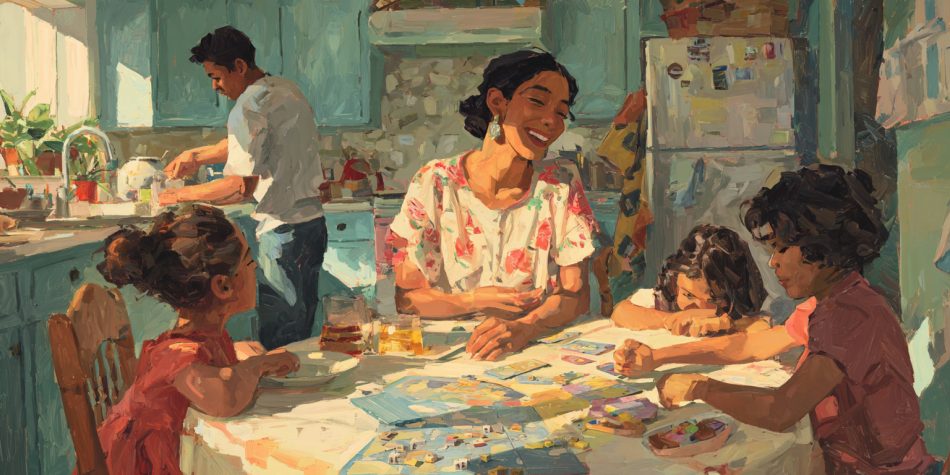
Something struck me recently, though. I didn’t know the details of this story from my dad. It was my mom who later told me of the missed interviews. Mom was the narrator of much of what occurred in our home, and this was just one example of many. It was Mom’s voice that often provided the tone of the plot points in our family story. She was an optimistic narrator who expressed reverence for the characters involved even when addressing complexity.
Much gets said about women’s emotional labor on social media. It’s argued that mothers carry the burden of the emotional needs of the family. As I look back on my parents’ marriage, I recognize that my more talkative mom did carry the responsibility of being the communication hub in our family, and by extension much of the emotional climate as well. But was it a burden for her? I hadn’t sensed that and she was a strong, confident woman who shared her thoughts.
My dad was a reserved man, and he didn’t talk as much as my mom. This difference in my parents’ personalities underscored to me that the way in which a wife approaches her husband’s strengths and weaknesses has a profound effect on a family. The healthy dialogue my mom encouraged invited a synergy of their strengths.
Mom did carry the responsibility of being the communication hub in our family.
Why do we as women sometimes allow our natural strengths, such as those of my mom’s, to be framed negatively as burdens? If we’re being honest with ourselves, we can’t deny our power. We know that our mood, whether for good or bad, affects the whole family and the relationships that are fostered within it. This emotional labor can feel heavy at times because family life can be difficult and it doesn’t come with guaranteed results, but anything that has the potential for great influence also has the weight of responsibility attached. And it seems that if we bristle at feminine power, we are often tempted to resent masculine power as well. The potentially complementary relationship between men and women can easily be turned into a competitive and adversarial one.
In 2006, Elder James E. Faust counseled:
There are some voices in our society who would demean some of the attributes of masculinity. A few of these are women who mistakenly believe that they build their own feminine causes by tearing down the image of manhood. This has serious social overtones because a primary problem in the insecurity of sons and daughters can be the diminution of the role of the father image.
Let every mother understand that if she does anything to diminish her children’s father or the father’s image in the eyes of the children, it may injure and do irreparable damage to the self-worth and personal security of the children themselves. How infinitely more productive and satisfying it is for a woman to build up her husband rather than tear him down.
The dialogue in our homes affects all family members and we are shaped by the conversations we are exposed to and participate in. The Canadian philosopher, Ralph Heintzman, describes how each of us is born into an ongoing conversation that began before our birth and will continue after our death. It is in a conversational context that “we develop our sense of ourselves and of the world…and it is by joining the conversation that we become who we are.”
If we bristle at feminine power, we are often tempted to resent masculine power as well.
Heintzman argues that in the West since about the fifteenth century, we have increasingly focused on feelings and behaviours associated with individual and personal freedom, and this is reflected in our language. He says we have embraced “virtues of self-assertion” expressed through words such as, “liberation, freedom, autonomy, separation, independence, individualism, empowerment, self-development, self-expression, and self-realization.” Heintzman further explains how this modern focus on self-assertion has marginalized many other values to such an extent that it is difficult to frame an argument or a position without incorporating the language of self-assertion.
But, Heintzman warns, we aren’t just individuals. We need to “give a full account of humanity…which reflects our necessary involvement in a greater whole.” Heintzman argues for language that addresses the relational nature of what it means to be human and provides balance for the language of self-assertion. The name that he gives to this is a “language of reverence.” He describes reverence as conveying “a human attitude of respect and deference for something larger or higher in priority than our own individual selves; something that commands our admiration and our loyalty, and may imply obligations or duties on our part.” “The virtues of self-assertion and the virtues of reverence are the two sides of the human paradox.”
As members of The Church of Jesus Christ, we are often taught in ways that remind us of the virtues of reverence, but we are immersed in a culture that speaks the language of self-assertion. Sometimes we are tempted to look at the gospel primarily through the self-asserted lens and as a result, we distort prophetic counsel or push against it. This is particularly true of teachings about the relationship between men and women because the virtues of reverence are so necessary for bringing feminine and masculine strength together. When focusing only on the self, without the tempering virtues of reverence, men use their strength against women to get what they want, as I’ve written about previously, and women weaponize their innate abilities to gain leverage over men. The results are a tragic loss of potential and some of the greatest human suffering. As Elder Neal A. Maxwell taught, “In the work of the Kingdom, men and women are not without each other, but do not envy each other, lest by reversals and renunciations of role we make a wasteland of both womanhood and manhood.”
We are immersed in a culture that speaks the language of self-assertion.
I feel very secure as a woman. I know that women are recognized, valued and loved by the Lord. I feel confident that this is truth…I also recognize that this regard for womanhood that is held by the Lord is the model for all who seek to be like Him…for those who are His disciples… and for those who bear His priesthood and act in His name. I appreciate the noble men of the church for the many responsibilities that they shoulder; for the service and respect that they give to women.
Mom had a confident voice full of reverence, and she used it to strengthen relationships. There were distinct themes in Mom’s life, and an appreciation for how men and women complement one another, both in the family and in church service, was one of them.
All those years ago on that track field, she had wanted me to know that Dad had cancelled his appointments to see me run, so I would understand how much he loved me. I’m so grateful for that.