
Education policy observers are carefully watching a renewed debate about religion in public schools. With new federal guidance on school prayer and state laws about religious symbols or texts in schools popping up, it’s not surprising to see headlines that ask questions like “Where is this headed?”
A recent Washington Post article frames the momentum as “religion being injected all over the place.” But a more precise description might be that the long-established boundaries between religion and public education are simply being reassessed.
When people think of public education, many picture a purely secular institution where mentions or expressions of religion are unwelcome. In fact, some believe that any formal interaction between religion and public education is legally forbidden.
While this belief is oversimplified, it is also understandable, given recent decades of increasingly strict policy and legal developments pushing the two apart. For years, the U.S. Supreme Court handed down rulings that prohibited school-sponsored prayer, banned reading the Bible in schools, said the Ten Commandments couldn’t be posted in classrooms, struck down moments of silence designed for prayer, and prohibited clergy-led prayers at public school graduations. As a result, much of the public accepted the truism that “never the twain (religion and public education) shall meet.”
But is that really the case? The legal and legislative landscape of recent years suggests a shifting dynamic between religion and public education, one that appears increasingly complex—and potentially more accommodating. Certainly, new challenges to parents’ rights and religious liberty in schools have arisen amid a changing culture, but we are at a moment when we might reach a more thoughtful policy outcome.
With courage to engage civilly, we can preserve the prudent policies we already have and build upon educational pluralism, in which students’ religious identities play an active role in their education, and where the benefits of religion support public education in constitutional ways for all.
I turn now to four developments reshaping the relationship.
The Growing Acceptance of Religious Accommodations
Religious accommodations that account for pluralism are on the rise.
Pluralism refers to the belief that diverse groups or categories can and should exist simultaneously. In addition to being an ideal, pluralism is simply a reality in public schools, where students come from families with different worldviews, religious beliefs, academic goals, and political perspectives. As a result, each student and family will have different experiences within the same educational system. Some of these differences can cause deep conflict, often because of religious beliefs.
Accommodation—or legal exception—is an important public policy that can serve as a pressure-release valve for those caught in these conflicts between religion and law, especially in public education.
In recent years, Utah’s legislature has taken the lead in creating new accommodations for students.
Just last year, the U.S. Supreme Court, in Mahmoud v. Taylor, ruled in favor of parents’ rights in education, protecting their right to be given notice and to opt their children out of instruction that violates their religious beliefs. This case will likely create a ripple effect, influencing other states as they consider legislation that better accommodates the religious families they serve in public education.
In recent years, Utah’s legislature has taken the lead in creating new accommodations for students. The state created “participation waivers” from “any aspect of school that violates the student’s or the student’s parents’ religious belief or right of conscience.” This bolstered parental notice for instruction on sensitive materials, allowing parents to be the decision-makers on moral issues, even while their child is enrolled in public school. Utah has also passed workarounds, allowing students who play school sports to wear religious clothing with their required athletic uniforms.
As much as people strive to keep public education neutral, a particular set of values is always ultimately adopted and diffused throughout the system. And, since a single value set won’t fit everyone perfectly, accommodations are crucial to make public schooling work for a pluralistic population. These types of policies may seem to be matters of common sense, but they still require courage from legislators to enact.
The Expansion of Education Choice
The rise in education choice programs across the nation has been another policy trend offering relief to parents facing conflicts between religious values and education. While “education choice” is a broad term, encompassing options in both public and private settings, in recent years it has focused on state-sponsored programs that subsidize families’ private education choices.
Though it had been bubbling up for years, education choice legislation exploded starting in 2020, with 2021 dubbed the “year of school choice.” When the COVID-19 pandemic resulted in school closures in 2020, families grew increasingly frustrated, and legislatures quickly began adopting policies such as education savings accounts, which allowed families to use state funds at a school of their choice or to educate their children at home through an à la carte version of homeschooling.
Many of these private options are religious schools or faith-based homeschool curricula, which families choose explicitly because they align with their religious beliefs. Pew Research Center data from last year showed that 75% of parents who choose to homeschool do so because they prefer to provide moral instruction, and over 50% do so because they prefer to provide religious instruction. Even before the pandemic, research showed that parents weren’t always choosing private schools for test scores; 64% of families that chose private schools did so for “religious education.”
Education choice programs that help families access private options are politically controversial and regularly challenged in court, but have most often been found constitutional. This is especially true when challenged on a basis state constitutional provisions, attempting to bar public funds from flowing to religious schools, since parents, not the state, select the schools.
Furthermore, in Espinoza v. Montana Department of Revenue the U.S. Supreme Court held that the state cannot withhold public funds from religious schools or organizations because of their religious affiliation. And in Carson v. Makin, the court held that a state cannot exclude a school from a state program based on the school providing religious instruction.
Considering current legislative and legal momentum, we can anticipate that state-sponsored education choice programs that allow families to pay for religious schools or home instruction will expand, potentially resolving religious liberty issues for another subset of families.
The Widening Gray Area for Religion in Public Schools
Still, not all public policies being passed right now are as clear as accommodations and new choices for families. Policies currently advancing religion in public education across various states have raised debates that may redefine legal boundaries. These issues typically center around the question, “How far does voluntary space for religion in public schools go before it becomes coercive and unconstitutional?”
An important legal line that should not be crossed for state action—or public-school policy—is whether something violates the Establishment Clause by coercing students into religion or a specific religion, essentially establishing a religion through policy.
But even this area has been changing. Where once the “Lemon test” was the rubric (stemming from the Lemon v. Kurtzman case), the court now looks to “historical practices and understanding,” thanks to the 2022 case Kennedy v. Bremerton School District.
This is a moment to revisit assumptions about religion and public education.
Texas also passed a law requiring districts to vote on the allowance of dedicated time for voluntary prayer and reading of religious texts. While the contours of the law appear to make it fully optional for districts to offer and go to great lengths to make it nondenominational, as well as entirely subject to parental opt-in, the law raises questions about what point voluntary, non-school-sponsored time for religious expression becomes coercive for students.
States have also advanced non-devotional instruction about religion. For instance, Utah just passed a bill allowing passages of the Bible to be read as part of social studies. Another Utah bill requires teaching the “primacy of religious liberty” in American constitutional governance and the “fundamental role of religion in the history” of the nation. While these are intended to be non-devotional in nature, some critics still feel these measures violate the Establishment Clause, if not its spirit.
Just last year, the U.S. Supreme Court was tied on a vote on the legality of what would have been the first religious charter school (which ultimately kept the lower court’s holding that it was unconstitutional), and it looks like another case is coming on a very similar issue. The creation of explicitly religious charter schools would be an enormous change and would create considerable uncertainty about how religious a state-funded school could be.
While each of these issues is distinct, none has a straightforward answer. The point is that this is a moment to revisit assumptions about religion and public education.
Increasing Faith-Based Support for Education Communities
Some trends in the intersection of religion and public education are less thorny. In March 2026, Harvard and BYU released a joint report that advocates a “third way” of approaching religion and public education, one “that avoids the two extremes of endorsing religion in schools, on one end, or entirely excluding it from the work of schools, on the other.” That approach is “non-sectarian partnerships” between public schools and faith organizations to meet the needs of underserved students and to improve their learning opportunities.
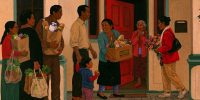
In accordance with their aim to do good, faith organizations often provide services that benefit the public and public schools. The report notes that “Educational programs of faith organizations offer a wide range of services such as donations of school supplies, parent education classes, student tutoring, mentoring, college preparation (e.g., entrance exam training and help with scholarship applications), anti-suspension initiatives, and youth classes that address topics like social competence, student motivation, and study skills.” While there are few studies on the impacts, some research shows evidence of benefits for students from these partnerships.
The report also highlights the benefits of “religiosity”–engaging in private prayer or participating in public rituals and services–which is correlated with student achievement, educational attainment, and goals for higher education. In fact, working-class families benefit more than higher-income families do, and male students benefit more than their female peers.
All this is to say that religion and education can bolster one another. Furthermore, the report suggests that the role of religion in public education need not be coercive at all, but that it can be supportive and complementary in ways that are desperately needed.
For education analysts wondering where these movements might be headed, it is hard to say definitively. But it’s clear that a new moment is upon us, with opportunities to get closer to a pluralistic view of public education. If so, we may build a public square within public schools that better acknowledges the role of religion in the lives of the individuals it serves and in our society at large.