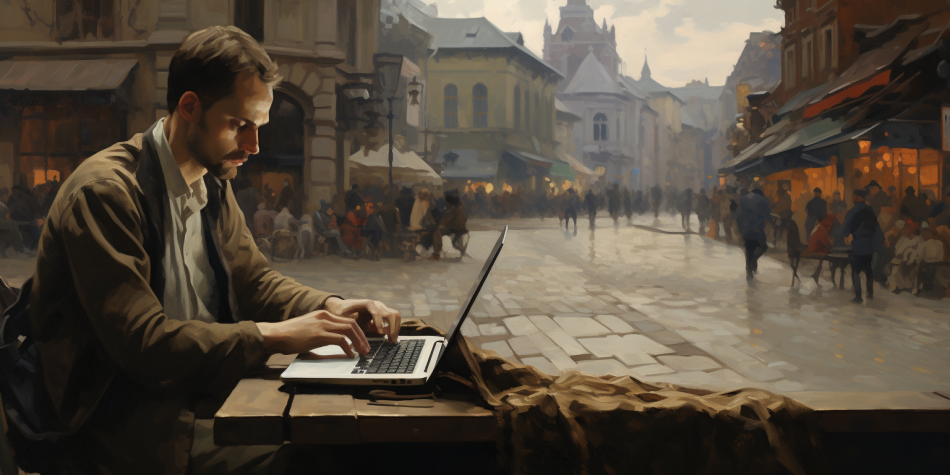
A journalist writes in a public square

A Year in The Public Square: Accountability to Our Readers

Our editors end the year with public accountability and a review of what we did and did not do well.

In our fourth year, we are ending the current year with a bit of public accountability. Our own Public Square Magazine review, if you will.

This year saw a transition in how Public Square interacts with its readers and critics. Our [email protected] email is available and provides a direct way to contact our editors. But with the policy transitions on X, formerly Twitter, our editors are no longer present on the platform. As a result, we needed to find other means to provide public accountability.

As part of this new approach, we hope to publish an annual report of the feedback we’ve received, the mistakes we’ve made, and how well we’ve fulfilled our mission.

We are proud of the work we’ve done.

This Public Square Magazine review is our opportunity to speak directly to you, our readers and supporters, about what we did right and wrong in 2023 and where we hope to improve next year.

Over the past years, Public Square Magazine has developed a reputation for editorial content that doesn’t oversimplify and looks at matters of importance from the perspective of Latter-day Saints. We are proud of the work we’ve done to continue to advance our mission of amplifying voices of faith and helping to improve the quality of our dialogue.

We’ve continued this path in 2023. We published several articles talking about how to reduce the passion of the culture war, pursue peace, and interact with one another in more meaningful ways. We also ran a long series on an ascendant religious movement in the United States and how understanding it as a religious movement could have a powerful effect in reducing the acrimony in our contemporary public discourse. 

In addition, we’ve continued to heed the call of the President of The Church of Jesus Christ of Latter-day Saints to “lead out in abandoning attitudes and actions of prejudice.” In particular, continuing to argue against white nationalism. We worked with the Archdiocese of Salt Lake City in an interfaith effort this year to publish an article to increase understanding of Catholic lent. And we participated with a broad coalition of faiths in celebrating the first annual Fidelity Month

We’ve continued our tradition of publishing articles from top writers, including Daniel Akst, Robert P. George, and Melody Warnick

Our coverage that received the most attention this year involved the finances of the Church of Jesus Christ. We’ve been very proud of our ability to provide additional insights into these stories from our unique perspective as Latter-day Saints. In addition, the experts who weighed in for us were able to provide context about these financial issues missing from almost all other coverage. We also were the first to publish the most robust research to date about sexual abuse rates in The Church of Jesus Christ of Latter-day Saints compared to other faiths—answering important questions that have been at the forefront of public discourse about the Church in recent years. 

This has also been a year of growth for our content. We launched our Public Square Media project, helping to highlight some of the best podcasts in our space. We began publishing original cartoons by talented artist Nathan Shumate. And began to receive screeners of films to review. We launched a new version of our website, and while the rollout wasn’t as smooth as we had hoped, the new design should better meet our needs for the next several years.

Time has validated our editorial work.

One notable trend this year has been the use of the pseudonym “Hypatia,” which we created several years ago in order to feature articles from authors who had important matters to discuss that they worried would negatively impact them if their identity was known. Our hope has always been to use Hypatia as infrequently as possible, as we have a strong bias toward publicly signed articles. And while we may certainly continue to use Hypatia as necessary, in 2023, we never published an article with that byline.

Our work this year was certainly not immune from criticism. Public Square Bulletin, a short-form blog associated with the magazine, shared some research we believed would interest our readers. We were later informed that while the research itself was not about race or pornography in any way, those who did the research had a history closely tied to white supremacist movements and the legalization of child pornography. As a result, we rescinded the article and left an editor’s note in its place

And while we are proud of the interfaith publications we did this year, there were fewer than in years past, a trend we hope to reverse next year.

One of our most persistent criticisms is our background as members of the Church of Jesus Christ. We always find it amusing when we are criticized for secretly being Latter-day Saints, and their evidence is a link to our “About” page. We continue to believe that being Latter-day Saints should not disqualify us from participating in the public square.

We also faced much criticism for an article about Tim Ballard, a public figure who has faced many varied accusations. Though our article called for caution and patience as accusations and evidence continued to come forth, it was primarily about how those who were fond of Ballard could process his public fall from grace. Many accused us of being credulous regarding the accusations and not being sufficiently skeptical of the sources. However, we believe time has validated our editorial work on the article.

We strive to make the best editorial decisions.

We also faced calls to rescind an article that spoke to potential reasons for low sexual assault rates at BYU and BYU-Idaho. Many have rationalized these low rates as occurring because of low reporting rates. The author of the article acknowledged this possibility but pointed to several factors known to reduce sexual assault that are also found on both of those campuses. Those who called for the article to be retracted believed that the evidence for low reporting rates was so conclusive it was illegitimate to propose any other reasons. As an editorial staff, we disagreed both about the conclusiveness of the evidence and the propriety of looking at all possibilities in reducing sexual assault, and we are proud to continue to feature the article. We also reached out to the author to ask him to address some of the most pointed criticisms on his personal website, which he did.

We continue, however, to take such feedback seriously as we strive to make the best editorial decisions. 

In 2024 we look forward to continuing our mission of providing sober, thoughtful, fact-based editorials on the issues of most importance. As it’s a presidential election year, we expect the rhetoric to be heightened, and while we certainly intend to engage, we hope always to be a source that helps lower the temperature as we seek to continue to try to build a better nation and world.


About the author

Public Square Staff

Our core team, including our Editor in Chief, Editor at Large, Managing Editor, Associate Editor, and Social Media Director.
On Key

You Might Also Like

What is an Oath?

As we look to make sense of the news of this last week, it may be wise to look back on a more than 50 year old film that asks what exactly is an oath.

Processing the Unthinkable

Some of the charged responses to inexplicable tragedies like this are only understandable. And some are clearly standing in the way of both greater healing and more effective prevention of future violence.

Dune: Part Two

I can’t wait to watch Dune: Part Two with my kids. Dune: Part Two is so good it lodges itself (and retroactively lifts its predecessor) into the pantheon of great epic movie trilogies. Depending on whether or not the third and final installment can stick the landing, I suspect it will be spoken of in the same breath as Lord of The Rings, The Dark Knight, and Star Wars.   Like the first two of those trilogies, however, the film is not right for young children. Dune deals with serious themes such as drug use, religion, violence, colonialism, gender, and terrorism. It does so in a way that avoids the overly simplistic explanations appropriate for younger kids, but that is honest and thought-provoking. The film provides easy access to difficult conversations with teens while telling a thrilling story, and adults will leave feeling satisfied and contemplative about some of the film’s broader implications.  The film picks up in the aftermath of the Harkonnen’s capture of Arrakis from House Atreides, and Paul Atreides (Timothée Chalamet) taking a place among the local Freman. For a part two, the film is remarkably well contained with a clear beginning, middle, and end. I wouldn’t recommend coming into this film without watching the first, but if you did, you would certainly enjoy the story on its own merits.  For Latter-day Saints, the film’s most poignant themes revolve around the nature and abuse of power. Among the Fremen, Paul is believed to be the Mahdi, a Messianic figure they expect will return them to control of their lands. Paul is torn between seeking vengeance for the defeat of his family and moving on by integrating into the Fremen society. The faction of Fremen who view Paul as the Mahdi complicates this by holding out the opportunity for the power he needs to seek out revenge. The ethics of how Paul wields that potential power are among the most potent themes of the film, one sure to be further explored in the trilogy’s final installment. The director, Denis Villeneuve, is in top form here. His shots are each expertly crafted art pieces on their own merits. They lend weight to the themes he’s exploring, and he weaves them together like a composer weaving together the themes of a symphony. He even includes an extended black-and-white motif that just works. You don’t even question it.  The script is well paced. It never lags like sometimes happened in the first installment, but also gives plenty of space for its beats to breathe. It’s never confusing, but also doesn’t feel the need to over explain to its audience. Just as in the first film, the sci-fi is absurd—dragonfly-like helicopters, giant worms, and magic yelling. But the imagination here makes them feel completely authentic. You can’t help but buy in. Perhaps the most fun new element—riding the sandworms—is so thoughtfully considered it feels obvious, quite a feet for a film that wants you to buy the reality of riding a worm.    Chalamet leads a stellar cast here that has added Florence Pugh, Christopher Walken, and Austen Butler. Butler in particular inhabits the grotesque Harkonnens in a way that feels both terrifying and authentic. As for the returning cast, Javier Bardem, Rebecca Ferguson, and Stellan Skarsgård are standouts. A lot of weight is put on Zendaya in this film and she is substantially up to the task. Dune: Part Two is a great story wrapped in a world class sensory experience executed by artisans at the top of their craft. It is certainly not a film for kids, but I imagine many parents connecting to their teens over it, and I would heartily endorse it to them. Five out of five stars.